


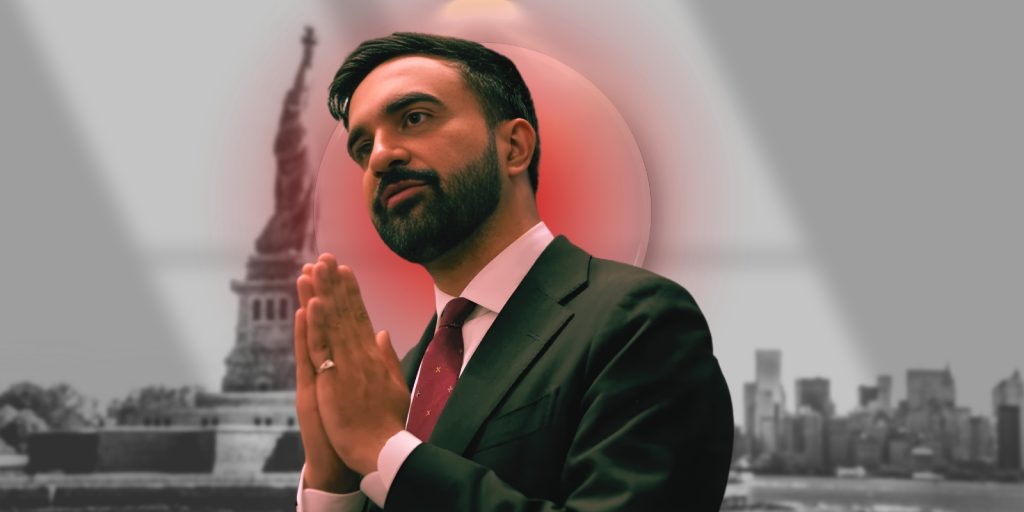
Zahran Mamdani’s election as mayor of New York was a symbolic moment that exceeded the bounds of an ordinary electoral achievement and transformed into a mythologized phenomenon that reflects a deep ideological struggle within the United States. Does this victory represent a challenge to the American urban capitalist order and raise a question about the future of the Democratic coalition itself?
The significance of his win is rooted in the geographic and financial context of New York City, the financial capital of the global capitalist system. The arrival of a self-described democratic socialist to lead the world’s economic center represents an immense challenge to the existing economic structure. The victory was seen as a symbolic conquest of the heart of capitalism, which explains the intensity of the American reaction and former president Donald Trump’s description of Mamdani as an obsessive communist.
Mamdani stands as the antithesis of the traditional political elites who have dominated New York and Washington. While former and current leaders such as Andrew Cuomo, Eric Adams, and Trump symbolize the old liberal or capitalist order, Mamdani presents a multilayered identity that contradicts entrenched elites and symbolizes transnational marginalization and the sidelined working class. His success was not accidental. It emerged from the dismantling of the identity-class binary.
Instead of centering his identity as the ultimate goal of the campaign, he used it as a tool to connect with diverse ethnic bases across New York’s neighborhoods. The core of his message remained anchored in class and economic issues such as the affordability of living.
The electoral struggle in New York defined a clear ideological trajectory. Cuomo described Mamdani and his allies, including Senator Bernie Sanders and Representative Alexandria Ocasio Cortez, as socialists seeking to take over the Democratic Party. He warned that Mamdani’s victory would spark a mass exodus of residents and businesses from the city. This reflects the Democrats’ fear of losing coalition and ideological control to the democratic socialist wing. The key to the mythologizing of Mamdani’s victory lies in his campaign’s success in transforming democratic socialist demands that appear radical in the American context into concrete and necessary solutions for the working class. His platform focused on issues of living costs, including a freeze on rents for one million rent-regulated apartments, universal free child care, and free bus services. Such proposals seem reasonable in a European welfare state but are ambitious and even radical in the United States, where the absence of a welfare state makes anything free appear dangerously close to communism. Nevertheless, Mamdani’s promise of the ability to remain rather than the traditional centrist promise of economic growth resonated. Cuomo’s attacks, likening Mamdani to a communist threat, reflect the deep ideological tension between the centrist and progressive wings of the Democratic Party.
Nationally intense reactions also contributed to mythologizing Mamdani’s victory as a symbol of the growing leftist threat. Conservative critiques portrayed him as an explicit Marxist representing a red green ideological alliance, a convergence between secular leftist anti-capitalist discourse and Islamist terminology and anti-Zionist positions. These descriptions aim to depict his win as a threat to national security and international relations, particularly with Israel and Western democracies. They linked the symbolism of anti-capitalism with Mamdani’s Muslim identity, adding an ideological charge to his victory. This discourse creates a negative mythologizing of Mamdani, framing him as an ideological extremist threatening urban liberalism.
Mamdani’s greatest challenges in governance lie in the fundamental contradiction between his ideology and the administration of the world’s largest financial center. His economic platform calls for higher taxes on the top one percent and a broad rent freeze, measures centrists see as direct threats to the city’s economic structure. Cuomo warned that such policies would trigger a mass corporate and capital flight. This contradiction represents a substantial practical challenge. While Mamdani aims to abolish capitalism and establish a democratically managed economy, he is obliged as mayor to manage a city budget that depends largely on the very capitalist system he seeks to dismantle.
Applying socialist ideology in a massive capitalist city will require inevitable pragmatic concessions, and this struggle between ideology and the practicalities of governance may soften the revolutionary mythology that accompanied his victory.
Mamdani’s win acquired its mythological character because it combined an explicit ideological challenge to the heart of global capitalism with the successful construction of a new electoral coalition based on class and generation rather than race, unifying minorities under a shared economic umbrella and demonstrating the ability of the activist left to move from protest to executive governance through organized and strategic electoral tactics. These factors may signal from afar the return of the left in the United States, particularly in the urban landscape. Yet the success of this leftist model ultimately depends on Mamdani’s ability to reconcile his radicalism with the pragmatism required to govern capitalist New York, a challenge that may gradually temper the myth of his victory. For now, however, his win remains a milestone in American progressive politics.
The views expressed in this article do not necessarily reflect those of +963 association.