


Ammar Yousef
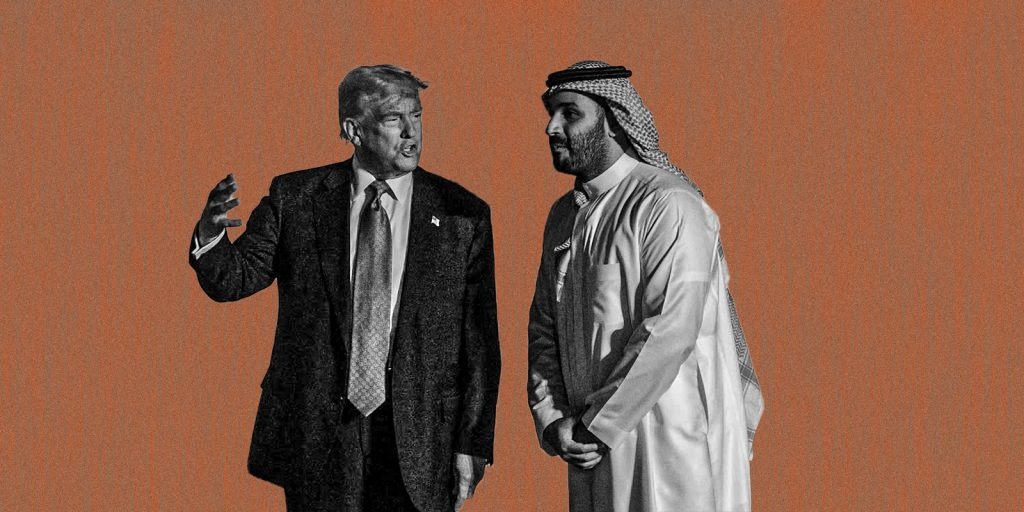
U.S. President Donald Trump’s announcement to lift sanctions on Syria marked a historic moment, one that could signal a fundamental shift in the Middle East, far beyond Syrian borders. His clear declaration that the move was made with the support and guarantee of Saudi Crown Prince Mohammed bin Salman sent a powerful message: Saudi Arabia is leading the region, and Trump wanted the world to see Mohammed bin Salman as the face of Arab leadership.
The decision to lift sanctions is loaded with political signals and implications that may shape the region’s next chapter:
First: After the fall of the Assad regime, many believed Syria had fallen under Turkish influence. But the Saudi-American summit made it clear: Syria is now under Arab sponsorship, with a Saudi guarantee. This marks a new phase of Arab cooperation, more unified and stable. It not only aims to rescue Syria from sanctions but also to free it from decades of entrenchment in the Iranian and Russian spheres, which left Syria deeply isolated and in need for many years to recover, economically, socially, and in terms of security.
Second, Trump demonstrated that sanctions work; they can break regimes, and this is exactly what happened with the Assad regime.
The message was clear: the United States remains the global economic and political superpower, and any nation that rebels against that order could face the same fate.
Trump’s announcement from Saudi Arabia reinforced both the power of sanctions and Saudi Arabia’s role as the region’s most trusted state.
Related: Ancient Syrian Rattles Show Toys Existed 4,500 Years Ago
Third: For Syria, the next step must be to focus on economic and social development. This won’t be possible without alignment with the region’s and world’s strongest economies, first Saudi Arabia and the Gulf, then the United States. At the same time, Syria must establish strong ties with Türkiye.
This alignment alone could bring about an economic, urban, and technological renaissance, signalling that Syria is once again looking westward, after a failed pivot east, and a failed experiment with the so-called “resistance” axis.
Fourth: The most significant outcome may be the new Syrian government itself, now with legal legitimacy, regardless of the price paid to lift sanctions. That price, simply put, was “unconditional peace with Israel.”
Still, several conditions were informally understood. These include addressing the presence of foreign factions and removing them from Syrian territory through a process that now seems agreed upon by the relevant powers. Another critical condition is the protection of minorities, a point President Ahmed al-Sharaa emphasised in his speech to the Syrian people following his return from Saudi Arabia and his historic meeting with President Trump.
In that speech, al-Sharaa stressed the importance of unity, preventing division, and protecting minorities, principles that now require practical steps and clear policies, both politically and on the ground.
Fifth: The biggest loser in this Saudi-backed agreement is Hay’at Tahrir al-Sham (HTS). Though it has formally dissolved, its factions still operate on Syrian soil. One of the quiet conditions agreed upon appears to be the removal of HTS from the political landscape, perhaps through a process of rebranding and restructuring that distances it from its past identity.
Sixth: We are witnessing a new political phase in the Arab world and the Middle East. Its features will emerge quickly, and one of its clearest components is Syria’s move toward unconditional peace with Israel.
Finally: Syria now stands before a historic opportunity, with strong support of Crown Prince Mohammed bin Salman, it has chosen to reposition itself in a world where only the economically and politically strong survive. The time has come to shed the old patterns of corruption and stagnation, and to build a better future for its people.











