


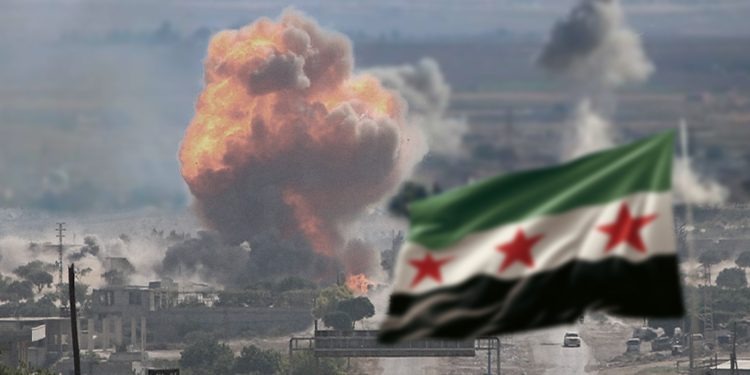
Not a day passes in Syria without reports of airstrikes, whether in the north or the south, deepening the cycle of violence that continues to claim civilian lives. Amid these attacks, international reactions remain muted, and questions persist over Syria’s ability to defend its sovereignty.
Late Sunday night, a Turkish airstrike targeted a house in the countryside of Kobani, northern Syria, killing nine members of a single family, including children. Hours later, one of the wounded, a young girl, succumbed to her injuries, joining her relatives in death.
At nearly the same time, Israeli warplanes launched an attack near Daraa in southern Syria, killing three people and injuring 19 others, who were rushed to local hospitals for treatment.
Lack of Official Syrian Response
Despite the escalating attacks, Syria’s new administration, led by Ahmad Al-Sharaa, has yet to issue an official response to these incidents. While the Syrian Ministry of Foreign Affairs condemned the Israeli airstrikes a day after they occurred, calling them a “flagrant violation of international law and a threat to regional security”, the statement notably omitted any reference to the Turkish airstrike in Kobani.
Read also: Israeli Airstrikes Target Sites in Central and Southern Syria
This selective condemnation has drawn criticism, with many questioning the government’s stance on Turkey’s repeated incursions into Syrian territory. Meanwhile, Mazloum Abdi, the commander of the Syrian Democratic Forces (SDF), urged the interim government to take responsibility for protecting its citizens.
Strategic Considerations and Constraints
Syrian analyst Hassan Al-Naifi, based in France, believes that Israel’s persistent strikes aim to keep Syria militarily weak. He argues that Damascus currently lacks the capability to retaliate against Israeli attacks, particularly given the destruction of Syria’s military infrastructure over the past decade.
“Any military response could give Israel justification for launching a broader campaign,” Al-Naifi told +963. Instead, he suggests that diplomatic efforts, leveraging international and regional pressure, may be the only viable path to curbing Israeli attacks.
Regarding the Turkish-SDF conflict, Al-Naifi points out that while Syria’s new administration seeks to mend relations with the SDF, its tensions with Turkey run deep. Without international mediation, he argues, the confrontation between Ankara and the SDF is unlikely to end. He believes only U.S. intervention could prevent further escalation.
Read also: Military Escalation and Economic Leverage: Israel’s Expanding Influence in Southern Syria
Israel’s Strategy and Its Regional Impact
Ismat Mansour, an Israeli affairs analyst, asserts that Israel’s continued airstrikes are designed to weaken Syria and prevent it from re-emerging as a military threat. He suggests that Damascus could use its recent diplomatic outreach to bring the issue to the global stage and pressure key international players to rein in Israel’s actions.
However, Mansour notes to +963 that Al-Sharaa’s administration appears reluctant to confront Israel directly, possibly due to domestic priorities or concerns about Western and American reactions to a shift in its stance.
“If Syria remains silent, Israel will likely intensify its strikes,” Mansour warned. He emphasized that Damascus must adopt a stronger diplomatic approach to challenge Israeli incursions.
As foreign powers continue to operate within Syria’s borders, many Syrians remain uncertain about how their government will address these persistent violations. For now, the country remains a battleground for external conflicts, with no clear resolution in sight.











