

For over a century, Kurdish culture in Syria has been far more than a mere expression of national identity within defined geographic boundaries. It has formed one of the foundational elements of Syria’s multi-ethnic and multilingual cultural fabric. This culture developed within a broad Syrian social and historical space and interacted with it across language, customs, arts, and daily life. This interaction gave it a distinct character, setting it apart from Kurdish experiences in neighbouring countries, while maintaining a deep connection to its ethnic roots.
Discussion of Kurdish culture in Syria cannot be separated from the concept of interaction – not as forced assimilation or absorption into a dominant culture, but as a long-standing process of give and take. Through this interaction, a complex Kurdish–Syrian cultural identity emerged, capable of preserving its uniqueness while contributing actively to the development of modern Syrian culture.
This interaction was not the product of a political moment or exceptional circumstance, but the result of long historical accumulation, reflected in literature, music, language, arts, architecture, cuisine, and everyday customs. Over time, these interactions formed a shared cultural narrative, redefining national culture as a pluralistic space – one that does not exclude but draws strength from diversity.
Historical Context: Marginalisation as a Driver of Continuity
For decades, Kurds in Syria faced official policies that limited their cultural presence, including bans on education in Kurdish, restrictions on publishing, and prohibition of public celebrations of cultural events, notably Nowruz. Rather than eradicating Kurdish culture, these policies prompted the search for alternative avenues of continuity, primarily relying on oral heritage, folk songs, and stories passed down within homes and villages.
Meanwhile, everyday interactions between Kurds and other Syrian communities in mixed cities, marketplaces, and workplaces created informal but highly influential spaces of cultural exchange. This day-to-day interaction, away from official discourse, established a shared culture in the details of daily life and contributed to building a social consciousness that transcended narrow ethnic boundaries.
Following the transformations in Syria after 2011, Kurdish culture enjoyed a wider margin for expression. Cultural centres were established, Kurdish-language publishing resumed, and artistic and musical events were organised, reasserting Kurdish culture as a vibrant and active component of Syria’s broader cultural scene.
Last Friday, Interim Syrian President Ahmed Al-Sharaa issued Presidential Decree No. 13 of 2026, including a set of measures concerning Syrian Kurds. The decree recognised Kurdish as a national language to be taught in schools, annulled the effects of the 1962 Al-Hasakah census, opened the way for granting citizenship to previously unregistered Kurds, and affirmed Kurds as an integral component of the Syrian people. The decree also mandated official protection of cultural and linguistic diversity and recognised Nowruz as a paid public holiday.
Kurdish Literature within the Arabic Language
Literature has been one of the most prominent arenas of interaction between Kurds and Arabs in Syria. Many Kurdish writers chose to write in Arabic, not as a substitute for their mother tongue but as a means of reaching a broader cultural space and contributing to Syrian cultural awareness. In this sense, writing in Arabic did not signify a relinquishment of identity but a conscious cultural choice for dialogue and influence.
For example, Salim Barakat represents the Kurdish imagination within Arabic literary expression. Originating from Qamishli, he established a unique contribution to modern Arabic literature. Although writing in Arabic, his works carry Kurdish myths, collective memory, and the environment of the Syrian Jazira region, providing a dual contribution: expanding the horizon of Arabic narrative and integrating Syrian Kurdish imagination into it. Barakat reshaped the Arabic language itself, introducing imagery and symbols from a previously marginalised environment, which became central to its human and existential dimension.
Similarly, writer and translator Jan Dost has served as a crucial bridge between Kurdish and Arabic cultures, writing in both languages and translating classical Kurdish works, notably the epic Mem û Zîn. He emphasises that Kurdish literature in Arabic created a new layer within Syrian culture, conveying the Kurdish experience of the Jazira, Kobani, and Afrin to the Arab reader, enriching contemporary literature.
Dost tells +963: “One can speak of Arabic culture being added to Kurdish culture, rather than a Syrian addition. Arabic culture has influenced the formation of a distinct Kurdish culture, infused with Arabic terminology and influences from Islamic culture. Some terms and vocabulary entered Kurdish through this contact, widely used by Kurdish intellectuals since early figures such as Malaî Cizîrî and Ahmad Khani, who incorporated terms from Sufism, philosophy, astronomy, and Islamic jurisprudence. Additionally, the clear influence of classical Arabic poetry on Kurdish verse led Kurdish poets to adopt Arabic poetic metres, prosody, and rhetorical devices like paronomasia and antithesis, integrating them into Kurdish poetry.”
Dost continues: “This influence persists today. Contemporary Syrian Kurdish intellectuals are also influenced by modern Arabic culture and contemporary Arabic poetry, as Arabic has long been their primary cultural language. It is natural that bridges are built between the two languages, enriching Kurdish culture and making it a diverse and unique cultural identity.”
Music: A Shared Memory
Kurdish music ranges from folk to classical and employs instruments such as the tanbur, daf, zurna, and dahol. Kurdish musicians have enriched the Syrian musical landscape by introducing new melodic and rhythmic elements, broadening public taste and deepening the shared emotional experience.
Mohammad Sheikho, for instance, performed Kurdish songs with a distinctly Syrian voice. His music draws from folk poetry and daily life, forming a collective memory for Kurds while resonating widely beyond their communities, influenced by Syrian maqams and expressing a shared human sentiment.
Visual Arts and Fashion: Interwoven Identity
Kurdish visual artists have contributed to Syrian artistic movements with works blending traditional motifs and contemporary expression. Artists such as Omar Hamdi, Nameq Sirajeddin, Khalil Abd al-Qadir, Wijdan Ali, and Adel Qureshi integrated symbols like the sun and peacock and colours inspired by Kurdish regions, adding a rich visual dimension to Syrian art.
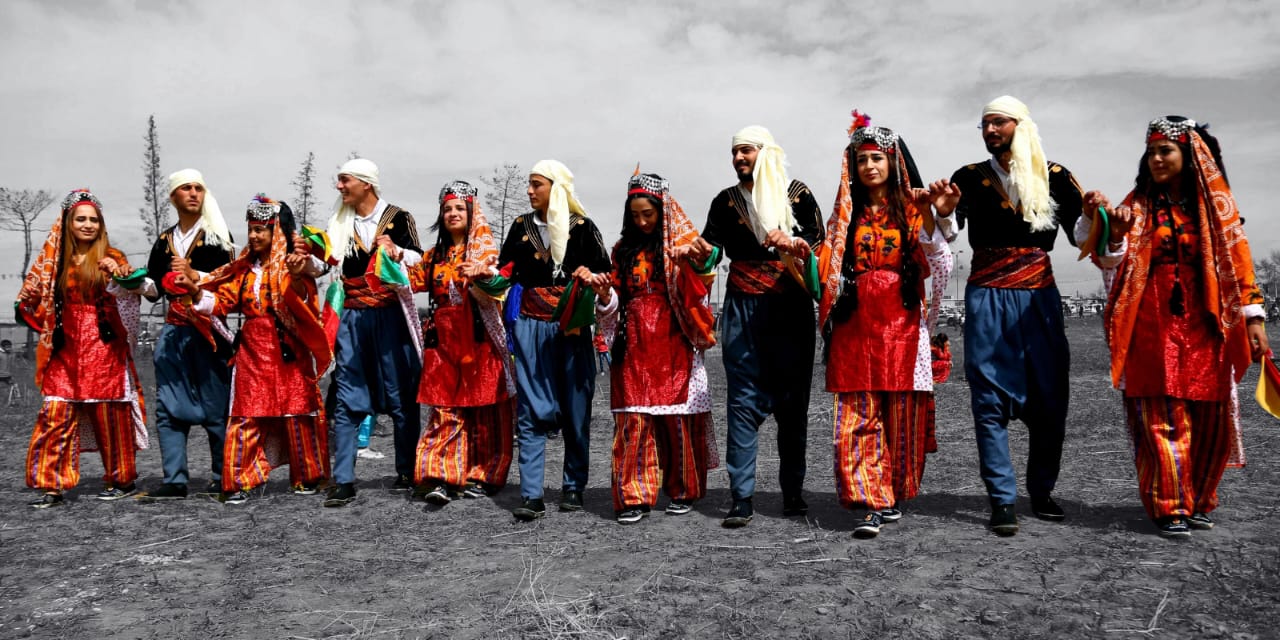
Fashion designer and visual artist Hikmat Dawud observes that Kurdish clothing forms an essential part of Syria’s cultural mosaic. “Clothing is not merely attire but a cultural statement narrating the story of place and people,” he says.
Architecture: A Continuing Historical Influence
Academic Azad Ali notes +963 that Kurdish contributions to Syrian architecture date back to the 12th century, particularly during the Ayyubid period, with the construction of fortresses, khans, schools, and hospitals (bimaristans). Villages preserved traditional rural construction methods until modern times, while Kurdish artisans continue to contribute to contemporary building projects alongside other Syrian communities.
Cuisine and Daily Life: Culture in the Details
Kurdish cuisine has added distinctive flavours to the Syrian table, including tandoor bread, Kurdish kubbeh, and kolija, with a strong reliance on wheat and dairy products. These similarities in food and customs reflect geographic and historical proximity, with shared dishes evidencing continuity and attachment to the land.
Dr Samar Ali, from the Higher Institute for Population Studies and Research in Damascus, highlights that Kurdish–Syrian cultural interaction evolved over a long history of geographic and social coexistence, contributing to clear linguistic, religious, and social exchanges. “Linguistically, Arabic and Kurdish coexisted in daily life, education, and work, producing bilingual realities in contact zones. Socially, family structures, hospitality, and celebrations intersected while maintaining cultural distinctiveness. Politically, citizenship and cultural rights have shaped a dual Kurdish–Syrian cultural consciousness, open to dialogue yet preserving ethnic roots,” she tells +963.
Kurdish Culture in the Broader Syrian Landscape
Novelist, playwright, and short-story writer Mohammad Al-Hafri from Daraa states that Kurdish culture has always been deeply present in Syria’s cultural scene, influencing both elite and popular arts. The Syrian experience demonstrates that Kurdish culture does not erase identity but reshapes it within a pluralistic framework. Kurdish culture has transitioned from oral to written forms, from local to broader human expression, expanding the Syrian imagination and reinforcing diversity as a prerequisite for cultural richness.
Acknowledging this influence does not mean privileging one group over another; it is a factual reading of a long history of coexistence and shared production. Kurdish culture in Syria has never been marginal – it has been a partner, shaping collective memory and remaining capable of contributing positively to a fairer, more truthful, and pluralistic cultural future.