


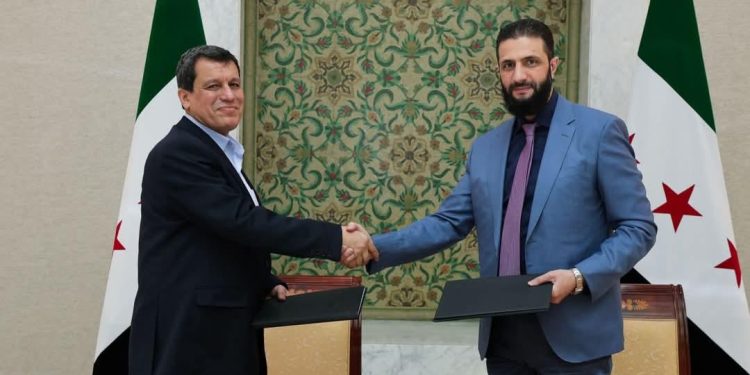
Since assuming the presidency of the new government in Syria during a complex transitional phase, Ahmed al-Sharaa has approached the issue of the Autonomous Administration in northern and eastern Syria through two parallel tracks: political negotiations and institutional integration.
In what has been described as a detailed initiative, the new government opened dialogue channels with the Syrian Democratic Forces (SDF), culminating in a comprehensive agreement in March 2025. This move aimed to reshape the relationship between the Syrian state and the Autonomous Administration, steering away from military confrontation or political separation.
In official statements following his inauguration, President of the Interim Government Ahmed al-Sharaa underscored the importance of dialogue with the SDF to achieve a peaceful and lasting resolution to the crisis in northeastern Syria. “The Kurds are an integral part of the Syrian fabric, and the solution must be rooted in peaceful patriotism, with no room for partition or imposed federalism, “ he said.
Al-Sharaa also stressed that one of his government’s priorities was to “integrate Kurdish forces into the ranks of the Syrian Ministry of Defence, so that the State alone possesses weapons,” arguing that such a move would reinforce national sovereignty and restore centralised authority while safeguarding the rights of all components of Syrian society.
The March 10 Agreement: Reformulating the Relationship
On March 10, 2025, a detailed agreement was signed between Ahmed al-Sharaa, and SDF commander Mazloum Abdi, covering the integration of military and civil institutions of the Autonomous Administration into the framework of the Syrian state. The agreement, described as “strategic”, addressed issues such as border crossings, airports, oil and gas fields, and security coordination against the “Assad remnants” and threats to national unity.
The agreement comprised eight key provisions, including the guarantee of rights for all Syrians, formal recognition of Kurdish society as an authentic part of the nation, facilitation of the return of displaced persons, and the rejection of hate speech and secessionist rhetoric.
Mixed Feedback from the Autonomous Administration
Despite what appeared to be tangible progress, the Autonomous Administration stated on March, 30, 2025 criticising the new government’s formation. It claimed that the new administration “is repeating old exclusionary policies that does not reflect real Syrian diversity”, warning that continuation of such practices “may return the country to ground zero.”
“With Integration and Institutions, however,”
In an interview for the sixth issue of the printed edition of +963, Yasser al-Suleiman, Joint Vice President of the People’s Democratic Assembly within the Autonomous Administration, stated that the administration was committed to Syria’s unity and had always championed inclusive national dialogue.
Commenting on criticism of the new constitutional declaration, al-Suleiman said: “We were not a party at the conference held in Damascus, nor were we invited to participate. Therefore, we have reservations about its outcomes, particularly as the declaration failed to achieve genuine national consensus, even if it was the most balanced option available.”
He added: “We support institutional integration, but only based on full partnership, not forced assimilation. The presence of more than six million citizens in northern and eastern Syria cannot be ignored.”
A Temporary Settlement, Not a Soft Federalisation
Political analyst Abdel Nasser al-Qadri described the agreement as a “temporary settlement,” stating in the sixth issue of the printed edition of +963 “What happened is not as soft federalisation as some suggest; it is a fragile agreement that has yet to be fully implemented, an attempt to contain pressure without compromising the unity of the state.”
Al-Qadri argued that “if the negotiation process is not underpinned by political understandings and constitutional guarantees, it will remain fragile and prone to collapse,” noting that the old conflict between the opposition and the SDF has left deep and unresolved scars.
Meanwhile, Mourah al-Baqai, editor-in-chief of the Arabic version of the White House platform, viewed the agreement between Damascus and the SDF as a positive step. In the same issue of +963, she stated that negotiation itself is a win-win. Every agreement requires mutual concessions. The current indicators are positive, and there are clear gains in Sheikh Maksoud and Ashrafiyah.
Al-Baqai added: “The negotiations are moving in the right direction. Joint committees are working to implement the provisions gradually, which demonstrates real political will.”
In a related development, the Syrian Government and the Civil Council in the Sheikh Maksoud and Ashrafiyah neighbourhoods reached a preliminary agreement encompassing 14 provisions aimed at regulating governance in these predominantly Kurdish areas. The agreement included respect for cultural identity, prevention of armed displays, and the withdrawal of military forces, with certain security checkpoints remaining under the supervision of the Ministry of the Interior.
The agreement also stipulated the creation of two internal security centres, guaranteed freedom of movement, ensured fair representation in the Aleppo Governorate Council, and called for the formation of joint committees to monitor implementation. Additional provisions addressed prisoner exchanges and the clearing of detention facilities.
Badran Jia Kurd, an adviser to the Autonomous Administration, described the agreement as “a first step towards a broader plan focused on ensuring a safe return for the people of Afrin, which will be a central objective in the next phase.”
Despite the progress made, significant challenges remain chief among them the lack of a comprehensive national consensus, the Autonomous Administration’s insistence on formal recognition and full representation, and the presence of government factions opposed to the negotiation track.
“We remain optimistic despite the challenges,” said Yasser al-Suleiman, “and we call for the drafting of an inclusive and comprehensive national constitution that establishes a democratic and pluralistic Syria, where all citizens live in dignity and justice.”
In conclusion, the Syrian Interim Government, under the leadership of Ahmad al-Sharaa, is attempting to navigate a political minefield, seeking to secure national unity on one hand, while laying the foundations for a just political partnership on the other. However, one critical question remains: is this enough to rebuild trust between Damascus and the Autonomous Administration? Or is there still a long road ahead?











