


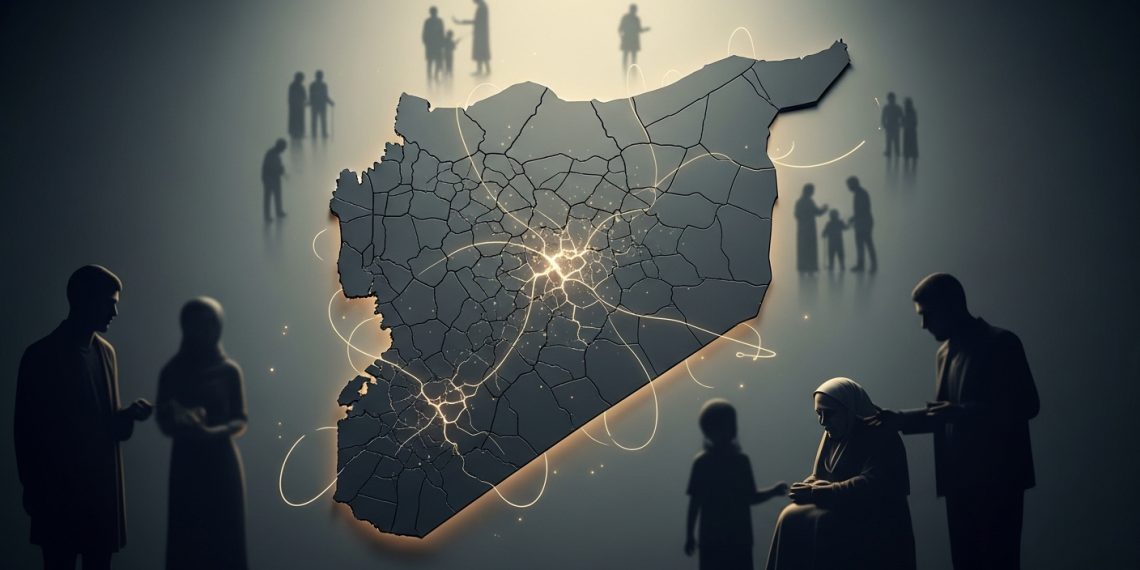
Perhaps the greatest challenge facing Syria after decades of authoritarianism and conflict lies not only in rebuilding its physical infrastructure, but in repairing its fractured national memory. Following the collapse of the Assad family’s rule, built upon the Ba’athist system, no alternative unifying narrative has emerged. Instead, memory has splintered into a mosaic of competing stories. For decades, Ba’athist authoritarianism imposed an exclusive official narrative that suppressed plurality and dissent. When that structure finally crumbled, it left behind an enormous void of meaning.
The fundamental disagreement over how to describe what has taken place in Syria since 2011 – whether it was a revolution, a civil war, or a foreign conspiracy – is not merely a semantic or academic quarrel. It is a political and moral barrier standing in the way of any collective memory project. Paradoxically, both sides of the Syrian divide – regime and opposition- converge in rejecting the label “civil war.” The Assad regime insisted on calling it a “global conspiracy,” while the opposition held firmly to the term “revolution.” This insistence on definitions reflects a deeper failure: the inability to reconstruct a social contract or a state with shared legitimacy.
A national Syrian narrative cannot mean a forced unification of individual experiences; rather, it must become an institutional and methodological framework that acknowledges multiple memories within a renewed national identity; an identity grounded in direct communication and mutual recognition.
The preservation of Syria’s oral history – now on the brink of disappearance – represents history written from the “base of the pyramid.” It is the only means of documenting the experiences of victims and survivors before they are lost to oblivion or distortion. Such an undertaking demands rigorous, methodical work based on accuracy, transparency, and scholarly discipline.
Read also: Gradual Participatory Decentralization: A Transitional Vision for Syria
Yet, the key methodological challenge lies in the issue of inter-subjectivity: the inevitable overlap between the researcher’s subjectivity and the witness’s memory. In recording oral testimony, the historian becomes a participant in constructing the very source being documented. Although this process is bound by ethical codes of testimony, it is rarely an equal exchange, researchers may unconsciously steer interviews to support their hypotheses or agendas.
To overcome this dilemma, the emerging historical narrative must not rest on political or ideological consensus but on the legitimacy of method. Transparency in research procedures, from the selection of witnesses to archiving practices and the management of the relationship between interviewer and interviewee, is not an academic technicality, but a necessary condition for public trust in the archive itself.
A comprehensive narrative also requires documenting not only the voices of victims but those of perpetrators, ensuring a full record of atrocities from all perspectives; an essential foundation for transitional justice.
Transitioning from competing narratives to a unified collective memory requires an institutional framework capable of securing public recognition of the past. The most effective mechanism for this is transitional justice, starting with the creation of a National Truth Commission tasked with investigating human rights violations, documenting atrocities, and fostering public acknowledgement of history.
International experiences, from Rwanda to South Africa, show that such commissions aim not merely at prosecution, but at uncovering truth, preserving memory, and enabling moral repair. Yet, this process depends on political will: the danger lies in reducing transitional justice to a mere bargaining tool or political instrument of exclusion.
Here, the media bear a crucial responsibility: to facilitate public dialogue, raise awareness of past injustices, and highlight stories of resilience and reconciliation; while avoiding sensationalism and bias that could deepen existing divisions.
A unified historical narrative does not mean telling a single story but rather creating a national “container” capable of holding multiple, sometimes conflicting, experiences of the past. That container is the constitutional identity. The new Syrian constitution must evolve into a living social contract, founded on active citizenship and mutual recognition.
Previous ideological narratives, whether nationalist or religious, turned national symbols such as the flag and anthem into extensions of partisan identity, tools of exclusion rather than unity. Redefining these symbols within a pluralistic framework is essential. Adopting a model of multi-layered identity, where Syrian citizenship is the common foundation, would allow diversity to become a source of strength and creativity rather than division.
Ultimately, the political energy released by the end of authoritarian rule should be channelled into a foundational process that reimagines the future.
The unified historical narrative Syrians aspire to is, at its core, an agreement on an institutional and ethical framework; one that ensures all voices of the past are heard, respected, and documented with integrity. Recording oral history, then, is not a luxury or a purely cultural project. It is an act of national reconstruction, a living process of rebuilding the moral and civic foundations of Syria itself.











