


Mazen Murshid
For more than fifty years, “elections” in Syria were nothing more than a staged performance, the outcome of which was known before it began. Ballot boxes looked the same, figures were absurd, and results were predetermined. We knew that everything was decided in advance, and our only role was to applaud at the right moment.
Today, in the recent People’s Council elections, something is different. Not because the process was perfect, far from it, but because it came after the collapse of the old system. For the first time in a long while, something is moving, even if very slowly and unevenly.
For years, Syrians treated “elections” as a repeated ritual that reproduced the same system with the same faces, under banners of “renewal” and a language skilled in replacing reality with slogans. This time, however, the context has changed completely. The system that once monopolized the scene is no longer present, and the society that once accepted silence is no longer the same. A significant gap now exists between past and future, and these elections attempt to fill it.
The recent elections were not a routine obligation. They were the first political step after the collapse of the old system, the first test of Syrians, or more precisely, their elites, to exercise a new political act in an environment whose contours are still incomplete. This is a starting point that cannot be ignored, but it is also a harsh test of the current phase: are we moving toward a state of institutions, or toward recycling old mechanisms of control under new masks?
Read also: Marxism Fails to Explain the Syrian Reality
Elections Without Elections?
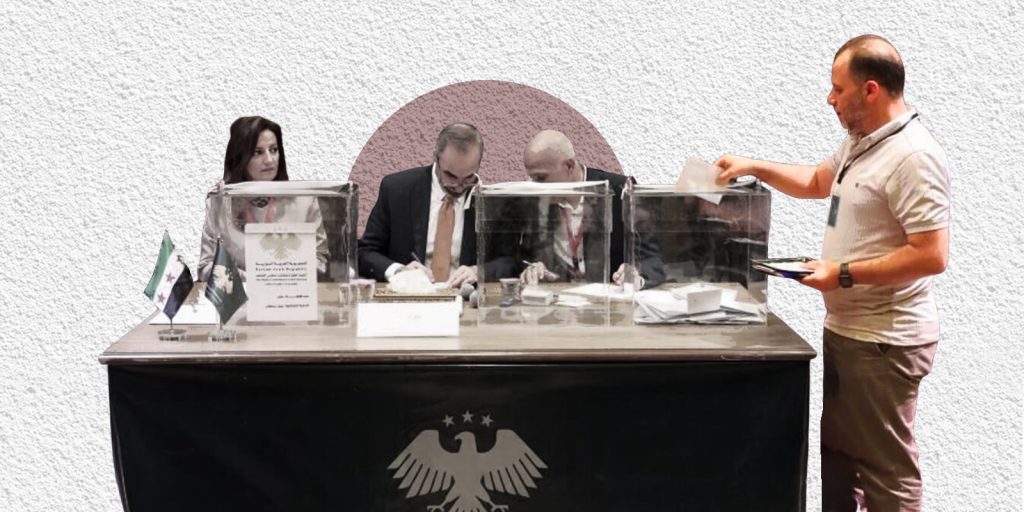
The truth is what occurred last Sunday was not an election in the traditional sense. About six thousand delegates from local councils and transitional bodies selected two-thirds of the parliamentary seats, while the remaining third will be appointed later by the interim president, Ahmad al-Sharaa.
Some may argue that this arrangement is necessary given the complex security situation, and they would be partially correct. The security and administrative challenges are immense, and the infrastructure for fully inclusive elections is still absent. But let us be frank: this mechanism places a thick barrier between the new parliament and ordinary citizens. You and I did not directly elect anyone, and the legitimacy here is extremely limited, a legitimacy of delegation rather than genuine choice.
The problem is not only the mechanism but also the results. So far, only four women have been announced out of 119 deputies. Representation of minorities, Christians, Kurds, and others, is shockingly weak. This is not just a numerical shortfall; it is a systematic failure to reflect the mosaic of Syrian society within its primary legislative institution in the new era.
This parliament does not represent Syrian diversity; it reproduces the same old mentality: managing affairs from above while expecting acceptance and silence from the people. The idea of “popular representation” remains in its experimental phase, making mistakes and successes alike, but it has not yet taken root in the consciousness of citizens or the behavior of new political elites.
Worse still, keeping one-third of seats for presidential appointments ensures that the executive branch retains control over a significant portion of the legislature. Where, then, is the separation of powers? And to what extent can such indirect practices redefine politics in a country where citizens have long been excluded from decision-making?
More important than the numbers is the approach governing these elections: a method still bound by centralized decision-making, where the process is top-down, and the grassroots are expected to grant “legitimacy through silence” rather than genuine trust. Allocating one-third of the seats for appointment reflects a clear desire to ensure stability and control during the transitional phase, a politically understandable necessity in a fragile environment, but it simultaneously limits the space for genuine, independent representation. It is a trade-off between urgent political necessity and the need for full democracy, with necessity clearly prevailing.
Read also: Who Has the Right to Issue Fatwas? Legislative Authority in Democratic Islam
Is There Light at the End of the Tunnel?
Despite all this, something new has occurred. For the first time in a long while, there is a public discussion about who is elected and who is appointed. This, in itself, is a change, albeit limited. Even the official rhetoric has shifted slightly. We no longer hear “the Syrian people elected by an overwhelming majority,” but rather “local bodies have chosen.” There is an implicit, if indirect, acknowledgment that this is not a full democracy.
Moreover, the emergence of new names in public life, even through indirect nomination, signals the beginning of a new social movement. The scene is no longer monopolized by one class or one discourse; it has begun, even partially, to include voices that were previously marginalized, marking a cultural shift before a political one.
The participation itself, with representatives from unions, civil organizations, and local bodies, gives the event a different meaning. True, the choice is limited and guided, but it is no longer a closed individual decision as it was before. Most importantly, even discussing the criteria for selection and representation within local councils serves as early political training, even if under supervision.
What Comes Next?
The new parliament faces an almost impossible task, not only in drafting transitional laws but also in rebuilding what remains of public trust in the state. Political trust is not granted by decree; it is earned through practice, accountability, and transparency. After decades of fear and defeat, convincing people that their voice can make a real difference is extremely difficult.
The real question now is whether this parliament will merely rubber-stamp decisions or become a genuine oversight authority. Will its members dare to critique? Will the leadership accept the existence of opposition under the People’s Council dome? So far, no one knows the answer, but what happens in the first sessions of the new parliament will indicate the shape of political life to come.
These elections are far from perfect. They are flawed, incomplete, and full of gaps, yet they remain an important step. After decades of enforced silence, the mere opening of public discussion about politics represents a shift in collective mentality.
Perhaps most importantly, it is not about who won or how many seats were gained. Syrians have begun, even if very slowly, to reclaim the idea that politics is not the monopoly of power but a public matter belonging to all, and that they have the right to question, criticize, and dissent.
In a country that has yet to learn how to disagree without collapsing, what is happening now may be nothing more than the beginning of a long exercise in accepting difference, discovering that the path to democracy is not straight but consists of hesitant steps, sometimes successful and sometimes faltering, yet ultimately moving forward.











