


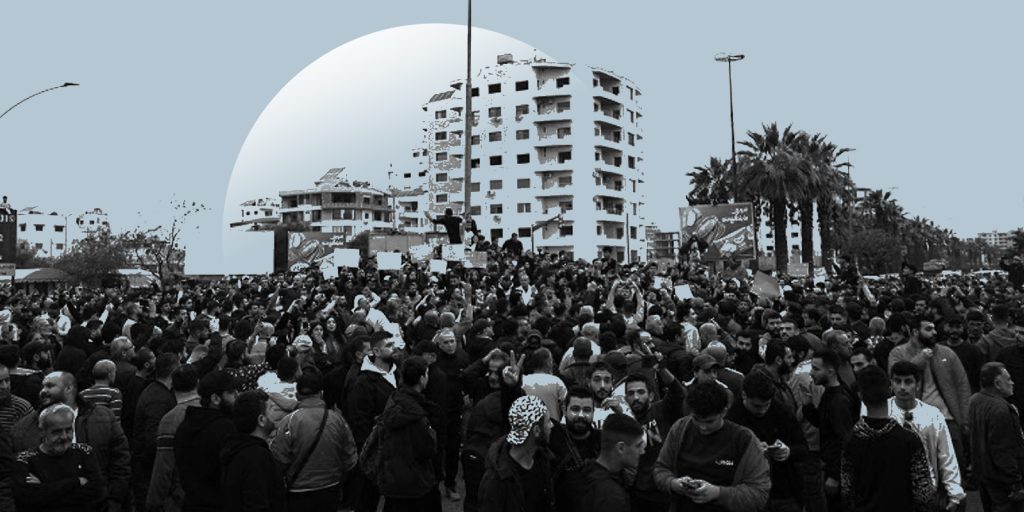
At a pivotal moment in Syria’s history, the Syrian coast has returned to the forefront of debate as a decisive test of a deeper question. Can the coast serve as a bridge for national unity, or will it turn into a new fault line that divides the country? After years of war, accompanied by the politicization of security and sect, and the instrumentalization of narratives of fear and privilege, the coast now carries a heavy legacy of doubts and divisions that have undermined national trust.
With the continued impact of regional and international actors and attempts to exploit internal fragility, the risks of reproducing sectarian and regional polarization are renewed. Between these two possibilities, the future of the coast remains tied to Syrians’ ability to address the responsibilities of the former regime, the role of elites, the establishment of justice and accountability, and the opening of genuine paths for dialogue and national participation. Only then can the coast be transformed from a card of division into a pillar of Syria’s unity.
Intertwined regional roles
Amid the highly complex Syrian scene, the intersection of internal dynamics with regional factors makes the Syrian coast a real testing ground for the country’s future unity. In examining this complexity, Dr. Khaled al-Ezi, professor of international relations and foreign policy and based in Beirut, told +963 that the situation in Syria is marked by a high degree of entanglement due to the overlap of regional powers that do not wish to see Syria as a sound and stable state. He noted that the roles of Israel and Iran cannot be separated from the course of internal developments.
This view aligns with what Wael Alwan, a researcher at the Jusoor Center for Studies, affirmed in statements to +963, when he argued that what is happening on the coast is not merely a local tension or a fleeting reaction, but rather a systematic investment in chaos led by groups linked to the defunct regime and others connected to Iran. These groups use regional and sectarian cover to achieve security and political gains.
In the same context, Mustafa Qalaaji, Secretary General of the Syrian Change and Renaissance Party and a member of the Geneva delegation, linked in statements to +963 the lines of contact inside Syria with regional and international lines of tension. He considered that the Syrian conflict has come to intersect directly with these struggles, making any internal eruption an extension of external agendas.
The sectarian dimension emerges as one of the most sensitive elements in the coastal file. Al-Ezi places responsibility on the Syrian authorities, from the era of Hafez al-Assad to Bashar al-Assad, for entrenching the discourse of protecting minorities against the majority. He argues that this discourse was less a tool of protection than a means to justify policies that plunged the country into a war lasting fifteen years and paved the way for practices of killing and displacement that affected large segments of Syrians.
This characterization converges with Alwan’s reading, which holds that the current problem does not lie in the policies of the current government or in reactions per se, but in the heavy legacy left by the defunct regime, which over decades turned the Alawite sect into a tool of sectarian and regional polarization across the country.
Alwan believes that this legacy still governs the approach to the coastal issue and prevents it from becoming a factor of national unification, despite a year having passed since the fall of the regime, because the measures taken have not yet risen to the level of the deep treatment required.
In describing the social and political reality of the coast, al-Ezi points out that influential groups attributed to the Alawite sect considered themselves part of the regime and defended their personal interests, not the regime itself nor the sect as a whole. According to him, this contributed to immersing the sect in the blood of Syrians and tying its fate to the practices of power.
At the same time, he notes that the coast, as an integral part of Syrian geography and home to a large segment of Alawites, still lives in a state of instability, and that a large portion of its population was powerless and suffered poverty, marginalization, and injustice, despite the involvement of some figures in supporting the regime.
For his part, Alwan stresses the necessity of a clear separation between the former regime, the Alawite sect, and the Syrian coast, warning that linking these components together is one of the most dangerous tools for investing in chaos, given its direct repercussions on civil peace and stability.
Justice as a condition for reconstruction
In this context, Alwan believes that the current authorities have tried to avoid politicizing sectarian identity on the coast, but that remnants of the former regime and groups linked to it have worked to repoliticize this identity through incitement and escalation. This, in his view, calls for more effective tools to confront this trajectory, whether at the political, media, or societal level.
This view intersects with al-Ezi’s question about the usefulness of continuing to reproduce old conflicts. He responds that Syrian elites are required today to realize that Syria’s future is not built by going backward or by implementing external agendas, whether Iranian or Israeli. He emphasizes that legitimate demands are achieved through dialogue and political participation, not through rebellion or threats.
Regarding ways out of the crisis, al-Ezi stresses that justice is a fundamental condition for building a new Syria, affirming that it is impossible to speak of any genuine political process without holding accountable everyone involved in killing or displacing Syrians.
He believes that the injustice suffered by many inhabitants of the coast, particularly as a result of the military and security policies of the former regime, should be a motive for a peaceful solution rather than escalation.
Sectarian polarization and the politicization of religiosity
For his part, Alwan acknowledges the existence of polarization between coastal society and other regions at regional, religious, sectarian, and intellectual levels. He considers this natural after a war that lasted fourteen years and authoritarianism that endured for five decades, but one that requires serious treatment beginning with rebuilding social frameworks, strengthening tools of civil peace, coexistence, and development.
Alwan adds an economic dimension to this path, emphasizing that improving economic and living conditions represents a key entry point to resolving many accumulated problems. He notes that the Syrian coast possesses significant agricultural and tourism wealth, and if invested properly, this would contribute to easing crises and enhancing stability, alongside the necessity of genuine participation by all components in building the new Syria.
In the broader political context, Mustafa Qalaaji affirms that emerging from the current impasse requires political forces that possess and control military power on the ground to prioritize the national interest over any other interests, whether private or linked to the agendas of actors intervening in Syrian affairs.
Qalaaji concludes by calling for agreement on the independence of the Syrian decision as the supreme goal at this stage, addressing an appeal to the rational voices among the nation’s people, who remain numerous, to elevate reason and wisdom and to unite all Syrians.
This view converges with the concluding vision of al-Ezi, who emphasizes that rebuilding Syria requires the participation of all Syrians in a spirit of cooperation and national belonging, and that Syria can only be a homeland for all, where rights are achieved through peaceful means and mutual understanding, and through the participation of all Syrians, with all their cultural and social diversity, in shaping the future of the country.











