


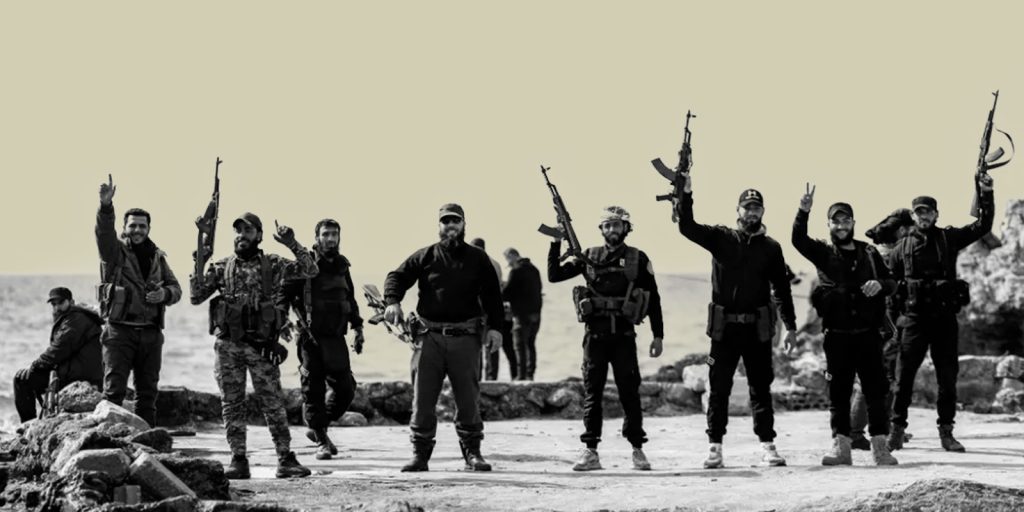
Despite the interim government’s confirmation that it regained control over the coast following the March 2025 clashes, succeeded in securing weapons depots, and arrested armed individuals, official statements and indirect media coverage have contributed to portraying the region as a “homeland for remnants of the Assad regime.” This has reinforced a public impression of a comprehensive threat, while available indicators show that former regime groups remain limited in impact, with scattered and unorganized threats, benefiting from sectarian divisions and security vacuums. The real risks lie in the media and political exploitation of these events, while the Alawite community remains affected by fears and internal divisions. This highlights the need to balance security measures with a reconciliation track to ensure sustainable stability without inflating the threat.
Declared Control and Field Fragility
Security affairs expert Mujahid al-Sumaidie tells +963 that “the security situation on the Syrian coast cannot be described as collapsed, yet it remains fragile and susceptible to influence,” noting that “the operations carried out by the interim government in March 2025 contributed to dismantling old security structures and seizing a number of weapons depots.”
He adds that “the persistence of mutual distrust, alongside the absence of full political stability, keeps the region in a state of low intensity tension, despite the decline in the level of organized threats.”
From a military perspective, retired Brigadier General Jalal al-Abadi, a strategic military expert from Jordan, tells +96” that “the survival of some remnants of any fallen regime is a natural matter following its collapse or defeat,” explaining that such remnants “usually consist of networks of beneficiaries and those harmed by change, and are spread across different areas inside and outside Syria, including the Syrian coast.”
Al-Abadi points out that these movements “may appear from time to time with limited support from parties that benefited from the former regime, with the aim of causing disruption and attracting attention,” considering that their impact remains limited.
Bloody Incidents Without Unified Leadership
The Syrian coast witnessed clashes in March 2025 described as the most violent since the fall of the Assad regime, resulting in the deaths of hundreds of civilians and military personnel, amid mutual accusations of sectarian executions. Despite the government’s announcement that it had regained control by March 10, sporadic security incidents continued, including attacks targeting Alawite neighborhoods in Latakia, prompting authorities to later impose a curfew.
In describing the nature of these events, al-Sumaidie says that “the recent security incidents, including attacks that targeted some Alawite neighborhoods, reflect scattered and unorganized threats and do not constitute evidence of the existence of a central network or unified leadership for remnants of the former regime.”
He explains that “most of these acts are individual or retaliatory in nature,” adding that they “are exploited media wise to inflate the idea of what is known as a homeland for the remnants, without concrete indicators of a large-scale insurgency.”
For his part, al-Abadi says that “the clashes witnessed in some areas in March 2025 were contained,” stressing the “need to encircle hotbeds where these groups are concentrated and prevent them from communicating with other areas, through tightening oversight and extending security control across various Syrian regions, north, south, center, and coast.”
Between Security Leaks and Impact Assessments
In contrast to describing the threat as unorganized, writer and political researcher Imran Zahawi tells +96” that “the involvement of senior officers from the ousted Assad regime in attempts to destabilize and seize control of the Syrian coast” represents a real source of concern during the transitional phase.
Zahawi points to “leaks and documents speaking of the presence of around 168,000 fighters from regime remnants, distributed across sectors in Homs, Hama, Damascus, and the coast,” along with “deployment maps and diversified armament including light and medium weapons, anti armor missiles, and artillery.”
He adds that these leaks revealed “financial and organizational disputes between Rami Makhlouf, Assad’s cousin, and Major General Suheil al-Hassan, the former commander of elite forces,” against the backdrop of “accusations of inflating fighter numbers to obtain greater funding,” in addition to “a leadership structure topped by well known names, and second tier leaders handling financial and military files and coordination among groups.”
Conversely, al-Abadi rules out “the existence of effective support at the present stage from regional actors such as Iran or Hezbollah,” explaining that these parties’ preoccupation with their internal files and regional and international pressures “limits their ability to provide any impactful support.”
He added that the Syrian transitional authorities “are working to encircle these groups and cut their supply lines,” expecting that they “will gradually fade in the near future, within a natural context witnessed by any fallen regime that loses its supporters one after another.”
Security Fears and Rejection of Collective Stigmatization
On the social level, part of the Alawite community suffers from security fears, amid their sectarian association with the former regime and the continuation of limited retaliatory incidents that have led to declining trust in the government among some segments.
In this context, Zahawi says that “the core problem does not lie in the existence of plots by remnants of the former regime, which is expected in a post collapse phase, but rather in the way they are handled,” warning against “turning these plots into a pretext for stigmatizing the Syrian coast or the Alawite sect as a single bloc linked to the ousted regime, whether politically or sectarianly.”
He points to “the persistence of divisions within the Alawite community itself,” calling on the government to “open channels of dialogue and direct talks with Alawite leaders on the coast,” with the aim of “reaching understandings that ensure control over the region and restore security and political order,” and providing “reassurances against exposure to retaliatory acts or the repetition of past violations.”
For his part, al-Sumaidie affirms that security measures, “despite their importance, remain insufficient unless accompanied by a genuine national reconciliation track and legal guarantees that ensure the protection of all social components and reinforce sustainable stability.”
Between Reality and Exaggeration: Where Does the Coast Stand Today?
In conclusion, developments on the Syrian coast reflect a complex reality that neither confirms its transformation into a “homeland for remnants of the Assad regime” in a comprehensive sense, nor denies the existence of ongoing security threats.
Between describing these threats as “scattered and unorganized” or “harassment fire,” and warnings against exploiting them politically and media wise, stability remains contingent on the transitional government’s ability to combine decisive security measures with societal reconciliation and the addressing of political and sectarian divisions in a transitional phase that remains open to multiple possibilities.











