


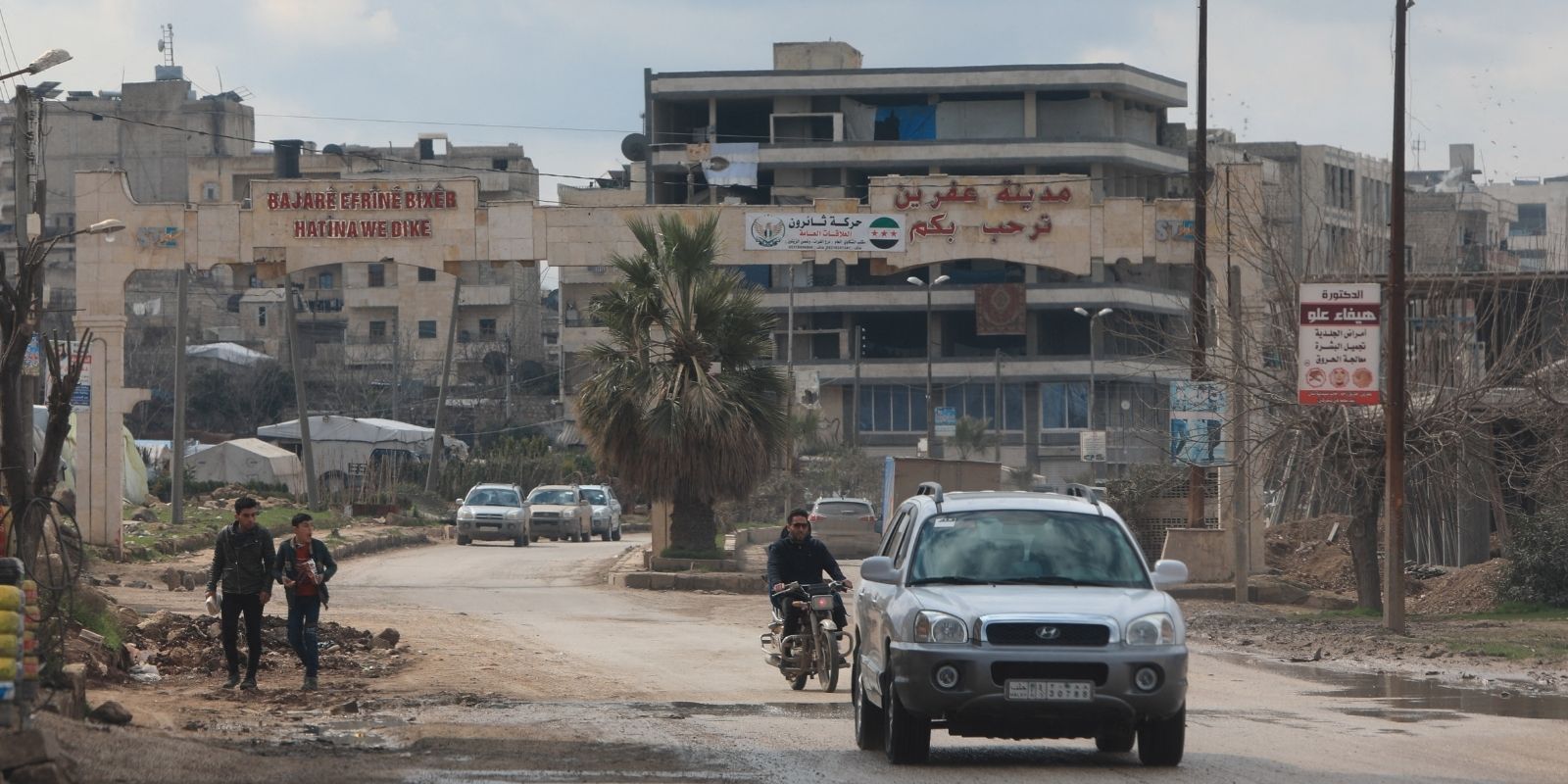
Aleppo, Northwest Syria – Human rights reports have documented a sharp increase in violations against residents of Afrin, in northern Aleppo countryside, following a series of killings and widespread theft of olive harvests in recent days.
Field reports from rights organisations indicate that the abuses are no longer limited to the seizure of olive crops and private property but have extended to the imposition of forced levies and violent crimes against civilians who attempt to defend their livelihoods or refuse to pay extortion money.
In mid-October, a report by Syrians for Truth and Justice revealed that farmers in Afrin continued to face arbitrary taxation by the Turkish-backed Syrian National Army, which controls much of the area. The organisation also recorded several fatal incidents in villages where residents tried to reclaim their land or stop looting, noting that armed factions often use force to intimidate locals and prevent them from documenting abuses.
Ibrahim Sheikho, Director of the Afrin Human Rights Organisation, told +963 that “the area is experiencing a state of factional chaos, lawlessness and unchecked proliferation of weapons, while security forces remain unable to impose control – despite the formal integration of armed groups into the structures of the Internal Security and Defence Ministries of the Syrian Interim Government.”
He added that this year’s olive harvest season has seen a rise in theft and assaults on residents: “Crops are being looted in front of their owners, either through collusion or failure of the economic committees affiliated with the internal security forces.”
According to Sheikho, recent weeks have seen several killings, including that of Shukri Ahmad Oso, a resident of Keferzît/ Kafr Zeita village in Jindires sub district, who was found dead under unclear circumstances while returning from an olive press. Another farmer was shot dead in his tent in Ghazzawiya village on Thursday night by two masked gunmen.
Read also: Syrian Defense Ministry–Linked Militia Arrests Kurds in Afrin
Sheikho noted that official promises to enable displaced residents to return to their homes “have not translated into tangible action”, saying that violations against locals “are worsening by the day, particularly with the growing seizure of olive crops and residents’ properties”.
He explained that “a government delegation – including the Deputy Governor of Aleppo and officials from the Presidential Palace – recently visited Afrin and met with community leaders, pledging to facilitate the return of displaced residents regardless of any political settlement that may or may not be reached with the Kurdish-led Syrian Democratic Forces (SDF).”
However, according to Sheikho, local factions and economic committees continue to confiscate harvests under various pretexts, such as the absence of property deeds or delays in providing ownership documents. “During these delays,” he said, “entire crops are harvested and stolen.”
The rights activist added that violations extend beyond property issues to the region’s cultural identity: “Kurdish, once the main language in Afrin, is now treated as a foreign language – taught for only two hours a week as part of foreign-language curricula. This represents a clear violation of residents’ linguistic and cultural rights.”
He stressed that “over 90% of Afrin’s original inhabitants are Kurdish, yet they continue to face discriminatory practices aimed at altering the area’s identity”, pointing out that “official pledges to restore property and ensure return remain mere statements, while looting and pressure on residents persist – effectively pushing them towards forced displacement.”
A previous report by Syrians for Truth and Justice, published in mid-October, stated that armed factions – including al-Amshat, al-Hamzat, Sultan Murad, al-Muntasir Billah, al-Mu’tasim, the 9th Division, Faylaq al-Sham, and Division 51 of al-Jabha al-Shamiya – continue to impose levies on olive farmers across Afrin.
The report, based on 39 detailed testimonies from Kurdish farmers and olive-press owners, described heavy taxation imposed on cultivation, harvesting, pressing and trade of olive oil. It added that tax rates varied by faction and village, and that payments were collected either in cash or in kind – often as a share of the harvest or oil – through faction-run economic offices, local councils and some village mukhtars.
The report documented numerous cases of intimidation and violence against farmers who resisted payment, including beatings, arrests, confiscation of property and even the cutting down of olive trees. The organisation called on the Syrian National Army to end these practices and protect farmers’ livelihoods, noting that despite its formal dissolution and integration into the Interim Government’s Defence Ministry, the group still exercises control over large parts of Afrin.
Turkish forces and allied Syrian factions seized Afrin in March 2018 following a two-month military operation against the Syrian Democratic Forces. Since then, several human rights groups have reported widespread abuses against Kurdish residents.
At the time, Amnesty International urged Turkey to end “serious human rights violations” committed by its affiliated armed groups, including arbitrary arrests, enforced disappearances, confiscation of property and looting.
According to the United Nations, the 2018 operation displaced roughly half of Afrin’s population of 320,000. Most have been unable to return to their homes since.











