


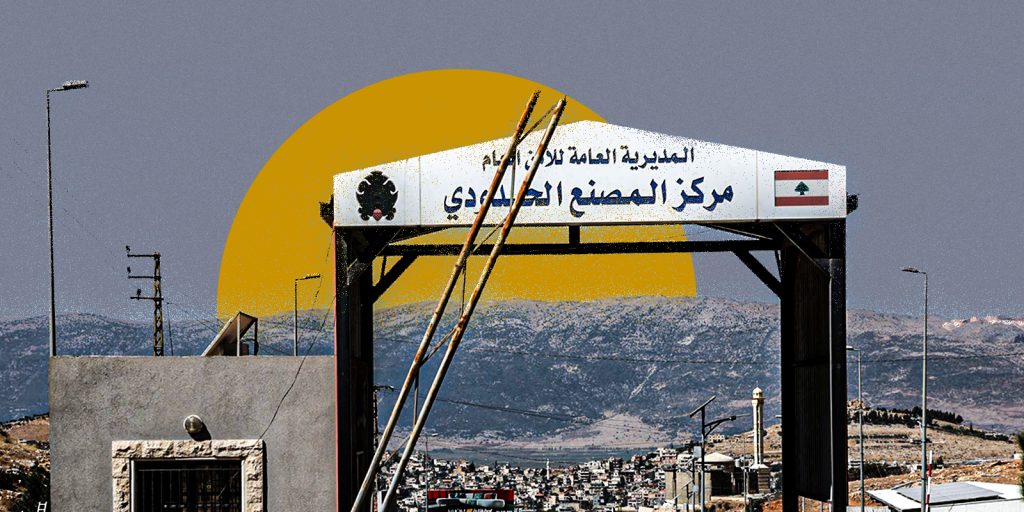
The long-standing border dispute between Lebanon and Syria is back in the spotlight after Beirut received archival maps and documents from France in May 2025. The delivery, made at Lebanon’s request, coincided with Syrian President Ahmad Al-Shara’s visit to Paris, where he met with French President Emmanuel Macron to discuss ways to strengthen border security.
This comes on the heels of armed clashes between Syrian forces and Hezbollah-affiliated factions near the border, which pushed Beirut and Damascus to sign a Saudi-brokered security agreement in Jeddah. The agreement includes forming joint committees to formally demarcate the roughly 375-kilometer border.
At the heart of the dispute lies the occupied Shebaa Farms, claimed by both Lebanon and Syria but under Israeli control since 1967. Beirut insists the area is Lebanese territory, while Damascus has long asserted it is Syrian land, an area that armed groups have used for decades to justify their military presence.
The complex situation and the solution
The French maps handed over this year reflect conflicting claims: some from 1932 show Shebaa Farms as Lebanese, while others from 1946 mark it as Syrian. Experts say a clear border deal would remove pretexts for militias to operate, bolster state sovereignty, and ease tensions that have simmered for decades.
The renewed push comes as Syria undergoes major political changes following the fall of the Assad regime in December 2024. For the first time in decades, Damascus is signaling stronger respect for Lebanese sovereignty and independence. Lebanon’s Foreign Minister, Youssef Raji, told Sky News Arabia that lifting sanctions on Syria would speed up its reconstruction, benefiting Lebanon by curbing cross-border smuggling. He acknowledged the border’s length and the deep tribal ties along it make smuggling hard to control, but he called demarcation a “historic opportunity” to secure the borders under state authority alone.
Read also: Netanyahu: Syria, Under Al-Sharaa, Opens Peace Channel with Israel
Possible consequences
Mustafa Hani Idris, a member of the Ru’ya Center for Political Studies, told +963 that demarcating the Syria-Lebanon border now seems more realistic than ever, mainly due to Syria’s shift toward a more independent political path.
Yet Idris points out that serious challenges remain. Lebanon’s deep political divisions make it hard to reach a unified stance on the border issue, with some factions treating it as a bargaining chip in wider power struggles.
There are also technical disputes over specific areas like the Shebaa Farms and the Kfar Shuba Hills, both requiring careful, mutually agreed solutions. Idris warns that border demarcation could even trigger internal tensions in Lebanon, especially among groups whose political legitimacy is closely tied to the narrative of “resistance” and unresolved borders.
He explains that the main sticking points are well-known: Shebaa Farms, the Kfar Shuba Hills, and the Qusayr area, all places where claims overlap and local communities straddle the border.
According to Idris, the UN could play a key role by providing a legal framework for the process, while Arab states that have helped stabilize Syria could facilitate talks between Beirut and Damascus. Western countries, too, could help by applying political pressure or offering economic incentives.
At its core, border demarcation would mean asserting the sovereignty of both states, tightening border security, and removing any excuses for outside interference. It could also pave the way for closer economic and security cooperation between Syria and Lebanon.
Idris notes that a “land-for-land” solution might be floated as a practical way to resolve lingering disputes, though unlike shady deals of the past, any arrangement today would need to respect the rights of local communities. This could involve administrative swaps or special arrangements for joint agricultural use or limited cross-border movement to keep family and social ties intact
Read also: A New Social Contract for Syria
What’s at stake
A clear border would strengthen both countries’ territorial sovereignty and close loopholes that allow internal or external actors to meddle. Idris also believes the UN could provide legal frameworks for the demarcation, while Arab states, some of which have invested heavily in Syria’s stabilization, might facilitate dialogue. Western countries, too, could play a role through diplomatic pressure or economic incentives.
One proposed idea is a “land-for-land” arrangement, but unlike shady deals of the past, any swap would have to ensure the rights of border communities, perhaps by allowing joint agricultural use or limited cross-border movement to maintain social ties.
For Washington, finalizing the Syria-Lebanon border is part of a broader strategy. Dr. Ahmad Al-Zein, a political analyst, told +963 that the U.S. wants to separate the Syrian track from the Lebanese one, especially since normalization between Damascus and Tel Aviv seems closer than any peace deal between Lebanon and Israel. By resolving the Shebaa Farms dispute, the U.S. hopes to undercut Hezbollah’s justification for keeping its weapons.
However, Al-Zein dismisses rumors of wider land swaps, like exchanging Tripoli for the Golan Heights, as media “bubbles” with no basis. He predicts most of the border can be settled with British mediation, except for the south, where deep disputes remain. Still, he says progress is possible within months if the political will holds.











