

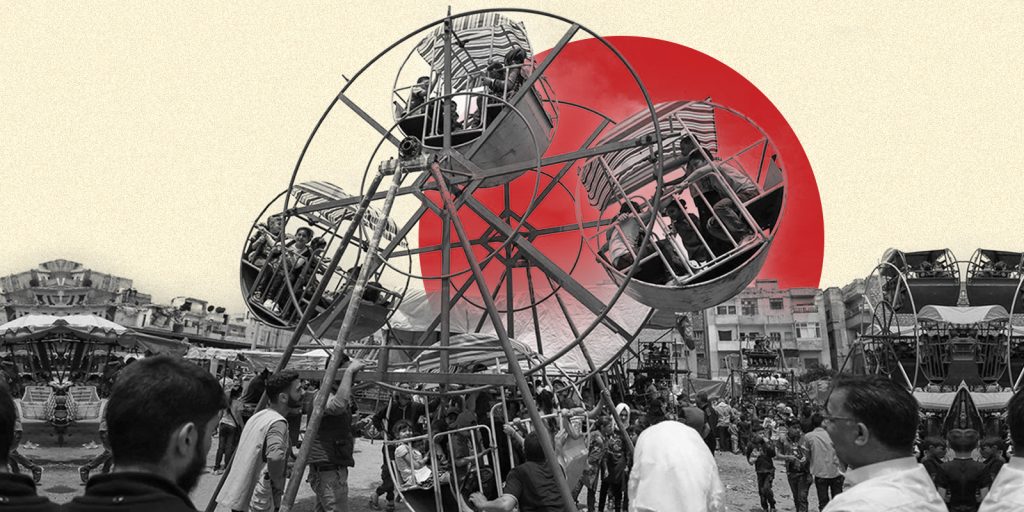
Since the official date of Eid al-Adha, the second major holiday in the Islamic calendar, was announced, Syrians have raced against time to complete preparations and secure the essentials for the occasion. This year marks the first time in 54 years that the country has experienced the holiday without being under the rule of the Assad family.
The Syrian capital, Damascus, rich in history and tradition, remains unique in its celebration. Its old neighbourhoods are adorned with colourful lights and religious decorations, accompanied by the echo of takbirs that fill the air with a sense of spirituality, serenity, and reverence.
Family Ties
Abdullah al-Hafi, a government employee in Damascus, expressed his commitment to the customs and traditions passed down from his parents, despite the changes in people’s behaviour and social dynamics, as he told +963.
He emphasised that maintaining family ties and visiting relatives are among the most important inherited traditions that he still practices. He believes that Eid is a true opportunity to strengthen family bonds and break the monotony of daily life.
Al-Hafi also highlighted his dedication to visiting the deceased, noting that he makes a point of going to cemeteries after the Eid prayer to recite whatever verses he can from the Holy Qur’an for the souls of the departed.
Eid Hospitality
Mays al-Masry, a university student, spoke to +963 about her family’s preparations for Eid. “My mother devotes the final two days before Eid to making sweets, special types we only prepare for this holiday,” she said.
She explained that the economic situation did not allow them to prepare all varieties of traditional sweets, such as those filled with pistachios and walnuts. Instead, the family opted for those stuffed with dates, which remain within their modest purchasing power.
She noted that many families have turned to making sweets at home rather than purchasing them ready-made due to their high prices, even though the cost of raw materials remains relatively affordable.
As part of the traditional Eid hospitality, she confirmed that Arabic coffee is essential for welcoming guests, along with offerings of chocolate and candy.
Children’s Joy
Saeed al-Haddad, a school teacher from Damascus, observed that Eid has lost much of its meaning for adults but continues to serve as a valuable opportunity to bring joy to children.
He said he eagerly awaits Eid so that he can take his three children to playgrounds and public parks. At the same time, he remains committed to visiting relatives, setting aside the first day of Eid specifically for that purpose.
“Our happiness lies in the happiness of our children,” he told +963. “We must ensure their joy by buying them new Eid clothes and preparing sweets and treats for our guests.”
He expressed hope that the holiday would offer a chance to bridge distances, forgive past grievances, and reinforce bonds of love and brotherhood within society. He also stressed the importance of exchanging greetings, answering well-wishes, and mending past wrongs.
Damascene Cuisine
Obaida al-Agha shared that he continues to uphold Eid traditions, beginning with a late-night visit to the public baths with his friends on the first day of Eid, followed by a hearty Damascene dinner in the Midan neighbourhood.
“At dawn, we head to the Umayyad Mosque for the dawn and Eid prayers, then rush back home to greet our parents and siblings and enjoy breakfast together,” he told +963.
Looking Back
Sahar al-Mulla reflected on how Eid celebrations were different in the past, owing to stronger social bonds and a deeper sense of community. In earlier times, neighbourhood residents supported one another, women collaborated to prepare food and sweets for Eid, while men handled cleaning and decorating.
“Eid used to have its rituals, joy, and significance,” she said. “Families would visit one another after the Eid prayer, then gather at the home of the family elder for a communal meal. But all of that has disappeared today. Life has become so complicated that even siblings rarely ask about one another anymore, unfortunately.”
A Tradition of Elegance
Karim al-Omari emphasised that Eid al-Adha holds a special beauty, marked by traditions he has observed since childhood, traditions he still upholds today, despite being in his forties.
He explained that he continues to accompany his father on the first morning of Eid for prayer, followed by visits to cemeteries to place flowers on the graves of loved ones and recite verses from the Holy Qur’an. Afterwards, they head to the market to perform the ritual animal sacrifice and distribute portions to relatives and neighbours.
He noted that his father is regarded as the head of the family, so relatives gather at his home before noon on the first day. In return, he visits them on the third and fourth days of Eid.