

With the conclusion of Pope Leo XIV’s visit to Lebanon – a visit he opened by declaring “Blessed are the peacemakers” – the country, particularly its southern region, appears on the threshold of a new political phase. This shift comes on the back of the latest meeting of the “mechanism” committee, attended by Lebanon’s former ambassador to the United States, Simon Karam, who was delegated by President Joseph Aoun to represent Beirut in this framework.
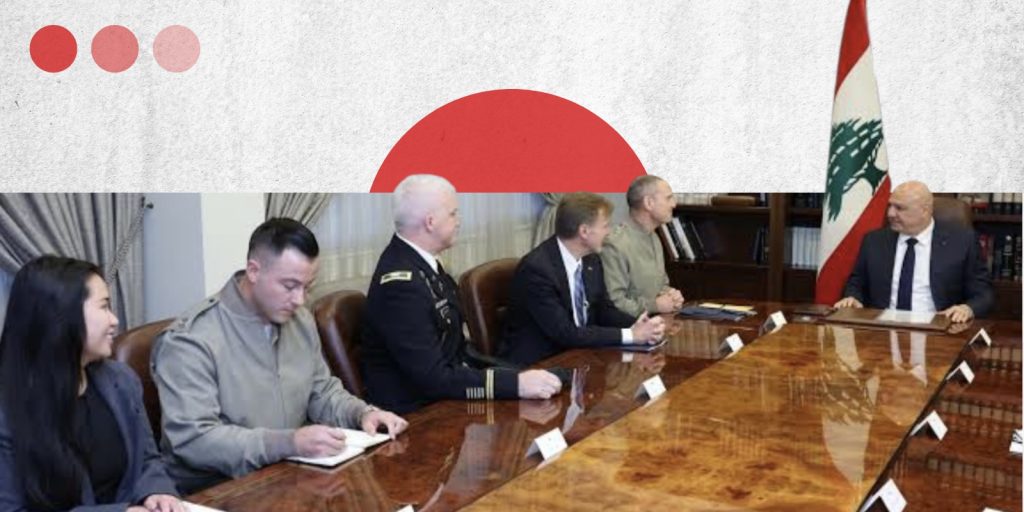
Karam headed the Lebanese delegation to the committee overseeing the implementation of the cessation of hostilities. He took part in its session last Wednesday in Naqoura alongside the American envoy, Morgan Ortagus. Ortagus is also expected to represent Washington in meetings held by the UN mission with ambassadors of Security Council member states in Beirut, where she will meet the Lebanese President, the Speaker of Parliament and the Prime Minister, as well as the Army Commander, General Rodolphe Haykal. She is then due to travel south to meet the mechanism committee and UNIFIL leadership.
Media reports note that Karam’s selection came after coordination between the President, the Prime Minister and the Speaker of Parliament. The move is seen as an attempt to prepare the ground for Hezbollah to accept serious negotiations aimed at reducing Israeli military pressure on Lebanon and opening the door to a period of calm and stability, rather than a widening conflict. This comes amid American guarantees meant to restrain Israel’s field operations – particularly following the attack targeting Hezbollah commander Haitham Tabatabai.
Security and political researcher Khaled Hamadeh tells +963 that Karam’s appointment was not spontaneous but the result of a longer process in which several names were considered. He recalls that both the President and the Prime Minister had previously expressed support for indirect talks with Israel, while Speaker Nabih Berri repeatedly endorsed negotiation efforts if they happened through recognised channels. In his view, adding Karam to the delegation created a middle ground by introducing a civilian voice, expanding the delegation’s scope to include a political dimension in addition to the technical and military one.
Hamadeh argues that Lebanon’s main negotiating priority is to stop Israeli aggression and reaffirm that Beirut has fulfilled its obligations under Resolution 1701. Israel, he says, claims the opposite – insisting that Lebanon has not fully implemented the agreement and linking its ongoing occupation and attacks to the disarmament of Hezbollah across all Lebanese territory. For Israel, the agreement supposedly grants it the right to address any “potential threat”.
Karam’s presence, Hamadeh believes, could push discussions beyond technical military issues – such as army deployment south of the Litani river or alleged threats cited by Israel – towards broader questions, including withdrawal timetables, the behaviour of the Lebanese state in areas vacated by Hezbollah, and the looming risk of a security vacuum as UNIFIL begins to draw down. Hundreds of UNIFIL troops have already left in recent weeks, raising concern about instability if Resolution 1701 is not fully implemented.
According to Hamadeh, full implementation in the near term will require direct international sponsorship through a new Security Council resolution addressing the UNIFIL withdrawal and what comes after. This is expected to be one of the key issues raised within the mechanism and later conveyed to the Lebanese government. Yet he believes Lebanon’s attempt to “buy time” cannot last, given rising Israeli and American pressure for complete implementation of Resolution 1701. He cites the strong messages delivered even during the Pope’s visit, including statements from the US envoy Tom Barrack and the American ambassador, whose remarks were reported in Israeli media as emphasising Israel’s freedom to act independently to protect its security.
Hamadeh concludes that deadlines are tightening as Washington has reportedly set the end of the year as a target for measurable progress. Negotiations – even with Karam involved – cannot continue without new ideas capable of reshaping the situation in the south. He places weight on the expected report by UN envoys after their tour of the region, where they will meet UNIFIL, the mechanism, Israeli officials, local residents and the Lebanese Army. Their findings will feed into a Security Council decision that could either reinforce stability through a new formula or compel Lebanon to fully commit to disarmament steps, with implementation carried out under clear international oversight.
For Mohammed Ali Shams Al Din, a senior researcher at the Information International institute, the fourteenth meeting of the mechanism carries implications that go beyond security. He points to statements by Israeli officials on potential economic cooperation and to the US Embassy’s reference to “peace and prosperity in the region”, which collectively suggest a phased approach beginning with a halt to Israeli military operations in Lebanon – particularly in the south. Such a step, he says, would lend credibility to the negotiation track.
Shamseddine notes that the next stage may include discussions on economic conditions and reconstruction, including plans to rehabilitate the heavily affected south. He stresses that Lebanon is entering a new phase, different from previous cycles, with an increasingly prominent economic dimension. But he cautions that reconstruction cannot proceed without broad international support, as the Lebanese state is incapable of absorbing the massive costs. Early estimates put direct damage at around USD 8 billion, with indirect losses reaching USD 4 billion – a total of roughly USD 12 billion, far beyond Lebanon’s capacity. Effective reconstruction, he says, requires international financing to allow people to return, revive economic life and ensure sustainable development.
Above all, Shamseddine insists that stopping the war remains the immediate priority. Any discussion of economic opportunities is meaningless without an end to military operations and the establishment of security.
The US Embassy in Beirut confirmed that senior officials convened the fourteenth meeting of the technical military committee (the mechanism) on 3 December in Naqoura to assess efforts toward a lasting cessation of hostilities. The meeting included Morgan Ortagus, Simon Karam and Israel’s National Security Council official Dr Uri Resnick as civilian participants – a step intended to deepen the political and military dialogue and strengthen prospects for a durable peace.
However, retired Brigadier General Marcel Baloukji tells +963 that the mechanism meetings are little more than a waste of time. He argues that the proposal advanced by the Lebanese President is unlikely to yield meaningful results. Beginning with the economic track, he says, is a fundamental mistake, as security arrangements should come first. The mechanism itself, he adds, is merely a technical military committee without the authority or structure required for formal negotiations between two states. The Lebanese representative lacks the mandate to make consequential decisions, rendering the outcomes negligible.
Baloukji stresses that ignoring the Hezbollah weapons issue undermines any initiative, as Israel insists on addressing it before making progress. He argues that Hezbollah rejects the entire process and is likely to continue doing so. Lebanon, he says, is not ready for economic talks with Israel, and such discussions remain far off – requiring political and security milestones that have not yet been reached. Meanwhile, Israel continues its military preparations, having achieved neither its political goal of securing the northern front nor its regional objective of curbing Iranian influence. Nor has the core issue – Hezbollah’s arsenal – been resolved. In his view, the mechanism may produce a brief one- or two-week truce at best, merely to test the waters, before hostilities resume.
Lebanese writer Choukri Moukarzel offers a different perspective. He believes Lebanon is moving towards meetings with a peaceful intent – potentially even toward a peace agreement or something close to it. Yet the situation on the ground remains complex, with Israeli bombardment continuing across infrastructure and, at times, residential areas. Moukarzel argues that such pressure is often used as leverage within negotiations, pairing political engagement with military escalation.
He considers the appointment of a civilian diplomat to the negotiation file an encouraging first step, given his conviction that diplomatic solutions offer far better prospects for Lebanon than military confrontation, which has historically brought little beyond destruction. Lebanon, he says, has already paid a steep price from the 2019 financial collapse to the present, including the banking crisis that he describes as the largest organised deception in the country’s history. The subsequent armed confrontations between Hezbollah and Israel were deeply asymmetrical, compounding losses without achieving meaningful gains. He therefore prefers a genuine peace-oriented dialogue, despite the painful compromises it may involve, arguing that weapons outside state authority are no longer viable.
Moukarzel also notes the recent designation of Hezbollah as a terrorist organisation in Iraq, along with the freezing of its assets – a significant shift even among traditional allies. In his view, Lebanon’s options are narrowing, and the only remaining path lies through diplomatic solutions. He expresses hope that negotiations can yield outcomes that ease, at least partially, the mounting hardship endured daily by the Lebanese people.