

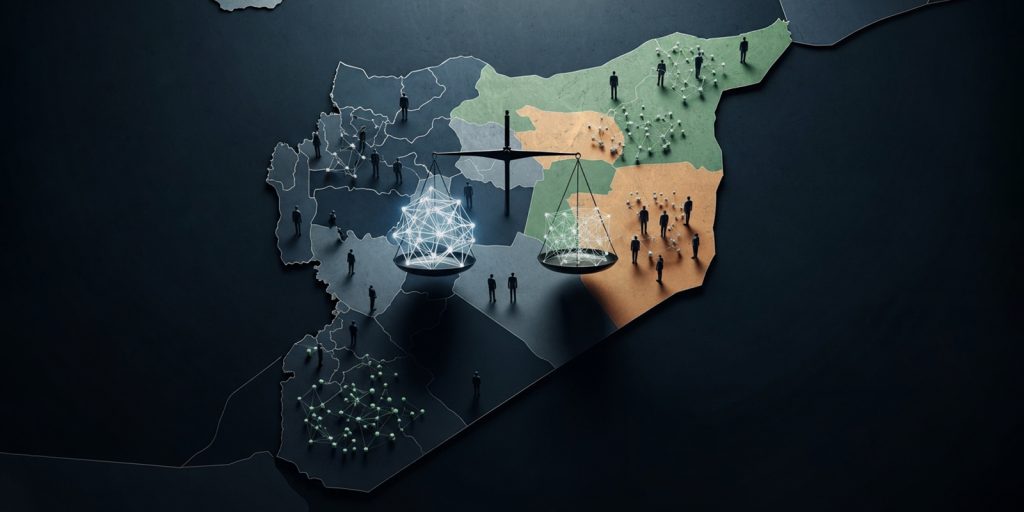
Syria finds itself at an unprecedented political juncture, one in which questions of statehood, authority, and identity intersect with a fractured social reality and a long legacy of authoritarianism and war. A state exhausted by years of conflict, its institutions eroded and its social fabric torn, now faces a central question no less critical than civil peace or reconstruction: which model of governance can preserve national unity, regenerate legitimacy, and establish a new relationship between the state and society?
The debate over decentralisation is no longer an intellectual luxury or a detached academic exercise. It has become integral to Syria’s political discourse on the future of the state. Between those who see decentralisation as an entry point for rebuilding trust and broadening participation, and those who fear it could become a gateway to fragmentation or renewed conflict, proposals multiply and concepts overlap – reflecting the depth of uncertainty surrounding the post-regime phase.
Conceptual ambiguity and terminological confusion
Approaching this debate, researcher Tareq Watfa points to clear conceptual ambiguity surrounding decentralisation. In comments to +963, he explains that “administrative decentralisation means sharing administrative functions only between the central government and local administrative units”.
He contrasts this with federalism, which he defines as “a constitutional arrangement based on the distribution of the three functions of governance – legislative, executive, and judicial – between the central government and regional governments”.
Watfa explains that, in a federal system, this distribution goes beyond transferring certain executive powers, granting regions full constitutional authority, whereby “each region has its own constitution and legislative, executive, and judicial powers, with competencies defined by the federal constitution”.
He further notes that regions “have the right to participate in federal decision-making on matters of shared interest, most notably through the legislative process via a second parliamentary chamber”.
In this context, Watfa argues that terms such as “expanded decentralisation” or “political decentralisation” remain problematic, as “legal and administrative scholarship has not settled on unified definitions for them”. He suggests these terms are often used to describe the degree of autonomy and scope of powers granted to local units, rather than clearly defined constitutional models.
This perspective aligns with that of governance researcher Zaidoun Al-Zoubi, who describes the prevailing discourse as marked by “severe terminological confusion”.
Al-Zoubi stresses to +963 that “there is no such thing as administrative, modified, expanded, or political decentralisation in the way these terms are commonly used”, considering such classifications imprecise.
Forms of decentralisation and their dimensions
Al-Zoubi explains that decentralisation, according to administrative and legal literature, falls into “three main forms – the weakest being deconcentration, the intermediate being delegation, and the strongest being devolution, which is regulated by constitutional and legal frameworks”.
He argues that the core of the debate should not revolve around labels, but rather around the substance and limits of transferred powers.
Al-Zoubi identifies three fundamental dimensions of decentralisation. The first is political – who represents the local community: elected or appointed authorities. The second is financial – the ability of local authorities to raise resources through taxes and fees. The third is administrative – empowering local bodies to formulate plans, budgets, and appointments.
Describing the Syrian reality, Al-Zoubi offers a practical example: “Today in Syria, the governor is appointed, yet cannot appoint a director of health or tourism, because the ministry retains that authority”.
He adds: “We also have elected provincial councils, but they lack real financial or administrative powers”, concluding that “Syria’s system remains administratively, financially, and politically centralised”.
Read also: Russia and Israel Test the Balance in Southern Syria
Governance models: administrative versus political
From a political perspective, Syrian politician Akram Shamo explains to +963 the differences between decentralisation models, stating that “administrative decentralisation involves transferring limited service and executive powers to local units, while the central authority retains sovereign and legislative decision-making”.
He emphasises that this model “aims primarily to improve administrative efficiency without undermining state unity or sovereign structures”.
In the same vein, Shamo notes that “modified or expanded administrative decentralisation represents an intermediate model, granting broader financial and planning powers to local administrations and strengthening elected councils, while maintaining unified sovereignty and political decision-making”.
This model, he argues, is often seen as more responsive to social diversity without generating political confrontation or threatening national unity.
As for political decentralisation, Shamo explains that it “grants regions political, legislative, and constitutional powers within a single state, potentially taking the form of federalism or extensive autonomy”.
He considers it “in principle the most just and sustainable formula for managing multi-ethnic and multi-component states”, provided it is regulated by “a clear constitution and unified sovereign institutions that prevent fragmentation”.
Post-regime collapse and the new political reality
Linking this debate to recent political shifts, Tareq Watfa notes that the fall of Bashar al-Assad’s regime opened the door to competing visions of the state. He observes that the current authority “leans towards a centralised system and views federalism as a call for division”, while “other authorities on the ground advocate federalism or decentralisation, considering them the only way to preserve Syria’s unity”.
Watfa warns that “establishing a centralised system today, amid weak or absent trust between the current government and certain forces, communities, and regions, could push the country towards civil war or partition”.
Conversely, he argues that “adopting an expanded decentralised or federal system may hinder state-building and reconstruction, due to limited political and administrative expertise, uneven financial capacities, and varying levels of destruction across regions”.
Emotional debate or institutional pathway?
Syrian writer Mohammad Hallaq Al-Jarf links the surge in decentralisation debates to the regime’s collapse in December 2024, noting that “political, security, and social factors have driven Syrians to place decentralisation on the table”.
However, he believes the debate “remains emotionally charged rather than a calm, institutional discussion”.
Al-Jarf cautions against presenting decentralisation as a magic solution, explaining that “its forms and consequences differ profoundly”, and that “uncontrolled terminology risks political misunderstanding and unproductive social polarisation”.
Internal and external challenges
Regarding obstacles, Watfa identifies several internal challenges, foremost among them “the nature of the current authority as a unilaterally inclined power with a military background that distrusts others”, alongside “hate speech, retaliatory and terrorist acts, entrenched social divisions, and delays in transitional justice”.
He also points to external factors, notably “regional and international competition over Syria and the resulting interventions and dominance”, as well as “Israel’s interest in keeping Syria weak or fragmented”.
Similarly, Al-Jarf argues that “state fragility, the militarisation of most regional actors, and the absence of trust among social stakeholders” necessitate “strengthening the central state, rebuilding the army on national foundations, and ensuring equal citizenship and the rule of law”, in parallel with “adopting a modified administrative decentralisation firmly anchored in a clear and robust constitution”.