


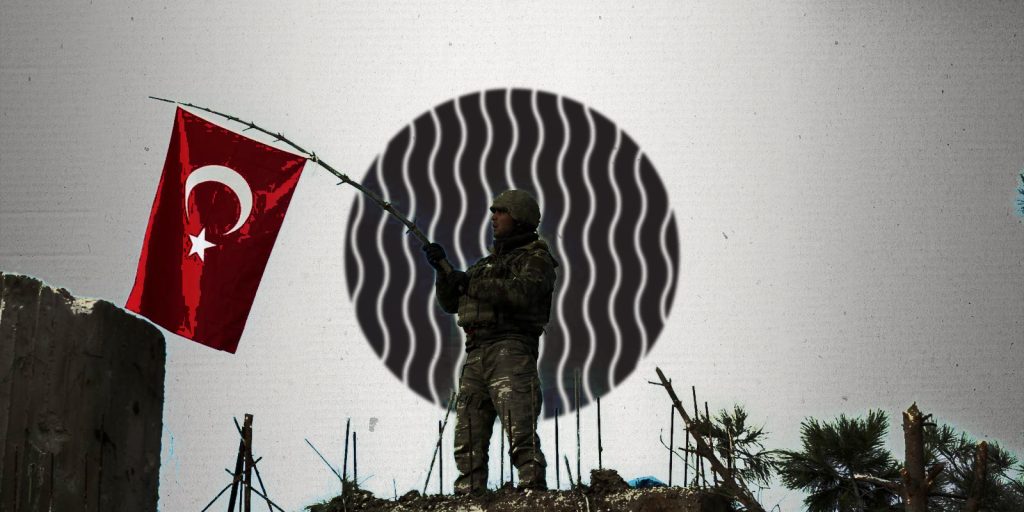
As Syria emerged from the shadow of its former regime, it entered a fragile transitional period against a backdrop of tangled regional politics. Multiple foreign powers, each with its own interests, are involved in shaping Syria’s future. While the new leadership in Damascus works to rebuild the state and its institutions, it also faces major challenges, especially around sovereignty, political balance, and international relations, with Turkey at the centre of that equation.
Turkish Influence in Syria: A Multi-Faceted Presence
From the early days of the Syrian conflict, Turkey has played a major role, not just politically, but militarily and economically. It has backed opposition forces, supported armed factions, and even taken part in local administration projects in northern Syria.
Now, as the transitional phase begins under President Ahmad Al-Shara’, there’s growing debate over just how deep Turkish influence runs. Turkish-backed factions like the “Syrian National Army” operate inside the country, and figures with close political ties to Ankara are increasingly being appointed to official roles.
This puts the new government in a tough spot. On one hand, it needs to assert full national control across Syrian territory. On the other, it must manage a delicate relationship with Turkey, a regional heavyweight involved in key issues like security, economics, and reconstruction.
Read also: Turkey Plans to Establish Military Bases in Syria
Struggles Over Independence in Decision-Making
In an interview with +963, Turkish affairs expert Mohammad Amer noted that Syria’s efforts to regain full sovereignty are still being tested. Turkey, he said, remains a major player, and its involvement often overlaps with U.S. policy in the region.
Trying to sideline Turkey entirely might be unrealistic, Amer argued, because of its deep presence on the ground, both through armed groups and political cooperation.
Instead of direct confrontation, Amer suggests a more strategic approach: manage external influence rather than trying to eliminate it. That means spreading out areas of cooperation in a way that prevents any one foreign actor from dominating Syria’s future. The goal, he said, should be a strong, independent national voice, especially on issues of security and sovereignty.
Political analyst Mustafa Rustum echoed those concerns, saying that some of the armed groups supported by Turkey have played an important role in backing the current transitional government. That creates a real, and potentially lasting, link between the country’s new political leadership and foreign-backed military forces.
Speaking to +963, Rustum warned that Al-Shara’ will need to strike a careful balance between short-term reliance on these forces and building long-term domestic legitimacy through inclusive, independent institutions.
He also raised a red flag: if relations between Damascus and Ankara sour, those same armed groups could be used as tools of political pressure. Bringing them under official state control or integrating them into the national military will be one of the biggest challenges ahead.
Read also: Israel–Turkey Deal in Syria: Deconfliction or Division of Power?
Regional Power Plays
Turkey’s growing role in Syria hasn’t gone unnoticed by other countries, especially some Gulf states. Rustum suggested that Saudi Arabia’s recent warming of ties with Damascus might be a move to balance Turkey’s power in Syria and support a more inclusive political process.
Meanwhile, the U.S. is watching these developments closely, particularly the evolving relationship between Syria and Turkey. Journalist and analyst Jawad Al-Sayegh, based in New York, noted that Turkey sees itself as a key player in Syria’s transformation, given its long-standing support for the opposition and military involvement.
Al-Sayegh added that Turkey is hoping to negotiate long-term strategic agreements with Damascus, like those it made with Libya’s Tripoli government, which sparked concerns over national sovereignty.
For President Al-Shara’, the real challenge is not just managing Turkey, but navigating a landscape filled with multiple foreign loyalties and competing agendas, each trying to shape Syria’s post-war future in its own way.
Sovereignty vs. Cooperation
Despite the complexity of the moment, some analysts believe the Syrian leadership has room to manoeuvre. Mohammad Amer sees the possibility of creating a structured, balanced partnership with Turkey, one that focuses on practical cooperation (especially economically and administratively) while firmly preserving Syria’s independence in key areas like defence and national policy.
He also stressed the importance of building internal legitimacy, by expanding political representation and adopting a message that recognizes foreign partners without being beholden to them.
Tying Syria’s stability to the interests of foreign powers, he argued, might even reduce external pressure. The message: destabilizing Syria serves no one, and a balanced, secure environment benefits all involved.
Interestingly, President Al-Shara’s recent use of the phrase “Marhaba Askar” (“Hello, soldiers”) during a visit to Turkey drew a wave of media attention. Some saw it as a symbolic gesture of closeness between the two governments.
Rustum clarified that the phrase has long been part of Turkish military tradition, dating back to the Atatürk era, and is only used in formal settings as a sign of respect toward the armed forces. While some took it as a political signal, others dismissed it as a standard protocol with no deeper meaning.
Read also: U.S. and Turkey Reaffirm Commitment to Syria’s Stability in High-Level Talks
A Difficult Road Ahead
Syria’s transitional journey is far from over. Major obstacles remain, from restoring full sovereignty, to dealing with foreign-backed armed groups, to rebuilding state institutions and managing complex international relationships.
The success of this phase will likely depend on whether the new leadership can navigate these realities while building a stable, truly independent foundation at home.
As regional and global powers continue to watch Syria’s next moves, Damascus still has an opportunity to strike a balance between cooperation and independence, between openness and control. If handled wisely, it could set the stage for long-term peace and stability.











