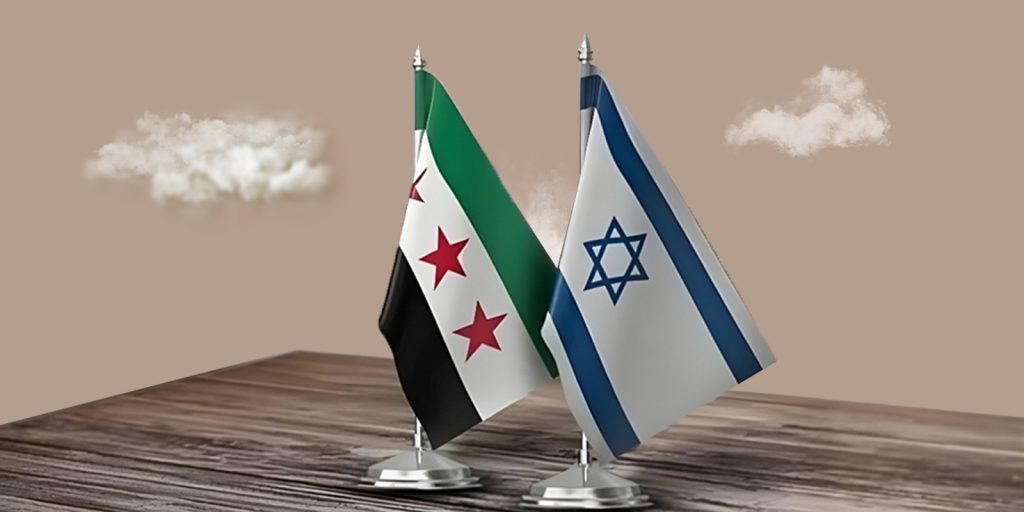
Negotiations between Syria and Israel have returned to the political foreground after weeks of stagnation, as international efforts intensify to contain rising tensions in the Middle East. Security talks, resumed in Paris under United States sponsorship, are unfolding amid mounting American pressure to finalise an agreement between Damascus and Tel Aviv within a sharply defined timeframe. The renewed momentum comes against the backdrop of unresolved disputes along Syria’s southern frontier, most notably Israel’s continued military presence in the Mount Hermon area, which remains a central obstacle to any comprehensive understanding.
According to Middle East Eye, US President Donald Trump has issued Israeli Prime Minister Benjamin Netanyahu with a one-month deadline to conclude a security agreement with Damascus. The deadline, which runs until late February or early March, is widely seen as a deliberate attempt to force progress after repeated negotiation failures. Sources describe the timetable as unusually tight, carrying a clear American message that prolonged delays will no longer be tolerated.
Trump is also reported to have conveyed this timeline directly to Syria’s interim president, Ahmad Al-Sharaa, during a recent telephone call. Expectations are now growing that, should negotiations proceed without major disruption in the coming weeks, an agreement could be announced in the near term. For Washington, the deadline is part of a broader strategy aimed at stabilising Syria’s southern border and using the Syrian file as a gateway to wider regional de-escalation.
Damascus’ conditions and sovereignty concerns
From Damascus’ perspective, any negotiation with Israel must be anchored in the principles of sovereignty and territorial integrity. Syrian officials have repeatedly stressed that talks cannot proceed unless Israel commits to halting interference in Syria’s internal affairs and refrains from exploiting minority issues, particularly in southern Syria and the north-east. These matters, Damascus insists, fall exclusively within the remit of the Syrian state.
Shaher al-Shaher, Professor of International Studies at Sun Yat-sen University in China, tells +963 that Syria’s core demands revolve around explicit security guarantees. These include Israel’s withdrawal from areas entered after 8 December, following the fall of the previous regime, and a return to the pre-existing boundary lines. Damascus also insists on the full reactivation of the 1974 Disengagement of Forces Agreement as the sole legal framework governing military arrangements between the two sides.
Khaled Khalil, an expert on Syrian–Israeli relations, argues in statements to +963 that Damascus entered the talks with clear and realistic positions. In his assessment, Syria’s objective is to end Israeli incursions and restore territorial control, enabling the government to focus on domestic reconstruction without compromising national rights. From this perspective, Israeli security justifications for continued deployment inside Syrian territory lack credibility.
This view is reinforced by Al-Shaher, who notes that Israel has carried out thousands of air strikes over recent years, destroying much of Syria’s heavy military infrastructure. In his assessment, this undermines claims that Syria poses an imminent threat to Israeli national security. Khalil similarly contends that Israel has struggled to recalibrate its strategic posture following the collapse of the Assad regime, relying instead on ideological assumptions that have increasingly been questioned within Israel itself, including by the Institute for National Security Studies in Tel Aviv.
US pressure and a shift in the talks
Observers point to the fifth round of negotiations, known as “Paris 3”, as a significant turning point. Khalil argues that the process shifted from escalation to de-escalation largely due to direct American pressure on Netanyahu, which, he says, compelled Israel to scale back military actions that violated international law and Syrian sovereignty.
While the current phase has brought a relative calm, both analysts caution that de-escalation remains fragile unless translated into concrete confidence-building measures on the ground. Al-Shaher adds that Syria’s interim government is placing considerable weight on the United States as the primary guarantor of any future agreement. In his view, Washington is no longer seeking a symbolic peace accord but a functional and enforceable arrangement that reshapes security dynamics.
Trump’s vision of a new peace model
Al-Shaher believes that Trump intends to present a Syrian–Israeli agreement as a new model for peace in the Middle East, positioning it as a personal political achievement for domestic and international audiences alike. The US administration, he argues, now views Syria’s new leadership as a credible partner, particularly on counterterrorism, limiting Iranian influence, preventing the re-emergence of armed militias, and blocking weapons transfers to Hezbollah.
Within this framework, President Al-Sharaa is increasingly seen in Washington as a preferred interlocutor. Al-Shaher notes that Trump’s enthusiasm for engaging Damascus appears to exceed that of other branches of the US administration, creating political space for rapid diplomatic movement. Developments in north-eastern Syria have further strengthened international confidence in Damascus, a shift reflected in recent statements by Syria’s Interior Ministry confirming accelerated implementation of security arrangements.
From the Israeli standpoint, al-Shaher argues that peace with Syria carries strategic weight. Syria’s historical influence in the Arab world, through its cultural and political reach, makes it a pivotal actor. He recalls the long-standing Israeli maxim that “there is no war without Egypt and no peace without Syria”, suggesting that while Egypt closed the chapter of regional wars at Camp David, Israel now seeks to complete the peace architecture through Damascus.
Economic considerations also play a role, particularly from Washington’s perspective. The US approach increasingly emphasises a Middle East free of armed factions, oriented towards stability and investment rather than perpetual conflict.
Regional calculations and the post-south arrangements
A key question, Al-Shaher notes, is whether Syria would sign a peace agreement with Israel outside a broader Arab framework, particularly without Saudi Arabia. Israel, he argues, views both Syria and Saudi Arabia as essential pillars of any regional settlement, given Riyadh’s political and economic weight. Damascus, for its part, appears keen to situate any peace process within a collective Arab context rather than pursuing a standalone agreement.
Al-Shaher also stresses that Washington is determined to prevent southern Syria from becoming a theatre of rivalry between Israel and Turkey. In this reading, an Israeli withdrawal from the south could eventually trigger parallel pressure on Turkish forces to leave northern Syria, on the grounds that security justifications would no longer apply.
Khalil highlights the 6 January Paris meeting as a moment of tangible progress, claiming that around 90 per cent of disputed issues were resolved. The talks reportedly moved from confrontation to de-escalation and included discussions on establishing a trilateral coordination room in Jordan involving the United States, Israel and Syria. This mechanism would oversee security, military and intelligence coordination, alongside economic dimensions. Proposals under discussion include replacing buffer zones with joint commercial, industrial and tourism areas along the border.
Khalil concludes that Damascus now holds strong legal and political cards, particularly given ongoing Israeli actions that contravene international law. In his assessment, Syria’s post-transition status has positioned it as a cornerstone of regional stability, a view increasingly echoed by Washington. He describes current Israeli strikes as temporary and politically motivated, aimed at improving negotiating leverage, a dynamic that ultimately prompted Trump to issue what he terms a “red card” to Netanyahu – culminating in the latest Paris understandings.