

Assad’s rapid fall on December 8, 2024 constituted a political shock among Syrians, especially in the Syrian coast, where the scene appeared unclear regarding their fate after Assad and his regime fled to Moscow, leaving them to face multiple possible outcomes with Hay’at Tahrir al-Sham (HTS). Some among them believe the group holds anti-Alawite convictions and considers Alawites a main driver of the former regime. However, the group’s shift toward political engagement partially distanced it from these scenarios, through its transition to assuming the reins of administration in the country.
After a year since the fall of the regime, the Syrian coast has turned into a point of international attraction among active parties. Over the past year, it witnessed a series of political events, military clashes, and repeated attempts to undermine authority in Damascus, supported by regional actors that were unable to absorb the new transformation in the region. In addition, there are many internal actors who perceived an internal vacuum that fragmented the coastal population in their word and stance. This vacuum was exploited by businessmen in an attempt to establish entities and religious leaderships in the region. However, this did not unfold as planned due to the severe fear and poverty among Alawites, especially after the events of March 6, 2025, when elements from the remnants of the ousted regime launched a wide scale attack on government sites in Tartous and Latakia. Days after the attack, the government announced the restoration of security control in the targeted areas and opened an investigation into the killing of hundreds of civilians and military personnel to identify those responsible and put them on trial.
Social reality
After a year since the fall of the regime, the Syrian coast has transformed into an exhausted society accused of all its actions. Government administrative institutions were not highly professional in their dealings with the people of the coast, as a large segment was subjected to exclusion, marginalization, and dismissal from their jobs. In addition, their authorities were stripped from all state institutions on a sectarian rather than administrative basis, although this varied from one institution to another. Accordingly, the dismissal of employees from government institutions formed the first nucleus of social tension.
These situations evolved into sectarian targeting committed by a number of extremists against residents, in a clear exploitation of the major security vacuum and the new governmental condition, in addition to the violation of homes in villages and the theft of property. Security forces intervened, albeit belatedly, to stop such phenomena.
Moreover, unemployment rates rose sharply among young people, most of whom had taken the army as their profession, making them vulnerable to external recruitment due to economic conditions, whether by joining the remnants of the former regime or enlisting in fighting military forces in northeastern Euphrates or in Suwayda governorate.
Alawite leadership
The Syrian government began to recognize the social dangers of sectarian tension and accordingly established the Civil Peace Committee to convey the demands of the coast to the authorities, especially after the March events. The committee is primarily overseen by one of the prominent figures close to President al-Sharaa, Khaled al-Ahmad, along with Fadi Saqr, the most prominent name in the leadership of the National Defense Forces during the former regime. Externally, businessman Rami Makhlouf and his military arm Suheil al-Hassan emerged, while a separate bloc appeared under the name The Supreme Alawite Islamic Council in Syria and the Diaspora, led by Sheikh Ghazal Ghazal. This unfolded amid desperate attempts by the former head of military intelligence in the regime, Kamal Hassan, together with businessman Abu Ali Khadr, to form an additional bloc. All of these are rival currents seeking to control the street after the social and political vacuum created by the fall of the regime, as there was no single figure in the coast capable of unifying their word, given that Assad had previously been their supreme reference.
These leaderships generated popular aversion toward many figures whose names were associated with the crimes of the regime. Journalistic leaks also revealed their communications with Israel and their willingness to implement any plan in exchange for leadership. In addition, the street did not observe any tangible change toward achieving its social demands. Consequently, Sheikh Ghazal Ghazal appeared to hold the relatively greatest weight in directing and mobilizing the street toward federal demands, which were met with division in the Syrian coast.
Governmental track
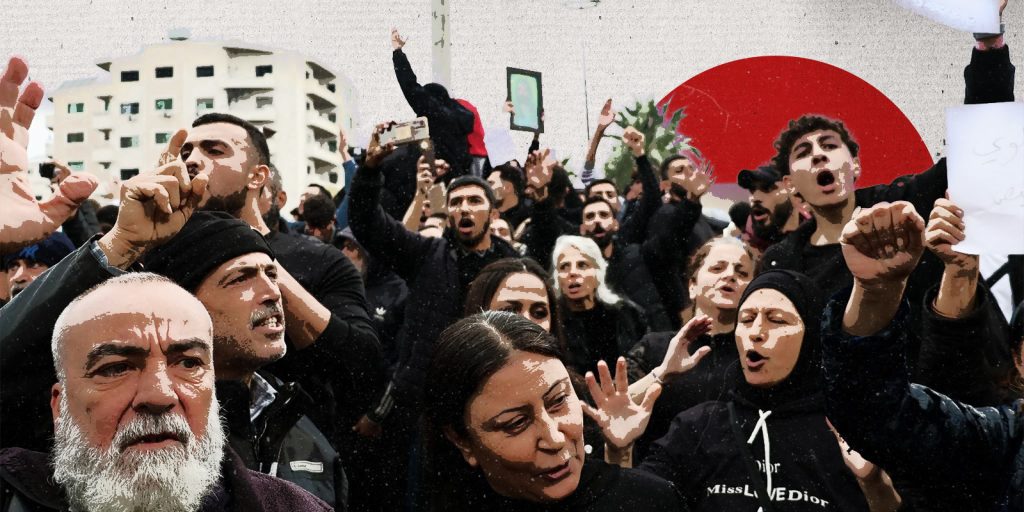
Recent protests reveal a flaw in governmental handling. Accordingly, one of two possibilities is suggested. The first is the inability of the government affiliated Civil Peace Committee to engage with social reality. The second relates to the government not giving the committee any real consideration. In both cases, the matter is dangerous at the internal level, as containing the coastal governorates in Syria constitutes a key point for regional stability and the reduction of tension hotspots. This requires immediate measures related to reinstating a large number of employees to their posts and restoring balance in government institutions based on competence rather than sect, affiliation, or loyalty.
It also appears that President al-Sharaa has begun working to contain the problems in the coast through his meeting with its dignitaries and notables on December 14, during which he listened to their security, political, and social demands and reassured them with a package of relevant decisions. Political sources close to the government indicate that the Syrian government has begun discussing serious and concrete steps to contain the crisis. However, until now this has not translated into real steps on the ground, at a time when calls by The Supreme Alawite Islamic Council in Syria and the Diaspora are escalating to intensify popular pressure in the Syrian coast.
The views expressed in this article do not necessarily reflect those of +963.











