


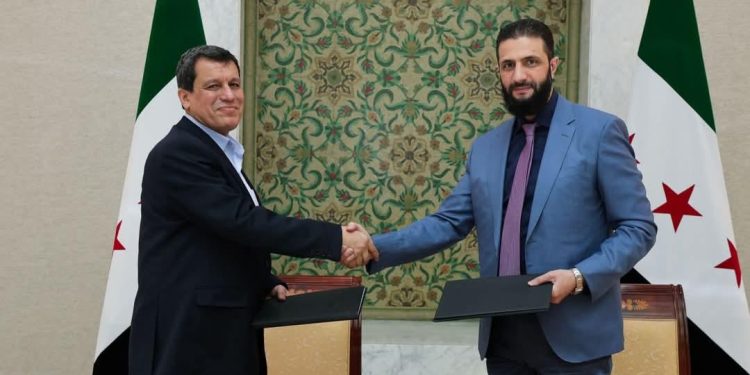
DAMASCUS – A Syrian government source told +963 on Tuesday that the Syrian Democratic Forces – a US-backed alliance that controls large parts of north-east Syria – and the country’s interim government have reached an agreement on the process of integration.
According to the source, the mechanism governing how the SDF will be integrated into state structures will be announced within the next few days. No further details were disclosed.
The announcement comes as Syria enters a fragile transitional phase following the collapse of the former Baathist government, with negotiations under way over security arrangements, governance, and territorial control.
Days earlier, SDF commander-in-chief General Mazloum Abdi described the 10 March agreement signed with the transitional authorities as the foundation for what he called a “new Syria”.
Speaking during an event marking the tenth anniversary of the Syrian Democratic Council in the city of Hasakah, northeastern Syria, Abdi said the agreement’s provisions were “historic” and had received international and regional support.
Read also: UNHCR to Oversee Humanitarian Affairs at Northeast Syria’s Al-Hol Camp
According to Hawar News Agency, which is close to the Autonomous Administration of North and East Syria, Abdi said the SDF and the autonomous administration remain fully committed to the agreement, viewing it as essential to building a post-war Syrian state.
Abdi acknowledged ongoing challenges, including security instability, the risk of renewed conflict, and political actors seeking to obstruct the agreement’s implementation. He said the SDF remains determined to proceed in cooperation with the international coalition and local communities.
He added that the agreement was never tied to a fixed deadline, stressing that gradual progress in negotiations is more important than speed.
Abdi said neighbouring countries are now more receptive to the agreement than in the past, calling it a significant regional shift. He expressed hope that Syrians would receive positive news before the start of the new year, particularly regarding military arrangements, while noting that broader political and administrative issues would require more time.
On governance, Abdi said the future of Raqqa, Deir ez-Zor, and Hasakah should be determined by their local populations, arguing that residents have earned the right to manage their own affairs after years of conflict.
He said the integration process is expected to reshape the political landscape in north-east Syria, presenting an opportunity to strengthen political representation and address longstanding shortcomings.
Abdi concluded by saying that the March agreement includes provisions for constitutional amendments that would guarantee the rights of Kurds and all other Syrian communities within a future constitutional framework.











