

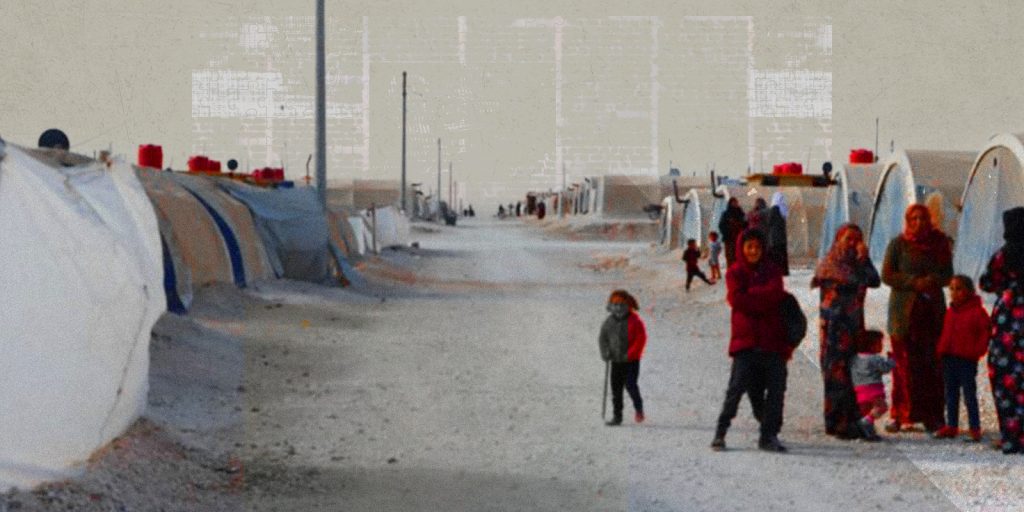
On the outskirts of Al-Talae Camp, Amira Ahmad sits inside her worn tent, holding her two children as she watches the overcast sky like someone observing a fate over which she has no control. Speaking in a voice stretched thin between exhaustion and hope, she tells +963: “We have come to know the rain through the tent… where it enters and where it leaves. Still, we wait for the organizations. Maybe one day something will change in our lives.”
This single sentence captures the space in which tens of thousands of displaced people live, caught between efforts that are made, evident shortcomings, and assistance that diminishes year after year, until fear becomes a daily companion and waiting turns into a harsh ritual resembling collective helplessness.
Organizations between idealized theories and an exhausting reality
Since the major waves of displacement in 2015, civil society organizations have been a core part of the humanitarian landscape in northeastern Syria. They provided relief, managed camps, supplied water, and supported education, health, and protection programs.
Daoud Daoud, Executive Director of Salam for Hope Foundation, tells +963: “We began our response during the days of the ISIS attack on Hasakah. We provided food and water, raised awareness about war remnants, and with the return of some families, we established safe spaces for psychological support. We then expanded to include shelter, food, health, education, and psychological and legal support services.”
He adds: “We also worked to restore stability for returnees from Al-Hol Camp through social cohesion programs, children’s education, rehabilitation of water and electricity networks, and support for economic facilities.”
But this picture is incomplete without mentioning the other side. “The suspension of 75 percent of US funding destroyed most of our programs. The gap widened after the displacement waves caused by military operations in Ras al Ain, Tal Abyad, and Afrin. We are now trying to compensate for the shortfall through European funding.”
Declining funding when the world slows down and hunger accelerates
On January 20 of last year, US President Donald Trump issued an executive order to shut down the United States Agency for International Development USAID and suspend its domestic and foreign activities for 90 days, under the pretext of reviewing efficiency.
This decision alone was enough to leave thousands of humanitarian projects in limbo and to deepen the fragility of millions of displaced people in Syria, who have come to rely on aid that evaporates day after day.
Stories from the camps promises are long and winter is shorter than the tent
Inside the camps, stories are many, but they converge on one point. What arrives is far less than what people need. Speaking about the absence of organizations, Sara Nabo from Ras al-Ayn residing in Al-Talae Camp, tells +963: “For four months, we have not seen a single organization enter our area. They visit the administration and leave. We young women are the most affected. We need education, psychological support, and a chance to become normal human beings again.”
On the lack of distributions and weak sustainability, Berevan Sido, displaced from Afrin and living in Al-Hurriya Camp in Tabqa, tells +963: “They helped us when we first arrived. Tents, mattresses, some food. But then what? The camp became forgotten. They come, look at people, and that’s it. Winter is at the door and the tent does not block a single drop of water.” She adds: “We want to live, not just receive a box every two months or more.”
Amira, a mother of three children, summarizes the anxiety with painful simplicity: “For a year we have been hearing that educational classes will open. My children are without school. How are we supposed to restore our lives?”
Displaced man Mohammad Hajo says: “Organizations focus on entertainment. Where is education?”
International and local organizations from wide presence to alarming decline
Years ago, the humanitarian scene in northeastern Syria was entirely different. This is clearly explained by the testimony of Naji Habo, Head of Organizations Affairs, who told Rojava TV: “We used to have 84 international organizations and 303 local ones. Now the number has dropped significantly, and some organizations have stopped completely.”
This statement alone reveals the scale of the transformation, from a field crowded with humanitarian actors to empty spaces filled only with need, and from sustained activity inside camps to a symbolic presence unable to fill the void of reality.
The decline was not merely an administrative shortage, but a direct blow to thousands of families who depended on these organizations for the simplest details of life, from water to medical care, and from education to psychological support.
Organizations what was delivered and what was missing
What was actually achieved were emergency responses during waves of displacement. Distribution of thousands of food baskets. Operation of mobile health clinics. Psychological support for women and children. Projects to improve sanitation and build temporary schools.
The gaps, however, were clear. Weak infrastructure inside camps. Absence of sustainable plans to improve daily life. Lack of programs for the elderly and people with special needs. Declining media coverage of displacement issues. Lack of transparency in some distribution mechanisms.
Organizations must work with the community not on its behalf
Local activist Rostom Issa says: “Project owners and organizations must involve displaced people in development activities. The displaced person must participate so they do not adapt to displacement and accept it as a permanent fate. This is the best solution. The role of the organization is supervision and guidance, not working on behalf of the people.”
On the legal dimension as a matter of monitoring rather than enforcement, legal expert Barzan Azm tells +963: “There is no law that obliges organizations to carry out specific activities. The local administration has the right to monitor, not to compel, and this leaves a gap in accountability.”
Mohieddin Issa, Executive Director of the Dar Association for Victims of Forced Displacement, tells +963: “Civil organizations are the first line of defense for the rights of the displaced, but they are not enough on their own. The international community does not exert the required pressure to ensure safe and dignified return, which prolongs suffering.”
Between need and hope, the displaced live in a very narrow space, a space inhabited only by waiting. The displaced person who has lost home and safety does not want a tent alone, but wants to feel that someone still sees them, hears them, and takes them into account.
International reports draw an even clearer picture of the scale of the humanitarian gap. According to the United Nations Office for the Coordination of Humanitarian Affairs OCHA for 2025, nearly 6.7 million Syrians among the most vulnerable groups depend on direct assistance to survive, while organizations need more than 1.2 billion dollars annually to secure basic needs, at a time when available funding covers only a limited portion of this amount.
Data from the Population Task Force for 2024 and 2025 indicate that around 2.3 million displaced people live in 1,774 displacement sites inside Syria, including formal and informal camps, most of which suffer from severe shortages in water, sanitation, and basic services.
Other UN reports, including those by the UN Refugee Agency and the United Nations Development Programme, confirm that more than 16 million people inside Syria are still in need of some form of humanitarian support. Meanwhile, the water and sanitation sector in the north of the country received only 2 percent of the required funding during the first quarter of 2024, leading to the spread of water borne diseases and higher infection rates among children and women. Specialized studies prepared by human rights and humanitarian organizations in 2024 clearly show that the decline in international funding from 2020 to 2024 was accompanied by a decrease in the number of active organizations and the absence of long term projects, especially in education, women’s support, mental health programs, and care for the elderly and people with disabilities, services that displaced people say are the most absent from their daily lives.











