


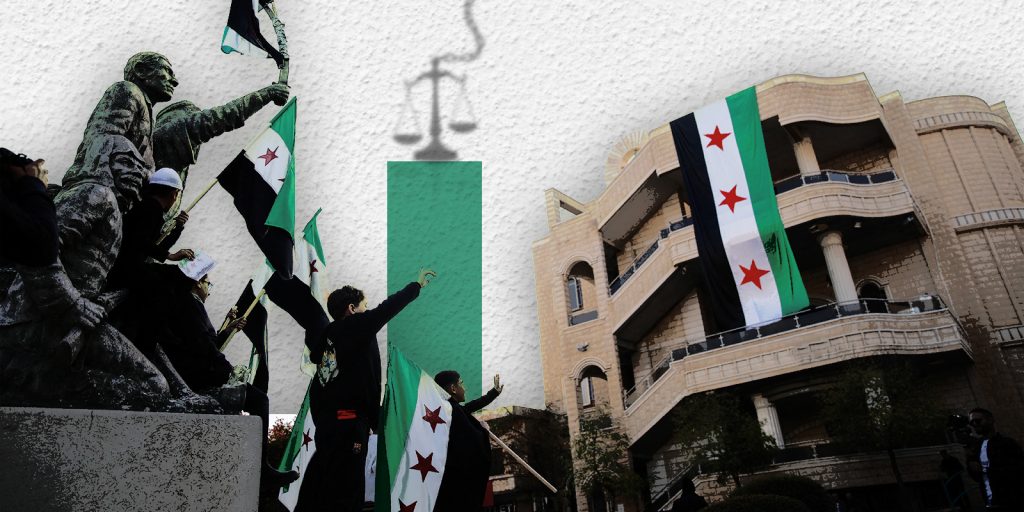
The repeated events witnessed in Syria since the fall of Bashar al Assad’s regime more than a year ago, and the accompanying violence and incitement rhetoric, underscore the urgent need to complete the transitional justice file in order to do justice to war victims and spare the country further conflicts and crises. Many crisis related files are tied to this issue, beginning with national reconciliation and the formation of the judicial apparatus and assessing its eligibility to serve as a reference and arbiter in the country’s complex cases, and extending to citizenship, the achievement of civil peace, and social cohesion amid the evident rift the country is experiencing and the successive developments and acts of violence that have deepened it across Syrian geography.
Formation of the Transitional Justice Authority
On 17 May, Syrian Interim President Ahmad al-Sharaa issued a legislative decree establishing the National Transitional Justice Authority to take over this file at the national level. Under the decree, the Authority was granted legal personality, financial and administrative independence, and the right to carry out its tasks across all Syrian territories, according to what was reported at the time by the official Syrian Arab News Agency Sana.
Authority member Radif Mustafa revealed last week to Al Watan newspaper, which is close to the interim government, that a decision had been taken to publish the draft transitional justice law on the Authority’s page and the pages of organizations and civil society, and to send it to the largest possible number of victims’ families to allow as many Syrians as possible to review it and submit proposals, with the aim of achieving broad public participation. He noted that the draft included penalties for grave violations, major economic crimes, and other crimes covered by the bill, as well as the establishment of transitional justice courts. He expected the discussion window to remain open for two weeks, after which feedback would be taken into account and gaps addressed.
Delay in completion
However, a year after the fall of the Assad regime, and amid continued emphasis by international and local human rights organizations, human rights experts, civil society organizations, and specialists on the need to accelerate the completion of the transitional justice file as a gateway to resolving many other issues, the delay has become a subject of debate and contention. This is accompanied by demands that officials in the interim government adopt a clear plan within a specific timeline to address what is considered the most urgent issue.
Pillars of transitional justice
Fadel Abdul Ghani, Director of the Syrian Network for Human Rights, affirms that Syria has witnessed initial steps toward a transitional justice path, but that it remains surrounded by deep structural and political challenges that hinder the achievement of comprehensive and fair justice for all victims. He notes that despite the end of the Assad era and access to much evidence and many sites, the legal and institutional structure of justice still suffers from deficiencies. In statements to +963, he says that the Syrian Network for Human Rights proposes a more comprehensive vision of transitional justice based on four interrelated pillars. These include criminal accountability that prioritizes holding senior leadership involved in violations to account, based on extensive databases that include thousands of documented perpetrators, and truth and reconciliation through the establishment of specialized committees to document violations and draw a complete picture of what occurred, with particular attention to the file of forcibly disappeared persons, whose numbers reach tens of thousands.
He adds that another pillar of justice is reparation, compensation, and remembrance, through comprehensive programs of material and moral compensation, ensuring official recognition of victims’ suffering, and preserving collective memory. The fourth pillar is radical institutional reform of the judiciary, security services, and the military, in a manner that ensures non recurrence of patterns of abuse and lays the foundations for a true state of law. He stresses that achieving real justice in Syria requires expanding the scope of transitional justice to include all violations, regardless of the party responsible, along with a collective commitment from transitional authorities, the international community, and human rights organizations. This must be accompanied by transparent and independent investigations into crimes covered by international law and the provision of full and effective forms of reparation for victims, including compensation, restitution of rights, rehabilitation, and guarantees of non recurrence.
Lawyer and politician Bassam al-Eisami, based in Austria, believes that the Transitional Justice Authority must meet the conditions and requirements for success, be neutral, possess comprehensive powers, and be insulated from interference by the executive authority. It should include representatives of victims and their families, civil society, and legal experts, which he considers absent in the current Authority. He argues that tampering with justice and victims’ rights and belittling their pain are time bombs that deepen societal rifts and divisions and keep wounds open.
The need for local committees
In statements to +963, he stresses that proper procedure would have required the current authorities, from the moment of the regime’s fall, to begin in a serious and effective manner to form local committees under their supervision in all neighborhoods, regions, and population centers across Syria, under judicial oversight. These committees would work to document violations, missing persons, and martyrs, listen to victims’ families, collect evidence according to international standards, and protect mass graves from tampering, which did not happen. He also affirms that the transitional justice path required the transitional government to accede to the Rome Statute and the International Criminal Court to prosecute perpetrators of major crimes through this court if the countries that received them refused to prosecute or extradite them.
In early December, the head of the Transitional Justice Authority, Abdul Basit Abdul Latif, revealed that the transitional justice law had reached its final stages and would be presented to the People’s Council once it is formed. He explained that the Authority had completed the formation of its six committees, namely the Truth Committee, the Accountability and Responsibility Committee, the Reparation Committee, the National Memory Committee, the Reform Committee, and the Peacebuilding and Civil Peace Committee. Meanwhile, Syria’s Public Prosecutor Hassan Al Turba stated that the Ministry of Justice in the Syrian transitional government would cooperate with the Transitional Justice Authority in the next phase, noting that the Ministry had allowed Authority teams to visit prisons and review detainees’ files, according to Sana.
What are the foundations of transitional justice
Abdul Ghani points out that transitional justice is an integrated package of mechanisms and processes that societies resort to in order to confront the legacy of widespread past violations, with the aim of ensuring accountability, serving justice, and achieving reconciliation. In this context, United Nations standards emphasize three decisive foundations. These are comprehensiveness and impartiality in addressing all violations regardless of the identity or affiliations of perpetrators, the centrality of victims in designing and implementing transitional justice mechanisms through genuine national consultations that go beyond symbolic participation, and strict adherence to international law, which prohibits accepting any settlements or peace agreements that include amnesty for the most serious crimes such as genocide, war crimes, and crimes against humanity. From this perspective, any selective approach limited to a single actor, as is the case in the current Syrian approach that focuses exclusively on the former regime, contradicts these standards.
He explains that the first pillar is criminal accountability, which must be non discriminatory and include all those responsible for grave violations, with priority given to pursuing senior leaders who formulated and directed criminal policies. The second pillar is truth seeking and reconciliation, through truth commissions that investigate patterns of systematic violence, their causes, and their deep structures, with attention to gender analysis and a focus on violations against children, drawing inspiration from experiences such as South Africa, which combined public acknowledgment of truth with the possibility of judicial prosecution for those who refuse or evade acknowledgment.
The third pillar includes reparation and compensation, where the text emphasizes that reparation programs are not limited to financial compensation, but must be designed through direct consultation with victims and affected communities. They should include material and moral compensation, medical and psychological services, restitution of property, official apologies, and symbolic measures such as memorials and the revival of victims’ collective memory. The fourth pillar is institutional reform, which aims to transform public institutions, foremost among them security, judicial, and military bodies, from tools of repression into institutions that protect human rights and enhance the rule of law. This is achieved through transparent and fair vetting procedures, excluding units and individuals involved in systematic violations, and dismantling the institutional structures most implicated in crime, according to the Director of the Syrian Network for Human Rights.
For the success of the transitional justice path, al-Eisami points to the necessity of establishing hybrid courts composed of local and international judges to deal with major crimes committed against the Syrian people over fourteen years, such as genocide, ethnic cleansing, and demographic change. These are crimes whose jurisdiction extends internationally, and it is unlikely that the local judiciary will be able to handle them. He considers that rehabilitating some former criminals and figures of Bashar al Assad’s regime, such as Fadi Saqr, Wael Al Halqi, Mohammad Hamsho, and others, constitutes an affront to Syrians’ pain and a departure from justice. He stresses that justice requires a constitutional declaration that is currently not in force, new texts, and a comprehensive set of laws.
In late November, Amnesty International Secretary General Agnes Callamard confirmed that she had held discussions with members of the National Transitional Justice Committee and the National Committee for the Missing in Syria regarding the process of collecting evidence from Bashar al Assad regime prisons. She noted that the process would be long and slow, and emphasized that the legal framework requires urgent reform, as some of the most heinous crimes under international law have not yet been criminalized.
Abdul Ghani believes that a hybrid approach can be adopted that goes beyond the traditional dichotomy between punitive justice and restorative justice. Comparative experience shows that combining the two is most effective in achieving sustainable peace. Punitive justice ensures individual accountability and deterrence through punishment, while restorative justice focuses on rebuilding social relations, community participation, and repairing the damaged social fabric. The two approaches are not seen as conflicting alternatives but as complementary. Punitive mechanisms can contribute to restorative goals if designed in a participatory manner that takes victims into account, and national and international courts can integrate principles of restorative and transitional justice by expanding the role of victims in proceedings, improving reparation programs, and coordinating with local mechanisms.











