


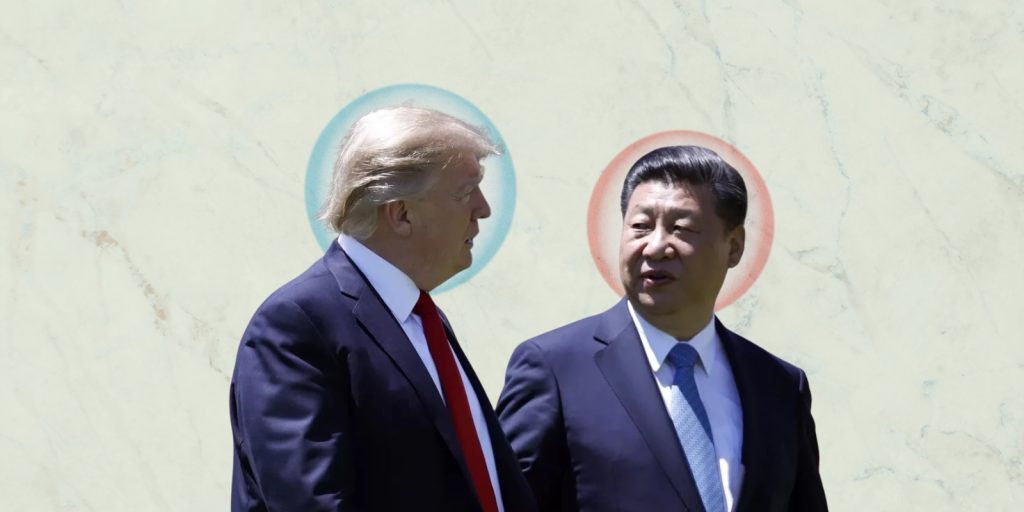
The rivalry between the United States and the People’s Republic of China has intensified in recent years, turning into a multi-dimensional strategic contest that is reshaping the global order. The confrontation is no longer confined to economic or trade matters, but now extends to technology, energy, security alliances and geopolitical influence.
While Washington describes the relationship as “a fierce but responsible competition,” Beijing insists it “rejects confrontation and seeks cooperation based on mutual respect and shared interests.” Official statements from both sides reflect a delicate balance between cooperation and deterrence.
In response to remarks made by US President Donald Trump, China’s Foreign Ministry reaffirmed its firm opposition to any form of coercion or political pressure, stressing that energy cooperation between China and Russia complies with international law and does not harm any third party.
Foreign Ministry spokesperson Liu Pengyu said China strongly rejects unilateral and illegal sanctions, the expansion of extraterritorial jurisdiction, and any attempts at coercion or pressure. He emphasised that economic relations between Beijing and Moscow do not harm the interests of others and must be respected and protected.
These remarks came after President Trump claimed that Indian Prime Minister Narendra Modi had informed him that India would stop purchasing Russian oil and urged China to do the same.
In a statement to the Russian news agency Novosti, the Chinese Embassy affirmed Beijing’s readiness to enter a trade war with Washington, if necessary, though it remains open to dialogue. It stressed that the United States cannot demand a resolution to the trade dispute while continuing to threaten tariffs – a position that underscores China’s insistence on defending its national interests while avoiding direct confrontation.
This evolving reality affects not only bilateral relations between Washington and Beijing, but also the global economy, supply chains, and political and military alliances across Asia, the Middle East, and Europe. Experts and officials agree that this competition is not a new Cold War in the traditional sense, but rather a complex race for influence and dominance in an increasingly multipolar world.
Read also: Washington Eases Toward Damascus, but Partnership Is on Hold
Economic and Strategic Dimensions
Dr Bassam al-Zu’bi, a Jordanian writer and economic analyst, told +963 that the rivalry between the United States and China is primarily economic in nature, though it sometimes involves political friction. “China,” he said, “is generally not interested in political disputes, especially with the United States.”
He explained that China’s focus remains firmly on economic development – expanding industries, strengthening global partnerships, and boosting demand for Chinese products to ensure continued growth.
According to al-Zu’bi, the United States sees China’s rise as both an economic and political challenge, yet it cannot fully confront Beijing economically, as many major American corporations have substantial investments and dependencies in China, particularly in advanced industries.
He added that China is building broad and diverse international partnerships, forming strategic economic alliances with India, Russia and Saudi Arabia, and expanding cooperation with Europe in areas such as automotive manufacturing and solar energy. This diversification, he said, enables China to strengthen its global economic ties and sustain long-term growth.
Al-Zu’bi ruled out the possibility of a military conflict between the two powers, saying such a scenario is unlikely given their shared interests. “Neither the United States nor China would risk open war,” he noted.
He also pointed out that the economic relationship between the two countries has global repercussions. “China is a key hub in the global supply chain,” he said. “Any tension may affect shipping and insurance costs, but these issues remain manageable because shared interests govern the relationship.”
The Middle East in the Balance
Al-Zu’bi noted that relations between Washington and Beijing tend to remain cautiously balanced, as both have too much to lose. “China always prioritises its economic interests,” he said, “while the United States often leans towards political provocation. Still, their relations remain largely stable – what we see publicly doesn’t always reflect what happens behind closed doors.”
He explained that economic considerations usually outweigh political ones, particularly in the US–China relationship. For Middle Eastern states, the priority is to strike a balance between political and economic interests, despite occasional American pressure.
Powerful regional players such as Saudi Arabia, China and Pakistan have strengthened their partnerships with Beijing through political and economic cooperation based on mutual benefit – sending a clear message to Washington that modern international relations are built on shared interests, not traditional alliances.
Al-Zu’bi concluded that Saudi Arabia aims to maintain balanced relations with all major powers through a Saudi–Chinese–Russian–Indian alignment, which poses a challenge to the United States. “Washington may view this as a shift in its traditional alliances,” he said, “but changing global dynamics and the logic of shared interests mean the US must adapt to a new multipolar reality.”
Read also: Syria… Between Economic Reform and Political Constraint
Strategic Competition
Brigadier General Mounir Shahada, former Lebanese government coordinator with UNIFIL, told +963 that US–China relations have undergone a major transformation over the past decade. “They have moved from engagement and cooperation to comprehensive strategic competition,” he said.
He explained that this competition spans multiple domains – economic, technological, military and geopolitical – making it distinct from the old Cold War, which was defined by ideological divisions and economic separation between the two powers.
According to Shahada, the current rivalry involves battles over global economic leadership, supply chains and trade networks, as well as a race for technological supremacy in artificial intelligence, semiconductors and telecommunications. Military and security tensions are also rising in the Pacific and Indian Oceans, driven by China’s naval expansion and ongoing arms competition.
He noted that each power relies on different tools. The United States leverages alliances such as AUKUS and the Quad, imposes sanctions on Chinese firms, and uses global institutions like the IMF and World Bank to sustain the Western-led order. It also projects soft power through media, education and democratic diplomacy.
China, on the other hand, focuses on the Belt and Road Initiative to strengthen its economic reach across Asia, Africa and Europe, invests heavily in advanced technology, and uses financial and infrastructure projects to build influence in developing countries. It also cooperates with Russia, Iran and other Global South nations to counterbalance US power.
Managed Competition
Shahada said that while the risk of open war remains low, flashpoints such as Taiwan and the South China Sea could trigger dangerous escalations. “Both sides understand that a direct conflict would be economically and globally devastating,” he said, “so they prefer managing competition over open confrontation.”
He added that the current trajectory points to “managed competition” rather than all-out conflict, as both sides recognise their mutual dependence in global trade, climate action and market stability.
However, deep strategic mistrust persists. Shahada argued that the United States, along with NATO allies, continues to pursue confrontational policies in the Middle East and Eastern Europe, increasing the risk of regional or even global conflict.
He said China feels increasingly encircled by US military presence, noting that Washington now operates 18 naval bases around Chinese waters. “The long-term outlook,” he said, “is for a prolonged contest for influence – with intermittent tactical calm but no full reconciliation.”
Shahada concluded that US–China rivalry is reshaping the world by dividing global trade into competing blocs and shifting influence toward emerging Asian powers such as India, Vietnam and Indonesia. Developing nations, he said, are trying to benefit from both sides without taking sides.
“The Middle East,” he added, “has become a testing ground for this delicate balance. The US remains the region’s main security power, while China expands economically through energy and infrastructure investments. Countries like Saudi Arabia, the UAE and Egypt are pursuing balanced strategies – seeking economic gains from China without losing US protection.”
In closing, Shahada said: “This is not a new Cold War but a multidimensional contest between a dominant power defending its position and a rising power seeking a system that reflects its weight. The future will depend on whether both can manage competition without sliding into military conflict – and on how the world adapts to a more multipolar order.”











