


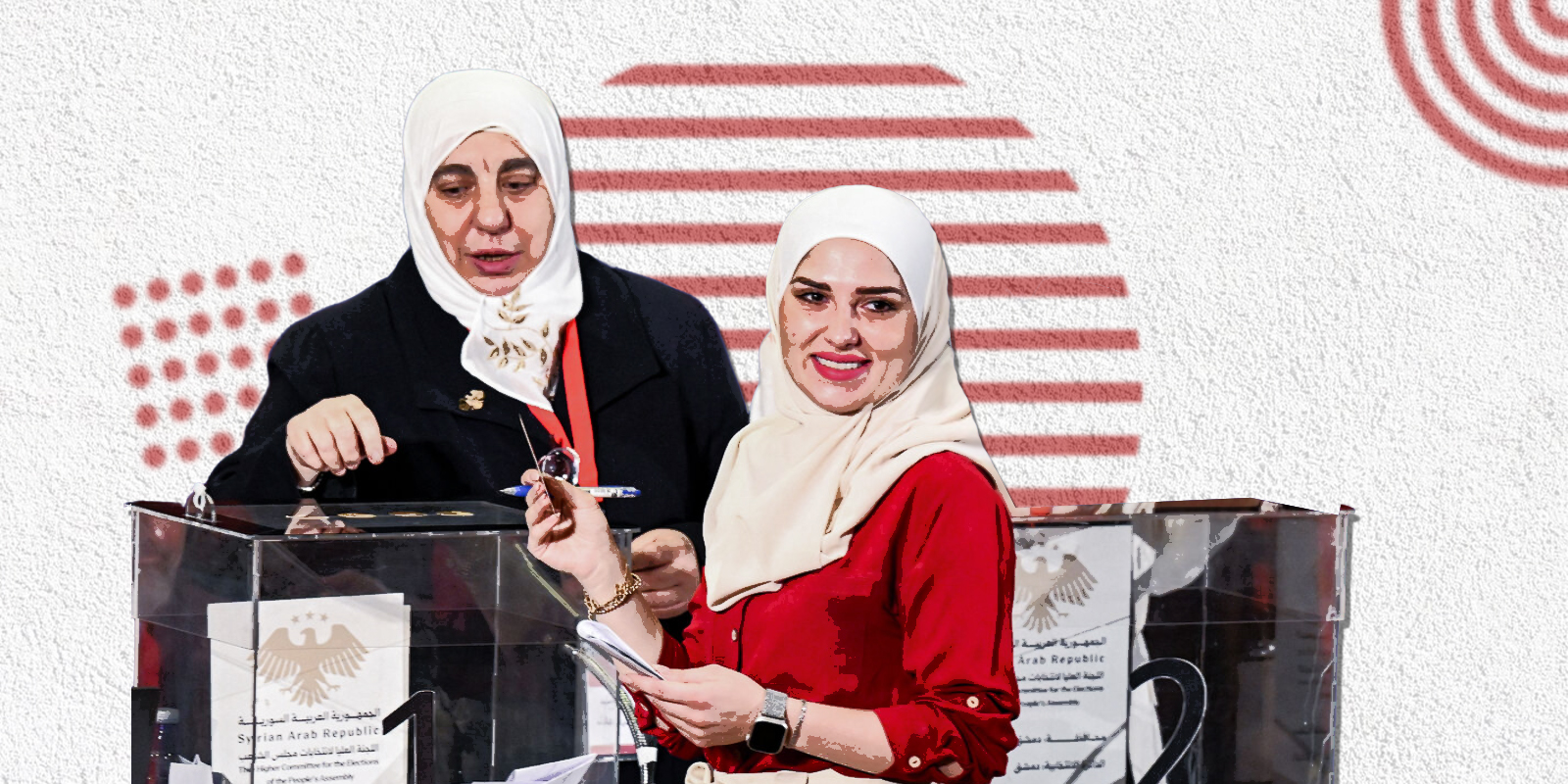
For decades, under the rule of the Ba’ath Party and the Assad family, Syria’s political life was tightly controlled by an authoritarian security system. Women were often present in parliament and ministries, but their roles were largely symbolic. Real power remained out of reach, confined to a small circle of male decision-makers.
Today, following the collapse of Bashar al-Assad’s regime and the formation of an interim government, the focus has shifted towards rebuilding the state and reconsidering the position of marginalised groups, especially women. The key question now is whether transitional president Ahmad al-Sharaa will turn his political promises into genuine reforms, or if women’s empowerment will remain a matter of rhetoric rather than reality.
Representation by Numbers
During Assad’s rule, women made up between 10 and 13 per cent of parliament. Governments typically included only two or three female ministers out of about 25 to 30, usually in social or cultural portfolios with limited authority.
In the interim government, representation remains modest. Of the 23 ministers appointed, just one – Hind Kabawat, Minister of Social Affairs and Labour – is a woman, giving female ministers a share of only around four per cent.
The new parliament, elected indirectly in October 2025, shows similar numbers. Only six women were elected out of 119 members – roughly five per cent – far below the 20 per cent quota mentioned in the legal framework for the elections.
Under the constitution, President al-Sharaa has the power to appoint a third of the parliament (70 of 210 members). Observers say this gives him an opportunity to raise the level of women’s representation. However, so far, there is little evidence of a serious effort to meet the promised 20 per cent threshold.
Read also: Syrian Women Redefine Identity Through Non-Belonging
Two Realities: Damascus and North-East Syria
Political analyst and international relations expert Dr Iyass Al-Khatib, based in Damascus, says there are “two opposing models” of women’s participation in Syria today.
He argues that the interim government maintains an “exclusionary mindset” influenced by conservative religious trends, which limits women’s access to political life. According to al-Khatib, women’s participation so far is largely cosmetic – intended to reassure the international community that progress is being made.
In contrast, he points to the Autonomous Administration in North-East Syria as a model of strong female engagement. Women there have taken leading political, military and social roles. Figures such as Ilham Ahmed and Fawza Youssef have represented the administration in talks with the government, while the policy of co-leadership — pairing a man and a woman in each senior post – has become a hallmark of governance in the region.
Researcher Lama al-Atassi takes a different view. She believes the interim government’s approach is more pragmatic than ideological. Rather than imposing strict gender quotas, she says, it prefers to let social change develop naturally.
“Even advanced countries have not achieved full gender equality,” she explains. “It’s unrealistic to expect a post-war society like Syria to reach that level immediately.”
Still, al-Atassi acknowledges the vital role women played during the Syrian revolution. “Without their resilience, the revolution would not have survived fourteen years,” she says. She argues that criticism of women’s limited representation should be constructive rather than dismissive, given that the country’s institutions are still in their early stages.
Challenges and Opportunities
Despite symbolic progress, Syrian women continue to face deep-rooted challenges. A patriarchal social structure still views politics as a male domain, and family or community pressure often discourages women from public participation.
Mohammad Taha al-Ahmad, head of the election committee, admitted that women’s participation in the recent parliamentary elections was “limited”, blaming it on “traditional attitudes that still act as a barrier to full engagement.”
Al-Khatib adds that the government’s ideological background, combined with the lack of binding gender quotas or protective laws, has hindered equality. “Without legal frameworks to secure women’s participation, real equality will remain distant,” he says.
However, al-Atassi argues that the interim government’s priority is stability and reconstruction, not immediate social reform. “The state is focusing on rebuilding institutions and restoring order,” she explains. “Social change takes time; it cannot be forced.”
Both experts agree that empowerment must begin at the grassroots level – in families, schools and communities. Girls, they argue, must be raised with self-confidence and a belief that public life is a shared space, not a male privilege.
Al-Atassi concludes that Syria has a wealth of capable and educated women – both inside the country and in the diaspora – who could become the core of a new female political elite if given the opportunity.
Dr al-Khatib shares that vision. “Syria’s recovery depends on the contribution of all its citizens,” he says. “But women, in particular, hold the key to creating a modern, balanced and inclusive society.”











