


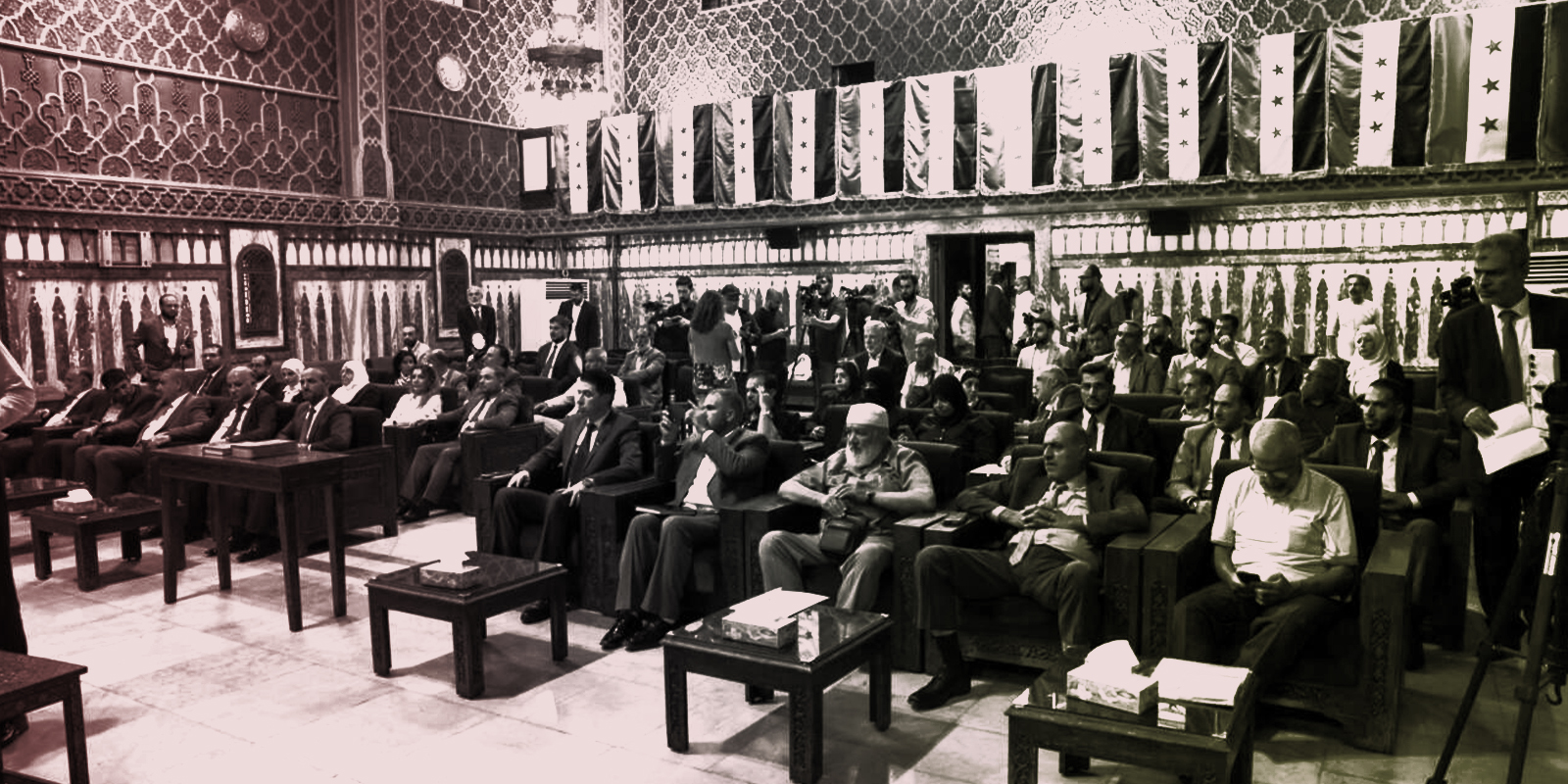
Syria is living through a transitional political phase characterized by the reshaping of its institutions and the holding of parliamentary elections described by some as a step toward stability, while others see them as a superficial process lacking democratic standards. The elections were held through an indirect voting mechanism, excluding areas outside the control of the transitional government. The results revealed a decline in women’s and minority representation, sparking debate about the inclusiveness and credibility of the process. While internal and international positions differ regarding the legitimacy of these elections, one question remains: does recognition signify the acknowledgment of a new system or merely another episode in a broader struggle for power and influence?
International Recognition as Part of the Power Struggle
Tariq Ajeeb, a researcher in political and international affairs, told +963 that in the Syrian case, it is evident that most, if not all, of the countries once championing democracy, freedom, and human rights no longer genuinely consider these principles as guiding their policies or decisions when supporting regimes or individuals.
He explained that this occurs when political and economic interests and power struggles dominate the decision-making of these governments. Ajeeb added that the recognition of the process by which members of parliament were appointed fits into a broader context of backing this administration.
He noted that this is linked to the regional struggle for influence and efforts to push the new administration to fulfill the conditions and demands set at various levels, regional, international, and economic.
Ajeeb asserted that regional stability cannot truly be achieved because, in his view, no region in the world enjoys complete stability, let alone Syria. He revealed that the presence of jihadist, extremist, and radical Islamist groups controlling large swaths of territory, or even an entire state like Syria, makes true stability impossible.
He added that such realities increase tension and the likelihood of a major regional conflict affecting many countries. In the past, the threat was confined to Israel, but now the entrenchment of a radical system will impact most states in the region. He stressed that the current international support is driven by interests and influence, not by principle.
Read also: The People’s Assembly in Syria: Between Representation and Functionality
Superficial Election
Ajeeb argued that what occurred cannot be considered genuine elections in any sense of the word, but rather a process of appointing parliamentary members through mechanisms unrelated to elections. He added that it is inaccurate to even label the process “Syrian elections.”
He stated that the new administration lacks legitimacy in every sense except what it calls “revolutionary legitimacy,” which he described as the legitimacy of power and arms, the revolution that succeeded in toppling the previous regime. This administration, he said, imposes its authority, weaponry, and ideology to dictate appointments and shape both constitutional and non-constitutional institutions according to its own vision. This, he added, forms the core of its dispute with many Syrians and supporting states.
Ajeeb explained that the needs of this stage are tied to interests and the distribution of power, emphasizing that the ongoing conflict over Syria allows such processes to pass as part of a broader strategy. Many external actors, particularly major powers, are still awaiting their goals and gains in Syria through this administration. The administration itself may not agree with everything imposed on it but ultimately complies with the will and policies of the major powers.
He stated, “We possess neither the legitimacy of the ballot box nor the legitimacy of an imposed reality,” clarifying that what allows these processes to occur is an “international formula of permissibility,” not legitimacy. According to him, constitutional, electoral, or governmental legitimacy currently has no place in Syria.
What exists today, he said, is an imposed reality without true legitimacy, a de facto authority that appoints, forms, and enforces its will based on military power and dominance. Under such conditions, it is impossible to speak of legitimacy.
He pointed out that many opposition voices reject both the legitimacy of the revolution and that of the ruling power, but what is effectively enforced is the authority of reality, not legitimacy. He concluded that legitimacy as a concept is entirely absent in Syria, where no genuine transformation has occurred, only surrender to an imposed reality serving external agendas.
International Contradictions
Ajeeb noted that states justify their contradictions by invoking “interests,” claiming to support the Syrian people. He described these slogans as insincere, used merely to rationalize support for an undemocratic and illegitimate process. In truth, he said, interests dictate these actions: the interests of these states align with the new Syrian administration, whose actions serve their objectives.
He highlighted a deep contradiction between democratic rhetoric and actual practice. Concepts such as democracy, electoral legitimacy, and regional stability are all absent. Even in the states engaging with Syria, democracy is not applied in its true sense.
According to Ajeeb, these states deal with Syria based on self-interest and the balance of power. They have proven that they prioritize their gains over values and principles like freedom and human rights, both completely absent in Syria.
He questioned whether the fear of chaos and the resurgence of extremist groups is a sufficient justification for normalizing relations with a system lacking legitimacy. He clarified that this radical system, classified as terrorist, lacks both constitutional and popular legitimacy. This logic, he said, governs the mindset of the states supporting this administration, they back it to secure maximum political, military, or economic benefit.
Much of this, Ajeeb continued, relates to the division of power and influence in Syria, if not geographically, then in terms of authority and control over specific areas. He rejected the notion that support stems from fear of chaos or extremism, noting that many figures within the new administration are themselves internationally and regionally designated terrorists.
He pointed out that most extremist factions, including Al-Qaeda, ISIS, Hay’at Tahrir al-Sham, and Jabhat al-Nusra, are part of this same administration. Therefore, support cannot be justified by the fear of their return when they are already integral to the system.
Ajeeb stated that economic interests and reconstruction are among the key objectives driving international support for the new authority. These interests shape each country’s stance depending on the extent to which its goals are achieved. The more gains one side secures, the more positive its position becomes, and vice versa.
He emphasized a shared concern: Syrian territory cannot be left under the control of extremist groups, as that would pose a long-term threat to the region and the world. He concluded that new political combinations may reshape power structures, noting that “this stage is the harvest season for foreign powers to reap their gains in Syria, and it is far from over.”
Consolidation of Power
Ajeeb explained that the process of recognizing the new parliament lacked all democratic, constitutional, and legal standards. He believes it will not endure, for if it does and achieves full control over the state, the international community will have effectively helped cement a radical and extremist authority on the ground.
He added that the situation on the ground remains dire and unpromising, stressing that the “harvest season” is not over yet, as further changes are expected.
He affirmed that international and regional political movements remain driven by interests, gains, and the distribution of power. Ajeeb expressed hope that a new Syrian administration would emerge, one acting with patriotism and commitment to a better future for all Syrians — without religious, ethnic, sectarian, or partisan discrimination.
He emphasized that Syria’s interest must come first, and that relations with all states should serve the national interest. Syria, he said, needs the world just as the world needs Syria. He concluded with hope that there will be a genuine effort to build a new Syria founded on citizenship, equality, and justice in rights and duties, adding, “We hope that all actions and steps will always lead toward a better future for Syria and its people.”
Read also: https://963media.com/en/20/10/2025/syria-a-nation-without-political-parties/
Cautious International Engagement
For his part, political writer and researcher Dr. Michel Chammai told “+963” that, in his view, recognition of Syria’s election results does not reflect an abandonment of democratic values in favor of pragmatic necessities such as regional stability, but rather represents an attempt to restore the stability and security of the Syrian state itself.
Chammai explained that the Syrian state, or regime, is not yet capable of being fully democratic. It is transitioning from a totalitarian Baathist ideology that sowed corruption, destruction, and oppression to a new democratic outlook.
He added that one must not forget the country’s difficult transitional period, marked by the rise of extremist ideologies from which President Sharaa has sought to free himself and join the international community, though this, he noted, will require time.
In response to a related question, Chammai said that the international community always deals with states according to their internal structures and nature. The Syrian regime, he noted, remains in a transitional phase and should at least be granted the opportunity to evolve, even though he personally remains wary of the fundamentalist currents that replaced the former totalitarian system and are now attempting to reshape the state.
He stated that while the new system cannot yet be fully trusted, there are no real alternatives on the ground. Therefore, granting it an opportunity based on de facto legitimacy, rather than imposed legitimacy, remains preferable to the absence of any clear political authority.
Chammai expressed hope that this transitional stage might represent a genuine step toward democratic stability through what is known as “ballot-box legitimacy.”
He further explained that the recognition of Syria’s elections by foreign states does not necessarily contradict their democratic principles but reflects an effort to give the new system a chance to demonstrate its commitment to building a civil, democratic state.
He viewed President Sharaa’s current rhetoric as positive in tone but stressed the need for tangible implementation. The states recognizing the election results, he said, are granting the regime an opportunity to be tested.
Incomplete Legitimacy
Chammai emphasized that extremist groups cannot justify engagement with an immature regime still in formation. He explained that this system has not yet fully emerged, having failed so far to establish complete constitutional or popular legitimacy, though it enjoys partial popular legitimacy that remains to be consolidated. This, he said, will take time given the ongoing conflict among Syria’s various factions during this stage of state formation.
He added that economic interests and reconstruction efforts play a major role in shaping attitudes toward the nascent Syrian state and President Sharaa. The country will eventually embark on reconstruction based on internal economic revival, helping rebuild its economy.
However, he noted that this remains obstructed until political stability is achieved, for without political stability, there can be no real investment, economic growth, or reconstruction.
Chammai concluded that international recognition of Syria’s elections represents an opportunity for transition, affirming that if President Sharaa reverts to extremism or the movements from which his government emerged, he will have no real chance of maintaining power or leading Syria’s young state.
He stressed that the president and his regime face clear conditions, the foremost being a transition from extremist ideology to a modern civil outlook. If Sharaa succeeds in this mission, he said, he will secure his position, and Syria will achieve a qualitative leap toward democracy.
If, however, he fails due to factional divisions and conflicting views, then, according to Chammai, he will have no future in the new Syria. The real danger, he concluded, lies not in challenging the concept of legitimacy in international law, but in accepting a system that contradicts modern international norms rejecting extremism, fundamentalism, and terrorism.











