


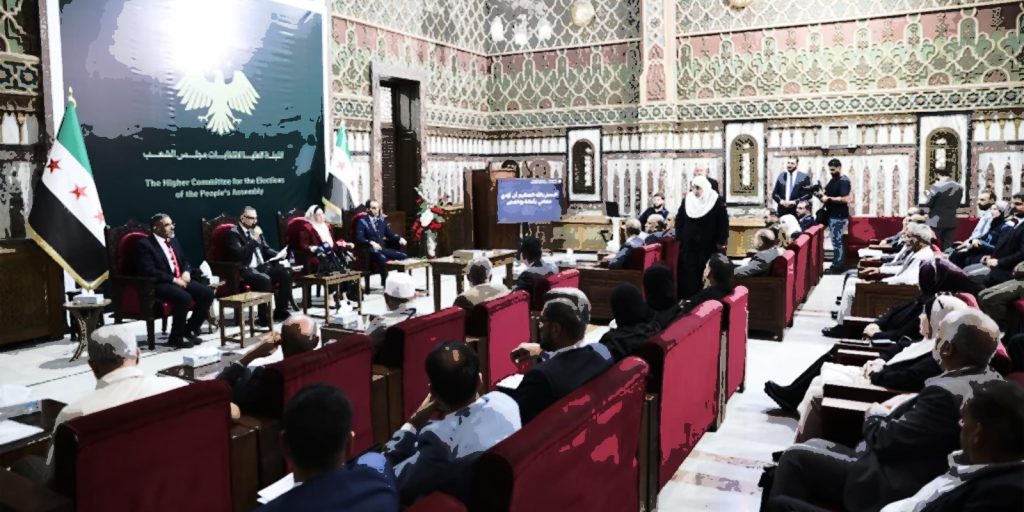
On October 5 of this year, Syria witnessed the first parliamentary elections since the fall of Bashar al-Assad’s regime. The elections were conducted through electoral bodies formed by subcommittees rather than by direct popular vote, in accordance with the constitutional declaration issued on March 13. The People’s Assembly was established as the country’s legislative institution. However, voting did not take place in three governorates, Hasakah, Raqqa, and Sweida, which remain outside the control of the interim government, as decided by the government itself. The process nevertheless drew mixed reactions among Syrians, between those seeking a truly representative parliament and those who view it as a step “appropriate to the transitional phase.”
On October 6, the Supreme Committee for the Parliamentary Elections announced the results of the vote, which was conducted in 49 electoral districts across the country, excluding Hasakah, Raqqa, and Sweida. The committee’s spokesperson, Nawar Najmeh, stated at a press conference that “the high level of integrity was the most distinguishing feature of the electoral process,” clarifying that “the announced results confirming the victory of 119 members are final and not subject to appeal, and that the one-third appointed by interim President Ahmad al-Sharaa is not linked to the electoral bodies.”
He added that “the People’s Assembly serves as the official forum for national dialogue among Syrians. Transparent elections reflect political realism and represent an important step toward strengthening civic participation and accountability. The primary function of the parliament is to support the government and oversee its work. We are facing a critical and revolutionary parliament that believes in the principles of the revolution.” He acknowledged, however, that “one of the main shortcomings of the electoral process was the unsatisfactory representation of Syrian women, while Christian representation amounted to only two seats, a weak figure compared to the Christian population in Syria. Some regions were also disadvantaged by the inability to determine their populations accurately, but overall representation adhered to the principles of demographic fairness and proportional allocation of seats among electoral bodies.”
Electoral Bodies and Appointments
According to Chapter Three of the Syrian Constitutional Declaration, “The People’s Assembly exercises legislative authority. The President forms a Supreme Committee to select members of the Assembly, which in turn supervises the creation of subsidiary electoral bodies responsible for electing two-thirds of the members. The President appoints the remaining one-third to ensure fair representation and competency. Members of the People’s Assembly enjoy parliamentary immunity and may not be dismissed except with the approval of two-thirds of the members. The Assembly holds legislative authority until a permanent constitution is adopted and new legislative elections are held in accordance with it.”
The declaration further stipulates that “The term of the People’s Assembly is thirty months, renewable. In its first session, members elect a president, two deputies, and a secretary by secret ballot and majority vote. The oldest member presides over the first session until the election takes place. The Assembly’s responsibilities include proposing, approving, amending, or repealing laws; ratifying international treaties; approving the state’s general budget; granting general amnesties; and accepting or rejecting resignations or lifting immunity. It also holds hearings for ministers and makes decisions by majority vote.”
Vote Suited to the Transitional Phase
The interim government justifies resorting to indirect voting through electoral bodies and subcommittees as a practical necessity during the current transitional phase. It argues that direct popular elections are extremely difficult given the vast destruction across the country, damaged infrastructure, the large numbers of displaced people and refugees, and the absence of reliable census data and official documents necessary to organize such elections. Additional challenges include major logistical and security obstacles and the lack of essential equipment.
However, critics and opponents of the process contend that “the interim government is using these justifications as a pretext for conducting non-popular or quasi-appointed elections, creating a functional council rather than a representative one, meant to fill a legislative void without exercising real influence or oversight over government policy.”
According to this view, “the government sought to establish this functional body from the outset, as the constitutional declaration allowed the President to appoint one-third of the members while the remaining two-thirds were elected by subcommittees chosen by the same authority. These subcommittees were not broadly representative but were selected based on their proximity to power and endorsement by the Supreme Electoral Committee, itself appointed by the President. Consequently, the People’s Assembly will act in accordance with government policies rather than serving as an oversight authority over the executive branch, including the interim President.”
Functional Institution
Syrian human rights activist and lawyer Ghazwan Qarnful, based in Turkey, argues that “what happened in Syria cannot be called parliamentary elections, but rather a selection process by the authorities to choose members of a legislative body through a specific mechanism. The purpose was to demonstrate the establishment of an institution to consolidate legitimacy—an essentially functional body assigned only the task of legislation.”
Speaking to +963, Qarnful added that “the Council has no authority other than to legislate laws. It does not have the power to hold the executive branch accountable, withdraw confidence from it, or challenge any of its members. It can observe and question the government’s actions but lacks the power of accountability. It is merely a witness to the government’s performance.”
Qarnful stressed that “the mechanism followed in electing members of the People’s Assembly does not reflect popular representation but rather the will and choice of the interim president alone, who was granted the authority to form electoral bodies and select one-third of the Assembly’s members. The aim was not to enable the people to exercise even part of their right to choose but to complete the structure of the last state institution needed to consolidate legitimacy.”
Read also: Syrian Women Redefine Identity Through Non-Belonging
Legislative Nucleus
However, researcher and academic Orabi Orabi disagrees with Qarnful’s assessment, viewing the new Council instead as “a legislative nucleus capable of development rather than a mere functional institution.” He argues that “the current agreement on indirect voting through representative bodies may be a rational choice in Syria’s particular context, as it allows for an electoral sequence that stabilizes the political scene and prevents institutional vacuum while preparing conditions for direct voting later.”
Speaking to +963, he said that “the Council is capable, within its powers, of fulfilling its legislative and oversight role if it activates the well-known parliamentary tools such as specialized committees, questioning sessions, and requiring the government to provide written and timely responses.”
“Self-Administration” Rejects the Process
After the Supreme Committee for the Parliamentary Elections announced that voting would not take place in Hasakah, Raqqa, and Sweida for “security and logistical reasons that cannot be ignored, as holding elections in areas outside government control would undermine the credibility of the entire process,” the Autonomous Administration of North and East Syria, the Syrian Democratic Council (SDC), and the “Higher Judicial Committee” in Sweida all rejected the elections and their outcomes, stating that they were not concerned with them. The committee added that “President Ahmad al-Sharaa may select representatives from Hasakah, Raqqa, and Sweida, whose seats constitute 10% of the total Assembly.”
Following the results, Bedran Çiya Kurd, the Co-Vice President of the Autonomous Administration of North and East Syria, declared that “the elected members do not represent the political will of Syrian society in all its diversity, and the Administration was not represented in this process. Therefore, the Assembly’s decisions are not binding for us.” He emphasized that “the Administration has a political will stemming from the components of the region, which have freely chosen their representatives through democratic elections, an expression of will that must be taken into account.”
Çiya Kurd stressed that “the electoral process lacks a democratic electoral law guaranteeing the participation of all Syrians without discrimination. It was not based on genuine national consensus under the current circumstances, which led to the exclusion of large regions and social groups. The mechanisms adopted do not align with international standards for free and fair elections. They lack democracy and transparency and diverge from the spirit of UN Resolution 2254, which constitutes the international framework for a political solution in Syria.” He concluded that “in its current form, the electoral process attempts to legitimize an authority that does not represent all segments of the Syrian people.”
Orabi notes that “the practical criterion for assessing the representativeness of the People’s Assembly is competency-based rather than absolute delegation. Selecting members through intermediary bodies can approximate popular representation if these bodies are broad-based and connected to real social, professional, and local sectors, along with a defined timeline for gradually integrating external proposals.”
He adds that “the People’s Assembly can succeed as a limited legislative institution and effectively monitor the government if it organizes its committees and expands its representative base. This should be accompanied by clear plans to develop the electoral system, advance transitional justice mechanisms, and resolve conflicts. These are the levers that can enhance the legitimacy of the process and enable the transition from a functional body to one genuinely representative of society.”











