


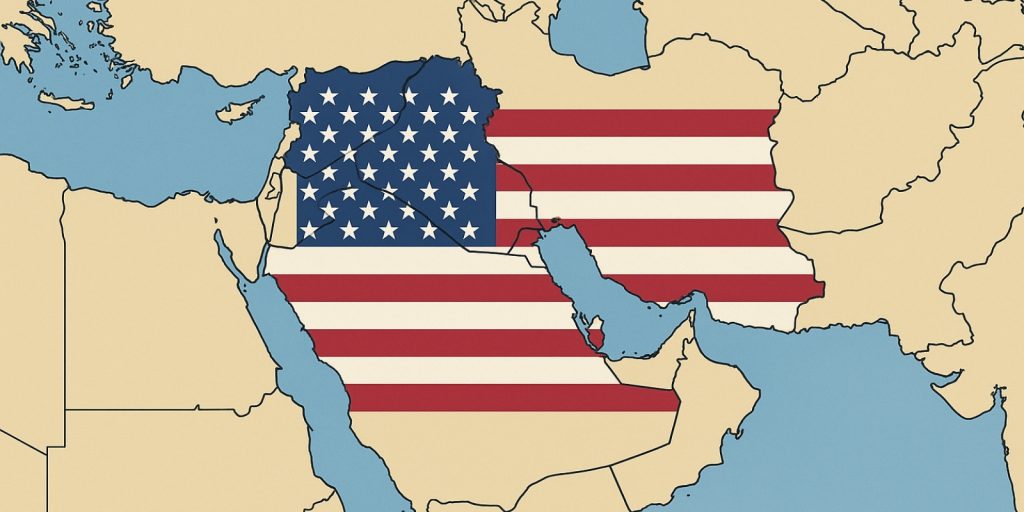
In the ongoing debate over the relationship between the concept of the modern nation-state and the states of the Middle East within U.S. strategy, statements by U.S. envoy Tom Barrack have highlighted how Washington’s decision-making circles view the structure of existing political entities in the region. This perspective sees the geography of the Middle East more through tribal, communal, and religious foundations than through the principles of the modern state.
In this context, U.S. envoy Tom Barrack said in a press statement: “There is no Middle East, but tribes and villages,” noting that the nation-states in the region were created by the British and the French in 1916 through the Sykes–Picot Agreement.
Barrack continued: “The nation-states in the Middle East were established by the British and the French… As Sykes–Picot said: we will take what is known as the Ottoman Empire, draw straight lines around it, and call them nation-states. But the Middle East does not work that way; it began with the individual, then the family, then the village, then the tribe, then society and religion, which ultimately shaped the concept of the state.”
He added: “The belief that 27 different countries in the region, encompassing 110 ethnic groups, can be unified under one political stance is a mere illusion.”
From this standpoint, the U.S. approach toward the Middle East and its issues appears marked by ambiguity, as Washington deals with the region from the perspective of its own strategic goals, mainly confronting China and Russia, through a logic of deals and direct interests.
Thus, U.S. policy in the Middle East, especially under President Trump’s administration, reflects clear biases toward energy security, ensuring Israel’s superiority, combating terrorism, protecting strategic corridors, and undermining the Iranian threat.
According to analysts, this perspective leads the United States to view the geography of the Middle East as a space open to reshaping according to its own calculations, whether through flexible alliance projects or by reorganizing borders and economic and security functions.
Consequently, the American stance approaches a pragmatic economic-security blend that recognizes only the concept of “functional stability,” allowing for the management of influence and balance of power.
Read also: Firas Alawi to+963: Syria Requires Neither Extreme Radicalism Nor Excessive Secularism
The Absence of a U.S. Strategy
In this context, Dr. Bernard Haykel, Professor of Middle Eastern Studies at Princeton University, said in a statement to +963 that the opinions expressed by Ambassador Barrack do not reflect President Trump’s views, but rather his personal positions.
Haykel stressed that, based on this, no conclusions can be drawn regarding U.S. policy in the Middle East, since Barrack implements President Trump’s policies, which constantly shift depending on the transactional opportunities the president identifies.
He further explained that the U.S. government lacks a unified or consistent strategy toward the region. All policies are transactional and subject to change at any time.
The American scholar concluded that President Donald Trump deals with each country individually and does not have a collective vision for the region, even though he recognizes that his allies, such as Turkey and Saudi Arabia, share one. He shares with both Riyadh and Ankara the desire for a prosperous and stable region, as such a scenario would serve U.S. interests, particularly commercial and military ones.
For his part, Dr. Samir al-Taqi, a researcher at the Washington Institute, believes that American diplomacy is undergoing a transitional phase, with the administration experiencing internal conflict over the prospects of alliances in the region. He noted that this is not limited to the Middle East but relates to the United States’ global position. He pointed out that Washington now tends to declare itself no longer fully responsible for global security but rather seeks to exercise its power and impose selective interests wherever and to the extent that serves its own calculations.
A Regional Alliance
Al-Taqi stated in his remarks to +963 that the ideal position the United States seeks is to establish a regional alliance to balance its strategic rivals, Russia and China. In this regard, he explained that Washington has tried to advance what is known as the “Middle East NATO,” though this path currently faces significant uncertainty.
He added: “We are anticipating significant developments these days, most notably President Trump’s position on resolving the situation in Gaza, and on a key issue concerning the delegation and support of a central Arab role in recovery efforts in Gaza, Lebanon, Syria, and even Iraq.”
In another context, al-Taqi explained that Netanyahu has held American policy hostage for a long time, and that Washington’s policy has, in turn, become captive to this influence, leading to a decline in its strategic role and ability to take initiative.
He emphasized that the signs of this decline are evident in United Nations deliberations, in the stance on recognizing the Palestinian state, and in the fading interest in the two-state solution.
He concluded that this is the first time since 1956 that an international initiative has emerged involving Europe independently of the main U.S. policy, an indication that Washington is attempting to find exits to avoid direct confrontation.
Al-Taqi added that American policy remains hostage to Netanyahu’s positions, particularly regarding Tom Barrack’s statements and the redrawing of the region’s maps and energy lines.
He argued that Barrack’s vision stems from an extreme right-wing perspective that views the Middle East as a set of sectarian entities and considers some states “failed,” whose borders should be redrawn. Such a view could lead to revisiting the Syrian-Lebanese borders, the future of Tripoli, and the partition of Iraq into multiple zones.
According to al-Taqi, the United States, in this transitional phase, is unable to undertake the major transformations it speaks of in the Middle East.
Read also: Gaza as Gateway to Regional Peace
He added that the loss of initiative prevents Washington from imposing new maps or shaping a different Middle East. The U.S. may envision an Arab-Israeli-Turkish alliance not necessarily directed against Iran, as Iran, in his words, is undergoing transformations that make it less dangerous than before, although it remains a state with regional military and strategic capabilities.
Al-Taqi also pointed out that most Arab and Gulf states have reached strategic settlements with Iran and arrived at understandings on several issues, particularly after the weakening of some of its regional arms. He confirmed that Tehran no longer invests in its proxies as it once did, focusing instead on building its national deterrence from within. Consequently, Washington is reorganizing its regional approach through inter-state alliances, while any attempt to reconsider the structure of regional states is likely to fail, and could deepen the failure of U.S. policy if pursued.
He warned that pushing Lebanon to the brink of explosion could lead to its division, a consequence the United States would be unable to control, the same applying to Syria.
He concluded by saying that granting “carte blanche” to settlers to implement their vision of the Israeli state and enact deep demographic and political changes, along with the proposals presented by Barrack, may ultimately lead to a broad failure of U.S. policy in the region.
For his part, Salem al-Jomaili, former director of the U.S. division in Iraqi intelligence, told +963 that U.S. policy in the Middle East reflects the dominance of businessmen over decision-making circles, shaping it primarily from an economic and investment perspective. The United States, he said, does not treat the Middle East as a coherent geographic unit but as a vital space defined by its direct interests: energy security, the protection of Israel, counterterrorism, and the security of strategic corridors. For this reason, some U.S. envoys avoid using the term “Middle East” as a unified concept, preferring instead to deal with it as a set of separate files.
According to al-Jomaili, Barrack’s statements signal a clear tendency within the American elite to view the region’s future through an economic and investment lens within a stable security environment, rather than through traditional political approaches, while seeking to integrate Israel into a new regional order. However, this vision does not reflect a unanimous American position; it represents a specific current that faces opposition from another, more entrenched current belonging to the traditional security-military school.











