


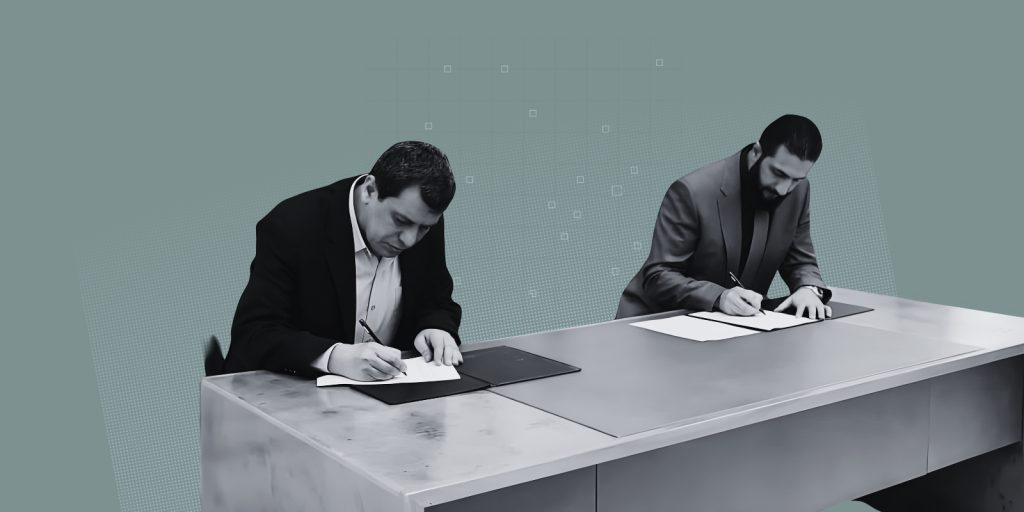
Syria’s political scene is witnessing renewed tension after the announcement of a meeting in Damascus between the Commander of the Syrian Democratic Forces (SDF) Mazloum Abdi and Syria’s Interim president, Ahmed Al-Sharaa. The meeting, aimed at reviving the long-stalled March 10 Agreement, comes after months of deadlock caused by deep political and security rifts.
The encounter unfolds amid a surge of shifting political and field dynamics across Syria, reflecting fragile balances between local, regional, and international actors. The implementation of the March 10 Agreement between the interim government and the US-backed SDF remains blocked under intense Turkish pressure and ongoing disputes over decentralisation, governance, and the shape of Syria’s future state.
Following a meeting that brought together Abdi, US envoy Tom Barrack, and CENTCOM commander Brad Cooper to discuss mechanisms for stability and the prevention of renewed conflict, alongside intermittent clashes in Aleppo’s Sheikh Maqsoud and Ashrafieh districts, the Al-Sharaa–Abdi meeting marks a key juncture. It serves as both a test of the two sides’ willingness to move forward and a measure of their capacity to overcome the accumulated barriers since the agreement’s signing.
While observers describe the meeting as an effort to rebuild trust, others see it as merely symbolic, given the absence of international guarantees and the persistence of divisions over decentralisation, military integration, and the future of self-administration in north and east Syria.
The Turkish Factor
Dr Udai Ramadan, a political scientist and former senior member of the Italian Communist Party, attributes the failure of the March 10 Agreement to “Ankara’s determination to block its implementation.”
“Turkey effectively controls the political levers of Syria’s transitional phase,” he told +963, “imposing its decisions, dictating agreements, and shaping the interim presidency’s direction. There are no concrete mechanisms to ensure the parties adhere to the agreement as long as Turkey rejects it outright. The United States, too, bears responsibility, it is not interested in the agreement’s success, seeking instead a share of the Syrian pie.”
Dr Zara Saleh, a researcher in peace and conflict studies based in the United Kingdom, agrees that Turkish influence remains the primary obstacle. “Ankara holds the strongest sway over the de facto authorities in Syria and seeks to impose its agenda on the peace process, linking it to the disarmament of Kurdish forces,” he said. “Turkey insists that the SDF is merely an extension of the PKK, which is inaccurate. This aligns, however, with Damascus’s centralising tendencies that perpetuate authoritarianism.”
Saleh adds that the Syrian leadership itself bears equal blame. “After the March 10 signing, the constitutional declaration practically annulled several of the agreement’s provisions, concentrating powers in the president’s hands. Implementation is possible only if Damascus abandons its sectarian and ideological rigidity; an unlikely scenario. The sustainable solution lies in a decentralised or federal system, internationally and regionally supported, as the Syrian state has long been a hostage to external bargains.”
Related: Tense Calm in Northern Syria: Aleppo Clashes Reflect Regional Power Struggles
Integration or Absorption?
Beyond Turkish and American roles, the debate over integrating the SDF into the Syrian state remains central. Saleh notes that the agreement’s clauses were interpreted unilaterally by Al-Sharaa’s government, especially concerning Kurdish rights. “The constitutional declaration ignored the question of Kurdish national recognition and reduced the idea of integration to individual enlistment within the state army rather than recognising the SDF as a distinct corp.”
When asked whether the Ministry of Defence could realistically absorb the SDF, Ramadan responded sharply: “Which army are we talking about? The same one dismantled since December 2024? If Turkish-trained forces represent the so-called national army, then integration is impossible.”
Saleh concurs: “The Ministry’s forces cannot be called a national army in any scientific or institutional sense. These are factions aligned with religious jurisprudence, loyal to Ankara, and opposed to any notion of partnership.”
The Decentralisation Divide
Ramadan emphasises that the dispute over decentralisation is less about the concept itself and more about widespread misconceptions. “Many, including within the transitional authority, misunderstand decentralisation. It’s about facilitating citizenship and simplifying governance, not dividing the country into cantons or confederations. Yet suspicion dominates public and political attitudes alike.”
Saleh adds: “Implementing decentralisation is precisely what Ankara and Damascus fear. Unless Kurdish rights are constitutionally recognised, the agreement will never materialise. The self-administration issue concerns not only the Kurds but all components of northern Syria.”
He warns that Damascus’s leadership, emboldened after Al-Sharaa’s recent visit to New York, is attempting to project international backing to impose its own agenda, echoing past atrocities in the coastal and southern regions. “The core dispute is ideological. This leadership is building a sectarian, exclusionary system that cannot coexist with genuine citizenship or democracy. Syria will never return to a fully centralised state.”
Saleh also notes that the regime’s attempt to revive Baath-era Local Administration Law No. 107 is doomed to fail. “Areas like Suwayda, Quneitra, and Daraa are effectively demilitarised and under Israeli protection, decentralisation has already become a de facto reality.”
On the Edge of Fragmentation
Saleh openly blames the Damascus authorities for Syria’s fragmentation. “Unless the government reconsiders its policies, the country is heading toward partition or a patchwork of competing international zones of influence.”
He dismisses suggestions of appointing Abdi or other SDF figures to senior positions. “The issue is not about posts but about power-sharing and governance. Symbolic appointments will not solve the problem. The Kurds and the SDF seek a federal framework dividing authority between the centre and the regions, not token inclusion.”
Ramadan agrees: “Such appointments would only serve to legitimise policies without real substance. Turkey would never accept Abdi in a senior role, given its hostility towards the Kurdish people in Syria, Iraq, and even within its own borders.”
Read also: Firas Alawi to+963: Syria Requires Neither Extreme Radicalism Nor Excessive Secularism
Beyond Cosmetic Solutions
Saleh concludes that any sustainable solution must address the state’s structure and constitution itself. “The existing government cannot build a professional, apolitical army. Its ideology of loyalty and exclusion runs deeper than any extremist group. What we are seeing is the rise of a Sunni Islamist emirate in Damascus and other regions.”
He predicts that European governments will ultimately back a model of expanded decentralisation close to federalism. “This framework would also suit Turkey’s interests: integrating the SDF into nominal state institutions while maintaining real control elsewhere. Yet the deep state in Ankara understands that the region’s post-Iran transformation will strengthen Kurdish agency. Federal entities, including a Kurdish one stretching from Afrin to Dêrik, are becoming inevitable.”
Saleh and Ramadan agree that a comprehensive military solution is impossible. “Neither Damascus nor Ankara has the capability or the international approval for a full-scale offensive. What we’ll see are limited skirmishes by Turkish-backed militias such as the Hamzat and Amshat groups, but no decisive war in north and east Syria.”











