


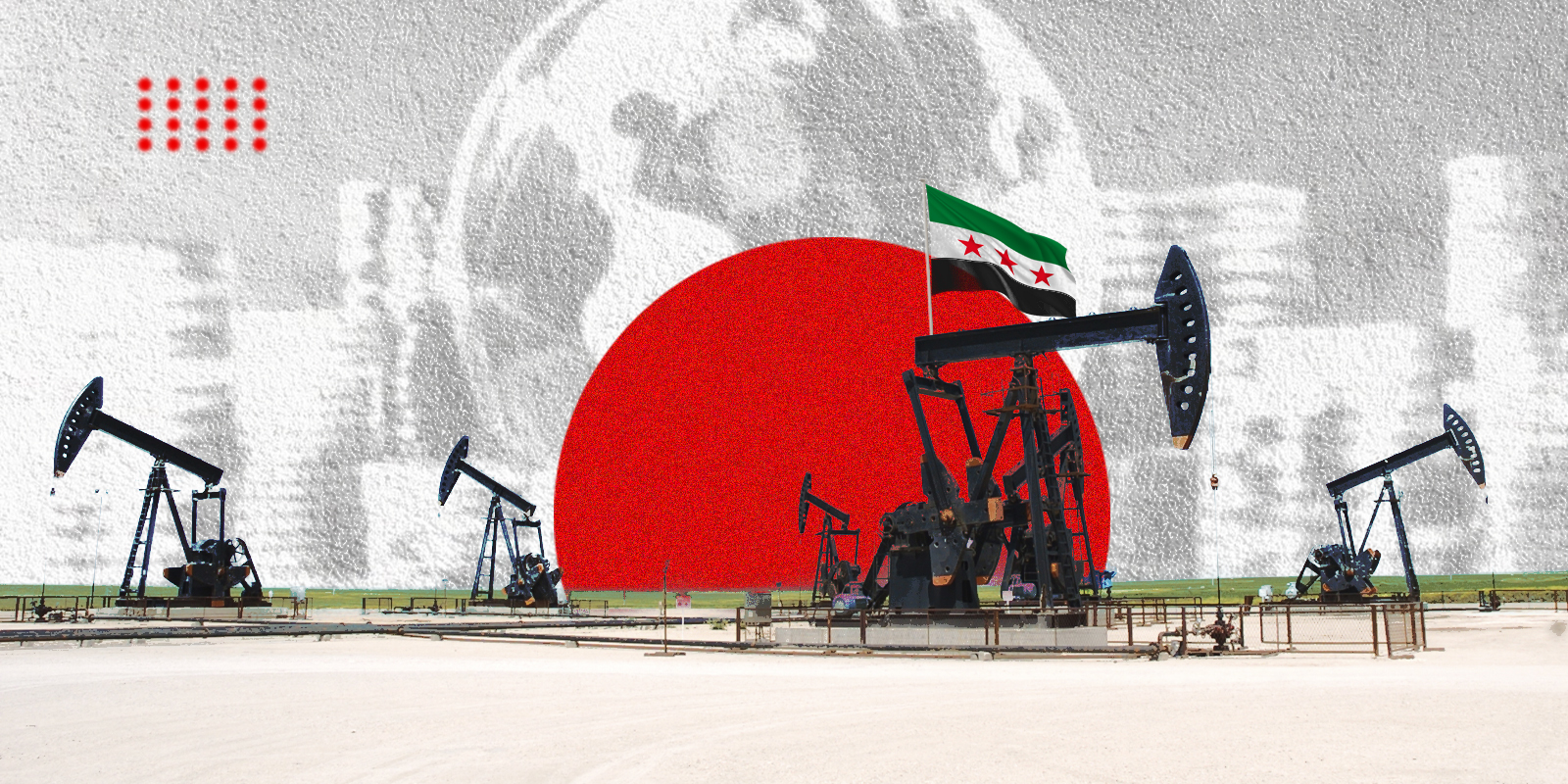
The Syrian Ministry of Energy announced last Monday the resumption of heavy crude oil exports from the port of Tartus on the country’s western coast, marking the first such shipment in years. According to a statement published on the ministry’s official Telegram channel, 600,000 barrels of heavy crude were exported aboard an oil tanker on behalf of an energy company, without disclosing the company’s affiliation.
The statement noted that the move was made within the framework of government directives and the General Directorate of Oil’s plans at the Ministry of Energy to strengthen Syria’s presence in international oil markets. It described the shipment as an important step toward revitalizing the oil sector and expanding avenues of cooperation with global companies, with further exports expected in the near future.
Most of Syria’s oil fields are located in the northeast of the country, in areas under the control of the Syrian Democratic Forces (SDF). These regions have witnessed multiple developments over recent years. Local actors began supplying the Syrian government with oil in February, but relations later soured over concerns related to social exclusion and minority rights.
In a related development, Syria resumed exports of non-crude petroleum products from the Baniyas refinery in Tartus Governorate last June, sending an initial shipment of 30,000 metric tons to international markets. Baniyas, located about 35 kilometers north of Tartus, holds strategic significance as it contains Syria’s largest oil refinery and a specialized port for crude imports and exports.
These developments followed the issuance of an executive decision lifting sanctions on Syria, which paved the way for U.S.-based companies to begin planning for oil and gas exploration and extraction. Additionally, Syria signed an $800 million memorandum of understanding with a global port operator to develop, manage, and operate a multi-purpose terminal in Tartus, after canceling a previous contract with the company that had been managing the port.
Media reports suggest that this resumption of exports represents an attempt to revive Syria’s oil sector, whose production has plummeted from 390,000 barrels per day to around 40,000 barrels per day in 2023, after once exporting 380,000 barrels per day in 2010.
At the same time, analysts raise fundamental questions about who truly benefits from oil revenues, noting that Syria remains in a stage akin to a cold war that could erupt into open conflict at any time. Some analysts doubt that the communities most devastated by the war, and now living in extreme poverty, will tangibly benefit from these revenues
A Boost for the Treasury… Priorities Define the Target
In July, the Syrian government announced a tender for the export of heavy crude oil. Syria produces both light and heavy crude, with the former more marketable due to its easier refining process. However, given the deterioration of infrastructure, the government intends to focus on exporting heavy crude.
Mohammad Ahmad, an economic expert at Karam Shaar Advisory LTD, told +963 that oil revenues would flow into the state treasury, with proceeds directed toward providing services to Syrians rather than military reinforcements.
He explained that export revenues are subject to the principle of unified budgeting, meaning that budget revenues are not earmarked exclusively for a single sector. Instead, the general treasury allocates funds to the security sector, military salaries, as well as specific amounts for the defense and interior ministries’ equipment needs, in line with government priorities. He emphasized that reconstruction remains a top priority for the Syrian government.
Ahmad added that revenues from Syria’s first oil shipment since the lifting of sanctions would be deposited in the Central Bank’s foreign currency reserves. Over time, this could influence the Syrian pound’s exchange rate, though not immediately, since the bank has not adopted a policy aimed at strengthening the pound within a defined timeframe.
Regarding domestic fuel supply, he noted that the impact depends on the government’s ability to balance supply and demand in petroleum exports and imports. While the government moves to export heavy crude, it is simultaneously seeking contracts to secure refined products and import light crude for partial domestic refining.
He stressed that oil revenues could serve as an incentive for peace, civil stability, and national reconciliation, by funding services, improving Syrians’ living standards, and supporting reconstruction. However, he cautioned that conflict could erupt if any party sought to seize revenues before they reached the state treasury.
Ahmad also revealed that a Dutch company had won the bid to export Syrian oil to Italy. He pointed out that several global and regional powers are supporting Syria’s reintegration into global markets, especially after the lifting of sanctions, with most countries endorsing Syria’s reconstruction process.
Doubts
Alan Berry, a political writer and graduate of the University of Vienna’s Faculty of Political Science, told +963 that the resumption of Syrian crude exports raises a fundamental question: who is the real beneficiary of these revenues? Will they serve the public treasury and the people, or will they be diverted to military build-ups and the interests of select groups?
Berry stated: “So far, we have seen no signs that public funds are being invested in infrastructure that benefits all segments of society.” On the contrary, he pointed to “a noticeable increase in military spending,” which, from the perspective of the current authorities, appears to be the top priority. “This is evident given the violent actions targeting the coastal region and Sweida,” he said.
He stressed that Syria remains in a cold war–like phase that could escalate at any moment, a condition persisting since the fall of the Assad regime. Berry added that “the massacres in the coastal region and Sweida demonstrated that Syria has not moved beyond the logic of war, elimination, and sectarian or ethnic cleansing, compounded by political divisions.”
When asked whether oil exports could alleviate the fuel crisis, Berry responded: “The Syrian citizen, especially those communities devastated by the war and living in extreme poverty does not figure into the current authorities’ priorities.” He expressed his belief that this segment “will not tangibly benefit from the authorities’ economic policies, whether current or promised for the future.”











