


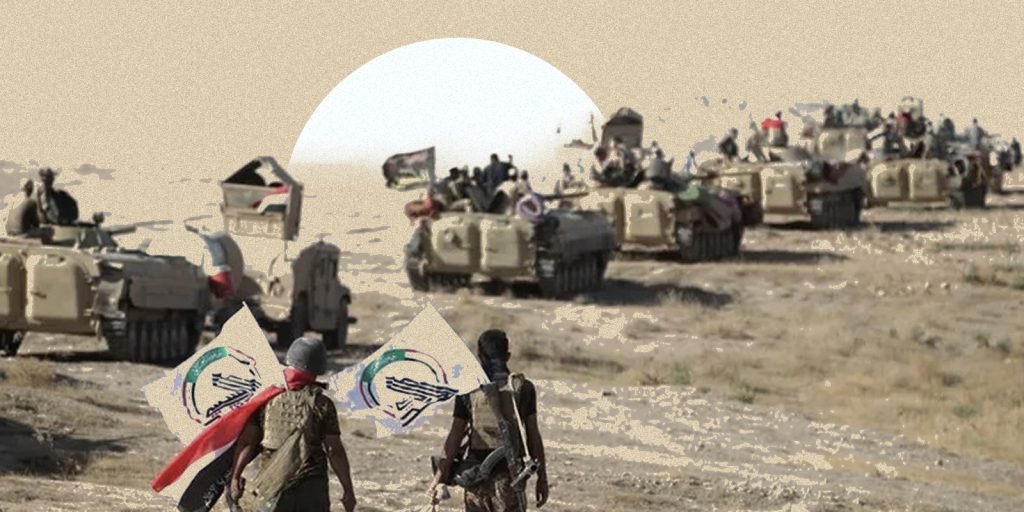
Last Wednesday, Iraq’s ruling coalition, the Coordination Framework, decided to suspend the vote on the Popular Mobilization Forces (PMF) Authority Law and postpone a decision on the future of these forces, whose ranks exceed 200,000 fighters.
It is widely believed that this law, strongly opposed by Washington, would grant Iran-aligned groups an institutional framework parallel to the Ministry of Defense, with financial independence and the privilege of training in a dedicated military academy.
The published draft revealed intentions to establish a “Directorate of Doctrinal Guidance,” raising fears that PMF members could be indoctrinated with sectarian instructions, as Iran’s Supreme Leader Ali Khamenei and National Security Council Secretary Ali Larijani have on multiple occasions defended the PMF and warned against its dissolution.
Contrary to the common narrative of Iranian dominance, the Shiite coalition, fractured by internal divisions, is now grappling with the law through formalistic alternatives. Leaders inside the Coordination Framework see the armed wing as a hot coal that cannot be held for long.
According to media reports, a senior figure said the coalition “decided to halt measures that were in sharp dispute with Washington,” having reached a “final conviction that passing the law would not serve Iraq’s higher interests.”
During the meeting, the head of a Shiite party told colleagues that “indicators coming from Washington are troubling and call for caution.” Politicians spoke of U.S. threats ranging from “ground invasion” to economic sanctions, considering Washington’s designation of Iraq as a “state harboring terrorism.”
The Coordination Framework nevertheless decided to pursue an alternative formula: approving a set of security positions within the PMF Authority under government jurisdiction, without returning to parliament. One leader described this formula as “cosmetic, to appease hardline factions,” while sources suggested the government is unlikely to initiate even such measures due to calculations tied to relations with the U.S. and electoral pressures on the prime minister.
The crisis reflects divisions within the Coordination Framework: one camp insists on passing the law to strengthen PMF legitimacy, while another fears international repercussions and American retaliation. Meanwhile, Sunni and Kurdish blocs remain explicitly opposed to the law.
Also read: Iraq–Syria Coordination on ISIS: Strategic Breakthrough or Delayed Battle?
Origins: A Response to an Existential Threat
In comments to +963, Iraqi writer and journalist Salah al-Zubaidi offered a comprehensive reading of the origins, evolution, and challenges of the PMF, describing it as a “legitimate state institution and one of the key pillars that preserved Iraq’s sovereignty and security.”
Zubaidi emphasized that “the PMF was born from the fatwa of al-jihad al-kifa’i which is translated as “sufficient jihad” (June 2014) after the fall of Mosul and ISIS’s advance.” The fatwa, he explained, “was clearly limited to defending the country, the system, and the constitution, not the project of a party or a sect.”
The PMF emerged amid “a lethal security vacuum, collapsed army units, an existential threat to Baghdad, shrines, and cities, and a Shiite-national popular base that pressed the state to fight.”
The Najaf religious authority approached the PMF with three principles: “disciplined defensive mobilization, insistence on avoiding transgression and protecting lives and property, and keeping the force under the state, not outside it.”
To prevent deviation, the PMF was codified in Law No. 40 of 2016, which Zubaidi described as “the legal foundation that protected the experiment,” equating the PMF with the armed forces, subordinating it to the Commander-in-Chief, and granting it a budget, salaries, and disciplinary codes.
Iraq’s Belonging and Arab Role
Zubaidi rejected accusations of the PMF being a “parallel state,” calling it “a politicized smear,” since the PMF “is a state structure with laws, accounting, and oversight by the Audit Bureau and parliament.”
The organizational structure includes a presidency and sub-committees covering operations, staff, administration/finance, intelligence, medical, logistics, engineering, media, education, and training.
He acknowledged the PMF’s accumulated capabilities in logistics and humanitarian operations, mine clearance, medical aid, disaster response; arguing these should be seen as “a sovereign reserve for the state.”
Operationally, the PMF “fills border and desert gaps under Joint Operations Command,” and “outside the battlefield, it does not impose itself on ministries nor compete with them.” Loyalty, he stressed, is “to Iraq first,” and its moral-religious authority sets the broad direction.
As for its ties to the “Axis of Resistance,” Zubaidi described them as “a defensive strategy: deterring ISIS and similar threats and deterring U.S.–Israeli assaults on sovereignty.” This, he said, was “a network of support, training, and expertise; not a guardianship over Baghdad’s decisions.”
Regionally, Iran “offered training, arms, and advisory support at Iraq’s official request during the 2014–2015 military collapse,” while other countries provided intelligence and air support. He insisted: “The decision to fight was Iraqi, and victory was paid for with Iraqi blood.”
Arab attitudes, Zubaidi noted, evolved from “initial demonization to pragmatic recognition after ISIS’s defeat,” with some Arab capitals now treating the PMF as “a state component.”
Also read: Over 200 Iraqi Families Depart Syria’s Al-Hol Camp
Domestic Context and the Sunnis
Zubaidi highlighted a shift in Sunni attitudes: “from fear to security partnership, through local brigades and tribal support.” He credited this to “disciplined conduct, compensation, reconstruction, and respect for local communities.”
Rejecting parallels with Hezbollah, he argued that “the contexts differ: Lebanon is a fragile state facing direct Israeli threat, while Iraq is a large state with an army, police, and vast borders.”
He outlined five factors for cohesion: unified professional training, standardized weapons, strict military hierarchy, separation from party arms (no elections in the PMF’s name, no political posturing), transparent financial governance, renewed social contracts with liberated provinces (compensation, reconstruction, swift accountability for violations), and evolving missions like border protection, desert cell clearance, tactical air defence, and humanitarian engineering.
Threats to cohesion, he warned, include internal politicization and media rivalries, legal warfare and sanctions targeting leaders, security infiltration and “false-flag” incidents designed to implicate the PMF, and administrative corruption or logistical stagnation if left unreformed.
Zubaidi also addressed the Sadrist movement’s influence, warning that “Shiite–Shiite conflict weakens the national front and opens doors for adversaries.” He called for “shielding the PMF from partisan feuds and agreeing on rules of political engagement that safeguard security.”
He concluded: “The PMF is a legitimate state institution, born of a fatwa and sealed by law. Its role is to protect Iraq, not contest power. Its regional ties are a deterrent arm, not a project of domination. Its strength lies in its discipline, electoral neutrality, and service to the people in peace as in war.”
“Iranian Militias of Money and Management”
Dr. Bassim Assaf, a Lebanese researcher and political analyst, presented to +963 a contrasting perspective, focusing on Iran’s role and sectarian risks.
Assaf argued that “the PMF was established only after U.S. security was secured, and following Iran’s penetration of Iraq socially, militarily, and politically.” He said Tehran supported dozens of Iraqi factions, which then coordinated with the U.S. military and asserted control in various areas.
He blamed Iraqi governments and political chaos for the rise of armed factions “that aligned on a sectarian basis to form the PMF, supported by Iran.” Some militias, he noted, did not join the PMF, “especially certain Shiite factions.”
According to Assaf, the PMF “carries multiple meanings, both domestic and external, particularly in relation to Iran’s Revolutionary Guard Corps (IRGC), which has spread its influence across Iraq, Syria, and Lebanon, and sought expansion beyond.” He stressed that the PMF “was in sync with the IRGC,” its organizational structure “made up of militias managed and financed by Iran, giving Tehran the upper hand in Iraq.”
He warned that “the growing military power of the PMF and the obedience of certain factions to Iranian orders created a threat of militarization and political interference, coordinated with Tehran.”
Arab states, he noted, often compare the PMF to Hezbollah and the IRGC, seeing in them a “single operational plan from Lebanon to Iraq to Yemen’s Houthis.” From a sectarian angle, Assaf asserted that “Sunnis are the biggest victims of the PMF’s actions, which built dozens of prisons specifically for Sunni populations.”
Also read: Former Iran-Backed Fighter Arrested Crossing from Iraq into Syria
Between Hezbollah and Iran’s Negotiations
Assaf argued that unlike Hezbollah, the PMF “did not spread its influence regionally to the same extent,” noting that the Sadrist movement remained “rooted in Iraqi priorities, not reliant on Iranian funding or orders.”
He predicted that the PMF’s fortunes would decline as “Israel strikes deeper into Iran, and as nuclear and weapons negotiations advance between Washington, Tehran, and Tel Aviv.”
“The PMF will be affected by these negotiations,” Assaf said. “Silencing Iran’s regional proxies will certainly include the PMF. It will not play a major role in the future, as drying up Iran’s financial channels will curb these groups. The PMF will not become another Hezbollah in Lebanon or the Houthis in Yemen. Instead, the militarization of Iran’s Iraqi proxy groups will be brought to an end.”











