


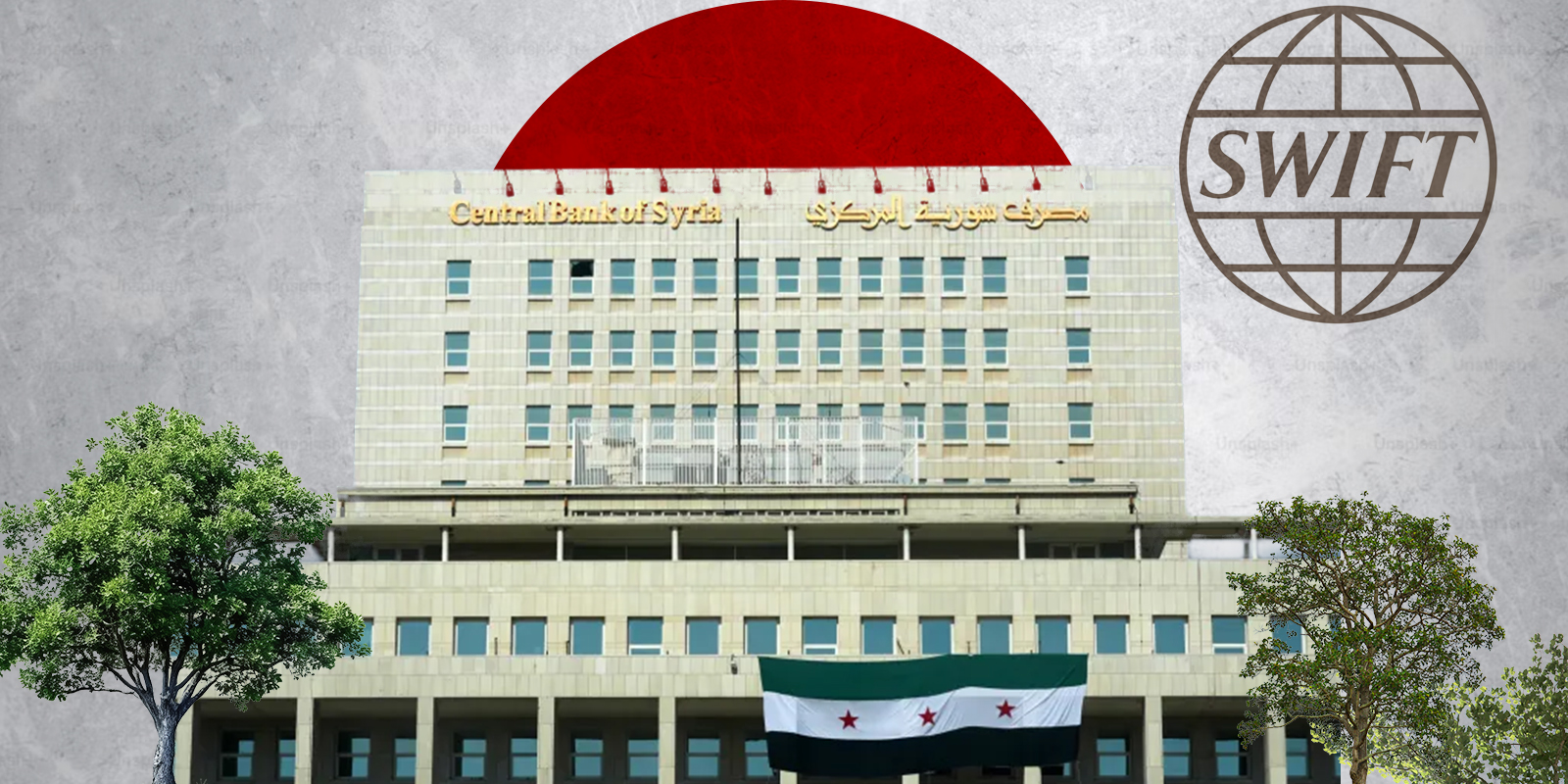
After more than 14 years of financial isolation, Syrian banks have been reconnected to the SWIFT system, and direct transfer options to Syria have begun appearing in some banks in Saudi Arabia, Turkey, Germany, and Italy.
Before SWIFT, transfers had to pass through informal intermediaries with fees reaching up to 40% and delays stretching into weeks, along with major legal and financial risks. Today, experts confirm, transfers will be faster, cheaper, and safer.
The Key to Economic Recovery
Dr. Amer Al-Abdullah, Professor of Economics at Muscat University, told +963:
“Two important developments today point to the beginning of financial recovery, which is the key to economic recovery in Syria. First, the U.S. Treasury’s Office of Foreign Assets Control (OFAC) officially removed Syria from the sanctions lists related to the assets-blocking program, legally allowing financial and commercial dealings with Syrian government institutions.”
The second development, he said, is: “The return of the Central Bank of Syria to the global SWIFT system, with the appearance of SY – SYRIEN, ARAB. REP. in international bank transfer directories across European, Turkish, Saudi, and other banks. This is a practical sign of Syria’s official reconnection to the global financial system after more than a decade of isolation.”
“These developments are not symbolic,” Al-Abdullah added. “They break the financial and political isolation imposed on Syria for years, opening the door for renewed external economic activity and allowing investment and bank transfers through the global SWIFT system.”
What is SWIFT and What Does Its Return Really Mean?
Economic expert Azzam Al-Khal, a former public bank director now based in Austria, stressed that the real turning point is Syrian banks’ compliance with international standards and their ability to restore correspondent banking relations, rather than a “decision from SWIFT” itself.
He explained to +963: “SWIFT is not a bank nor a direct transfer channel, it is a secure financial messaging network that standardizes communication between banks (BIC/ISO 9362, ISO 20022), enabling payments, collections, and letters of credit via correspondent banks. In other words, returning to SWIFT does not by itself guarantee money flows; it requires foreign banks willing to accept or process instructions from Syrian banks. SWIFT, as a Belgian company, complies with EU decisions to cut off certain entities, as happened with Iran in 2012 and some Russian banks later. In Syria’s case, there was no direct SWIFT decision; rather, global sanctions and compliance risks made banks withdraw.”
Why Was Everything Blocked for So Long?
Lawyer Saba Al-Ali, a Dubai-based specialist in corporate and banking law, told +963:
“Western, especially U.S., sanctions made it extremely difficult for global banks to assess the risks of dealing with Syrian economic entities, even when humanitarian exemptions existed. True, OFAC issued ‘General License 23’ in February 2023 to facilitate earthquake-related relief transfers for 180 days, but that was not a lifting of sanctions. Once the license expired, the complications returned.”
The issue, he said, was not technical but compliance-related. Global correspondent banks increasingly adopted a “de-risking” policy to avoid fines. In high-risk environments like Syria, compliance costs rise by double-digit rates annually, and violations can bring penalties of hundreds of millions. Thus, many international banks prefer to cut ties entirely, even if transactions are technically legal.
“This,” Al-Ali added, “is why Syrians relied on informal “hawala” networks for years. As for trade, most imports were financed through advance payments, complex transfers, or regional money-exchange intermediaries, all of which raised costs and risks. Today, reactivation should, in theory, allow a return to normal trade finance tools such as letters of credit, documentary collections, and short-term credit lines with correspondent banks.”
According to him, the direct impact will include Lowering the “risk premium” on import bills (previously 5–15% above global prices due to multiple intermediaries and advance payments), improving payment terms from upfront payment to 30–90 days credit, easing immediate demand for foreign currency in local markets, in addition to narrowing the gap between official and parallel-market exchange rates as regulated inflows return.
But Al-Ali cautioned: “The question remains: will Gulf, Turkish, or European banks agree to open correspondent accounts with specific Syrian banks?”
“This depends,” he added, “on each Syrian bank’s compliance profile, legal and insurance guarantees, not on the label of ‘reactivation’ itself. Experts call this the critical layer in any comeback.”
Officially: Syrian Banks to Join SWIFT in Weeks
On July 6, Central Bank Governor Abdel Qader Husrieh announced that Syrian banks had regained access to SWIFT services for the first time since 2011, confirming that actual operations would begin within weeks.
He explained that the sector had already started sending and receiving transfers but still needed to establish direct correspondent relations with foreign banks. Work is underway, he said, to reconnect with Arab and European institutions as part of a central strategy to restore Syria’s international financial role.
He added that the Central Bank is seeking direct licensing to operate on SWIFT without intermediaries or service bureaus, placing Syria among the few Arab countries with such access. This, he said, will positively affect citizens by lowering costs, as imports will now be processed at official banking fees far below the rates of previous years. All foreign trade operations will henceforth be managed through the banking sector in coordination with the Ministries of Economy and Industry.
Optimistic vs. Cautious Scenarios
Analysts expect a visible effect on import prices within 3–6 months of the first successful letter of credit with correspondent banks, through gradually reduced risk premiums and the shift of up to 50% of transfers to official banking channels.
On the other hand, remittance experts foresee fierce competition between official banks and informal “hawala” networks. Unless banks offer better rates, faster processing, and higher transparency, most flows may not migrate to official channels.
As a result, correspondent account openings are likely to remain slow due to compliance fears, with remittances continuing to rely heavily on informal channels, limiting the impact on exchange rates and trade and confining improvements mainly to administrative processes within banks.











