


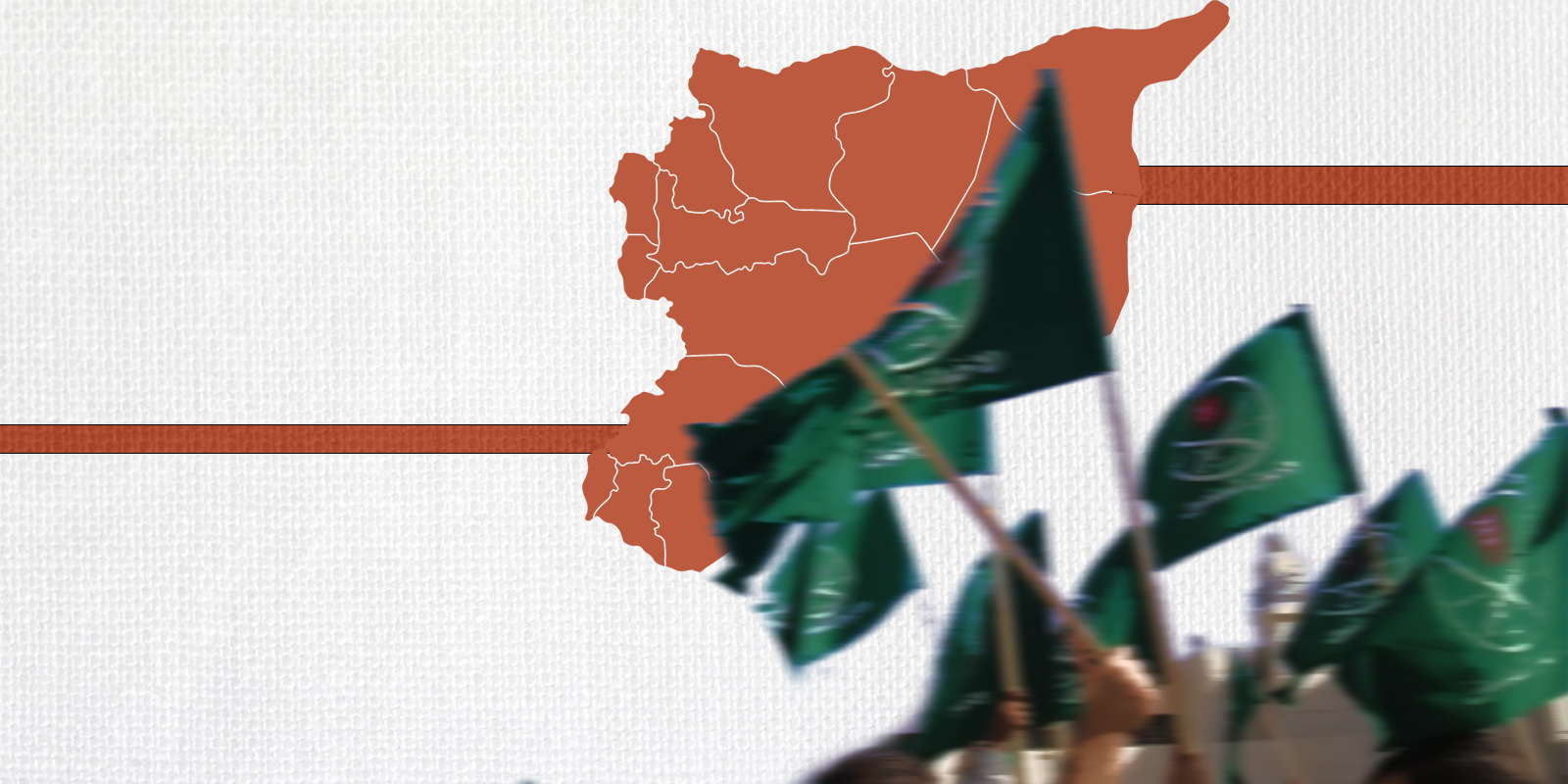
Amid the sweeping political transformations unfolding in Syria after the fall of the Assad regime, political voices have recently called for the dissolution of the Syrian Muslim Brotherhood. The move raises pressing questions about its timing, its relation to the ongoing Syrian–Gulf rapprochement, and its impact on the country’s future.
The Muslim Brotherhood in Syria is currently reassessing its political and social position in light of the complex shifts in the Syrian scene. The prospect of “dissolving the organization” is increasingly presented as a tactical pathway toward political gains.
Analysts argue that this proposal is far from incidental; rather, it represents a deliberate political signal with weighty meaning. It can be read as a preemptive measure designed to secure the stability of the nascent state, shielding it from regional powers openly hostile to the Muslim Brotherhood. In this sense, it appears more like a “security bond” ensuring Syria’s protection and strengthening its trajectory of recovery after decades of authoritarianism.
The Brotherhood’s Political Failure… and an Existential Challenge for the State
Supporters of dissolution argue that in today’s Syria, where the state confronts existential security threats and international pressures, suspending certain parties even if temporarily, could yield a greater benefit. This is particularly so as Syria reopens to the world and advances in regional reconciliation, which may come with conditions of reciprocity or guarantees of non-hostility.
Yet the Muslim Brotherhood’s own history in Syria complicates the matter. The group once dissolved itself during the union with Egypt, only to later reemerge. This raises questions about the utility of dissolution if it is not embedded within a broader national consensus project, one that acknowledges the distinctiveness of the current phase, secures broad political and social participation, and is safeguarded by clear constitutional guarantees protecting pluralism and the freedom of political action.
In this light, statements by the Presidential Advisor of Ahmed al-Sharaa’s, Muwafaq Zaidan, gain significance. He threatened the Muslim Brotherhood with exclusion unless it dissolved itself, arguing that its transnational project has failed, and that its proposals have drifted far from reality, no longer serving the state’s present needs.
Also read: https://963media.com/en/25/08/2025/the-return-of-the-syrian-army-should-anyone-still-be-waiting/
Analysts interpret these remarks as a reassuring signal to Arab states that outlaw the Muslim Brotherhood and resist its reemergence in Syria’s new political scene. They also mirror the evolving mindset within Damascus’s ruling political environment.
From this perspective, the option of “dissolution” is not just an organizational act, but a crucial turning point in drawing the outline of the new state. While stability is a legitimate and necessary objective, the optimal path to it remains consensus: forging a unifying national charter, transforming threats into opportunities for reconstruction, and balancing domestic and foreign interests alike.
Syrian writer and political figure Darwish Khalifa told +963 that since mid-July in Turkey, the Muslim Brotherhood has begun reassessing its political and social role, more than four decades after most of its leadership was pushed out following the events in Hama, Aleppo, and Jisr al-Shughur.
Khalifa notes, “with the fall of the Ba’athist regime and the rise of a religiously oriented military force that was never part of Syria’s traditional political scene, the political and social landscape appears ambiguous and uncertain for all actors, including the Muslim Brotherhood.”
Despite ideological proximity between the Muslim Brotherhood and Hay’at Tahrir al-Sham, and the involvement of some the Muslim Brotherhood-affiliated figures in ministries or local administrations, Khalifa observes that the Muslim Brotherhood’s situation “differs little from other parties and movements whose influence and presence have sharply receded.”
He explains that the Muslim Brotherhood, founded nearly eight decades ago as a cross-border Islamic religious project, has been unable to adapt to the region’s profound shifts, nor has it succeeded in redefining its role within Syria’s new realities.
Internal Divisions… Dissolution as an Option
According to Khalifa, the Muslim Brotherhood cannot be compared to the Syrian National Coalition (SNC), nor even to armed factions that emerged to topple the old regime. “The Islamic organization has clung to a narrow vision that has not fully absorbed the logic of Syrian political work or its evolution.”
The Muslim Brotherhood also suffers from entrenched internal divisions, particularly between its Hama and Aleppo blocs. This rift paved the way for the election of General Supervisors from outside these blocs over the past fifteen years, starting with Mohammed Walid from Latakia for two terms, followed by Amer al-Bousalama from Deir Ezzor in the current term.
Given these dynamics, the possibility of voluntarily dissolving itself remains on the table. “Not as an act of surrender,” Khalifa stresses, “but as a tactical move that could allow it to secure political concessions from Transitional President Ahmed al-Sharaa.”
Still, he adds, “such a decision will not come without reciprocal guarantees, especially given the fragility of Syria’s political and administrative stability.” This course, however, could provide the Brotherhood with an opportunity to reposition and continue its political and social engagement after an eight-decade journey.
Dissolution as a Path to Stability
Munir Adeeb, a researcher on extremist movements, international terrorism, and national security issues, told +963 that “dissolving ideologically driven and extremist religious groups, including the Muslim Brotherhood, is a crucial factor for the stability of regional states.”
Adeeb argues that the presence of such groups undermines the strength of the nation-state, its internal control, and its political stability. He adds: “If the Muslim Brotherhood wishes to engage in politics, it must operate as a party subject to the rules of political parties, or else dissolve itself and function as a social current within society.”
For Adeeb, stability in Syria and the wider Arab world begins with the Muslim Brotherhood and similar groups disbanding. “Any religious, ideological, or extremist current could trigger renewed conflict in Syria, whether in the short or long term, bringing instability and chaos,” he stresses. “The solution is dissolution.”
He further notes that this principle should have been applied by all religious and extremist organizations in Syria from the very first moment of liberation from Bashar al-Assad’s regime. He adds that Ahmad al-Sharaa’s call also applies to Hay’at Tahrir al-Sham (formerly al-Nusra Front), which is now compelled to implement dissolution in practice rather than by mere statements.











