


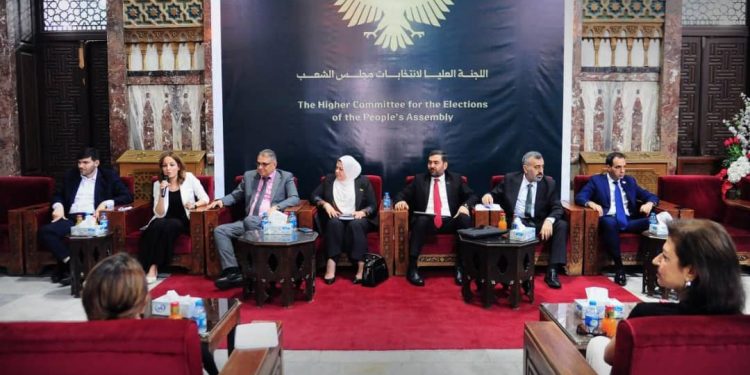
Damascus / Hasaka – Syria’s High Electoral Committee announced on Saturday the postponement of parliamentary elections in the provinces of al-Suwayda, Raqqa, and Al-Hasakah due to “security concerns”.
The Syrian Electoral Committee told Al-Hadath that it has coordinated with local and international organizations to ensure election integrity, noting that electronic voting is not feasible for security reasons. With no alternatives to postponing elections in Raqqa, Al-Hasakah, and al-Suwayda, the committee emphasized that voting will not take place outside these provinces, which are responsible for the delay. Their allocated seats make up 10% of the People’s Assembly, and the president may appoint their representatives.
Earlier, President Ahmad Al-Sharaa ratified a temporary electoral law for the People’s Assembly, outlining eligibility criteria for candidates, seat allocation, and voting procedures. Under the law, the assembly has 210 members: two-thirds are elected under the presidential decree, while the remaining third are appointed by the president. Candidates must meet strict criteria, including Syrian nationality before May 1, 2011, legal competence, no criminal convictions (except certain political cases), and no affiliation with the former regime or extremist organizations.
Al-Suwayda, located in southern Syria, is predominantly Druze and recently witnessed outbreaks of violence, prompting local factions to unify under a new military formation called the “National Guard.” Announced yesterday, the initiative is reportedly endorsed by the spiritual leadership of the Druze community and aims to consolidate local forces within an organized institutional framework to enhance regional security.
Read also: https://963media.com/en/24/07/2025/who-governs-suwayda-regional-power-contest-in-southern-syria/
Raqqa and Al-Hasakah, in northern and northeastern Syria, are under the control of the Kurdish-led Autonomous Administration of North and East Syria (AANES), which oversees civil and security affairs with a focus on decentralized governance and multi-ethnic representation.
The Administration has formally rejected the upcoming elections, calling them “undemocratic and inconsistent with the goals of the Syrian revolution”. In a statement, the administration argued that the vote would marginalize nearly half of Syria’s population through displacement or exclusion and said that labelling their region “unsafe” is a false justification to deny over five million Syrians their political rights. The administration urged the international community and the UN not to recognize the vote, citing UN Resolution 2254, and emphasized the need for a truly inclusive, decentralized political process in Syria.











