


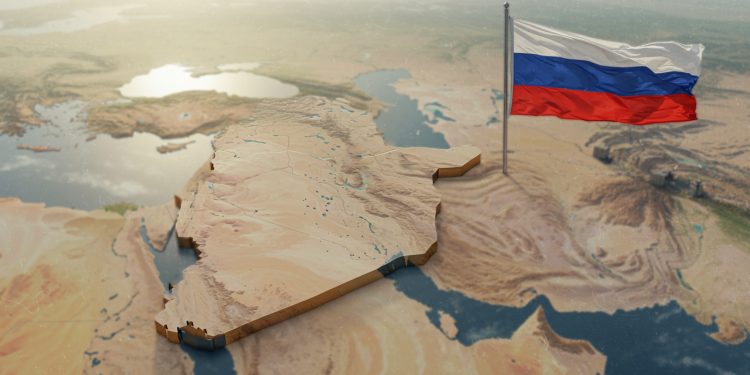
Following a phone call on Monday between Russian President Vladimir Putin and Israeli Prime Minister Benjamin Netanyahu, in which Putin reiterated Moscow’s support for Syria’s territorial integrity and sovereignty, a key question resurfaces: How influential is Russia in Syria today, particularly after the fall of the previous regime?
According to a Kremlin statement, the two leaders discussed strengthening coordination between Moscow and Tel Aviv to address regional security and counterterrorism challenges, with Syria as a central focus. Putin also emphasized the importance of protecting minority rights in Syria, calling it essential for internal stability and national security.
Russia’s Political Focus in Syria
Despite these official statements, this support has not translated into concrete on-the-ground action, according to international relations expert and Russian affairs analyst Mahmoud Al-Afandi. He told +963 that Russia has significantly scaled back its political and security presence in Syria since the fall of the former regime.
Al-Afandi notes that the relationship between Moscow and the new Syrian government, led by Ahmad Al-Sharaa, remains in a “transitional phase,” limited to diplomatic exchanges and talks on the future of Russian military bases in the country.
He explains that Russia’s current approach to the Syrian file is largely political, evident in its positions at the UN Security Council, particularly its condemnation of repeated Israeli strikes on Syrian territory. In a recent speech, President Al-Shara’ expressed appreciation for Russia’s political stances despite the notable decline in direct support.
On the ground, Al-Afandi says Russian presence is now confined to key strategic locations such as Hmeimim Airbase and the port of Tartus. Moscow has reportedly declined local requests for military intervention, especially in northern Syria; signaling, in his view, a deliberate decision to avoid entanglement in security matters.
This reflects a broader shift in Moscow’s strategic priorities, Al-Afandi argues. Russia now views the Syrian conflict through a global lens, tying it to its ambition of reshaping the international order and moving away from the current U.S.-led unipolar system.
As for Russian-Israeli relations, Al-Afandi notes that repeated phone conversations between Putin and Netanyahu have not curbed Israel’s strategy of weakening Syria from within by exploiting internal divisions and capitalizing on the power vacuum left in the aftermath of regime collapse.
Russia as a “Quiet Coordinator”
Political analyst Hassan Naifi offers a more critical view, describing Russia’s role in recent years as that of an “unofficial coordinator” between Israel and Syria. He points to Moscow’s control of Syrian airspace and foreknowledge of Israeli airstrikes as evidence of its intermediary role.
However, Naifi believes Russia’s ability to continue playing this role has diminished following major developments, most notably the events of October 7, the fall of the previous regime, and the waning of Iranian influence in Syria.
Russia’s efforts to preserve a minimum level of influence in the region help explain its intensified dialogue with Israel, despite knowing that Tel Aviv rarely yields to international pressure. Russia, Naifi adds, now lacks the tools to restrain Israeli airstrikes and is instead focused on maintaining Israel’s relatively neutral stance regarding the war in Ukraine.
On the new Syrian government, Naifi highlights cautious engagement from Moscow, particularly after President Al-Sharaa requested the extradition of former President Bashar al-Assad and his aides, who are currently residing in Russia. Though Moscow has not publicly addressed the request, its silence reflects an unwillingness to engage openly on such contentious matters.
Inside Syria, Naifi notes that opposition forces continue to seek foreign backing, while Russia maintains a low profile, and Iran selectively supports certain former military figures. He underscores that all external powers, including Israel, treat local Syrian actors as tools to serve their strategic agendas, rather than engaging with genuine concern for Syria’s stability or communities.
A Fragile Balancing Act
In conclusion, Al-Afandi warns that the new Syrian government faces mounting challenges amid eroding trust with Moscow, escalating Israeli aggression, and the absence of a meaningful international response.
He argues that restoring balance in Syria and the broader region requires a serious rethinking of the global system and international law; both of which have proven inadequate in deterring ongoing violations and foreign interference.
According to experts, despite Moscow’s continued verbal commitment to Syrian sovereignty, its current approach to the Syrian file is marked by caution and calculated distance. Russia appears to be monitoring domestic and regional developments without making firm commitments or taking decisive action, waiting instead to see how global power dynamics evolve.











