


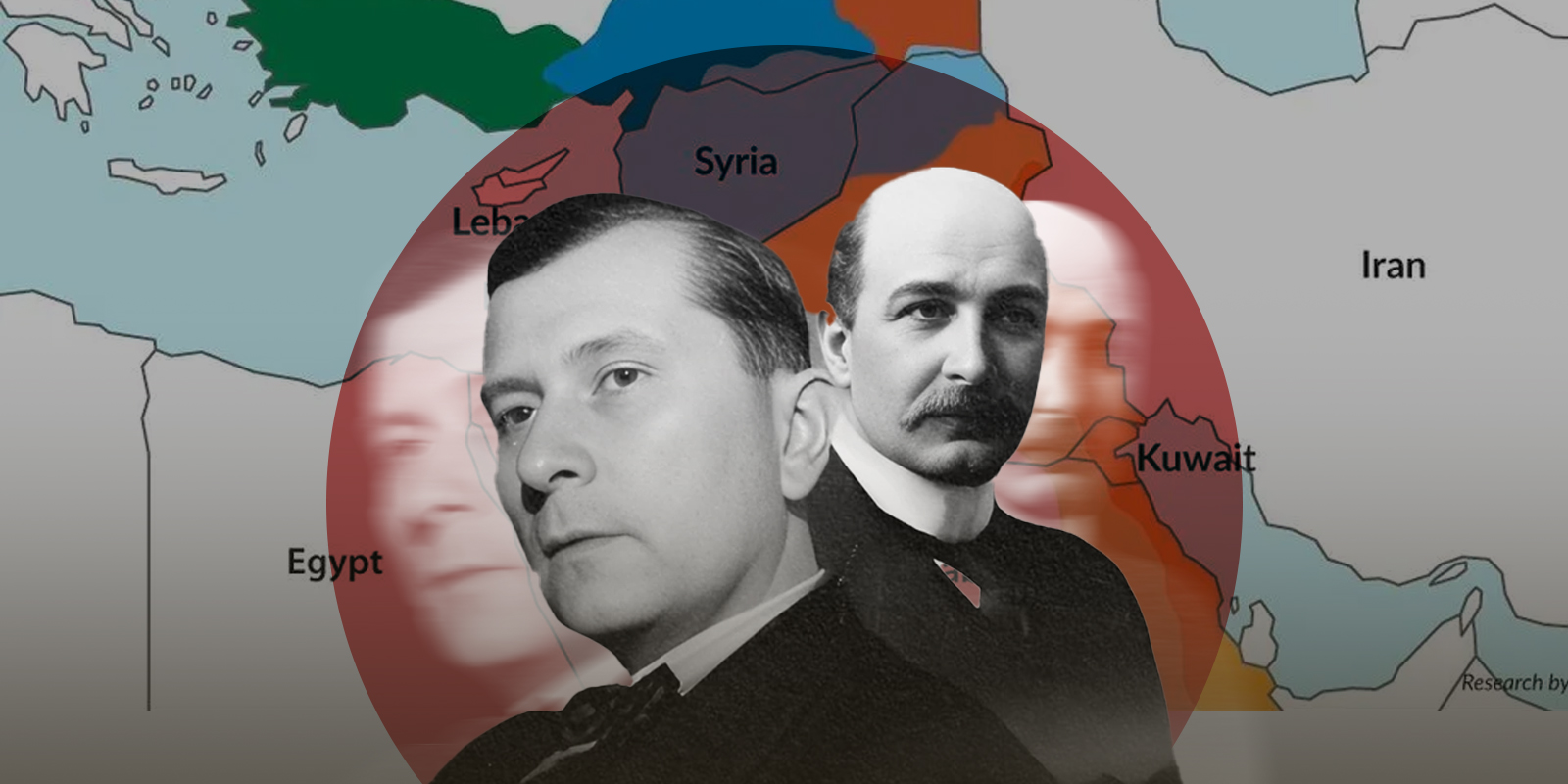
As part of a series of often controversial remarks since his appointment as the U.S. envoy to Syria, Ambassador Thomas Barrack, currently based in Turkey, made notable statements in late May regarding the 1916 Sykes–Picot Agreement. He referenced the historic deal that helped shape the modern-day borders of the Middle East, especially amid ongoing discussions of a so-called “New Middle East,” a concept the U.S. has promoted, and which Israel has echoed frequently since the Abraham Accords were signed with several Arab countries.
What Was the Sykes–Picot Agreement?
The Sykes–Picot Agreement was a secret deal between Britain and France, signed in 1916 during World War I. It was negotiated by British diplomat Mark Sykes and French diplomat François Georges-Picot. The agreement, later approved by the foreign ministries of Britain, France, Russia, and Italy, outlined the division of the defeated Ottoman Empire’s territories in the Levant and Mesopotamia.
Under this agreement:
- Northern Iraq, Syria, and Lebanon were placed under French influence.
- Southern Iraq, Jordan, and the Palestinian ports of Haifa and Acre were placed under British control.
- Italy was promised parts of eastern Anatolia.
- Russia was to receive Armenia and control over the Turkish straits.
These arrangements laid the groundwork for the modern borders of several Middle Eastern states including Turkey, Iraq, Syria, and Lebanon.
Read also: Syria and Israel Hold Secret Talks Amid Shifting Regional Alliances
Regional Solutions and the ‘Era of Investment’
In a post on X (formerly Twitter) in May, Ambassador Barrack asserted that the era of Western-imposed borders and mandates in the Middle East was over. “A century ago, the West imposed maps, mandates, penciled borders, and foreign rule,” he wrote. “Sykes-Picot divided Syria and the broader region for imperial gain—not peace. That mistake cost generations. We will not make it again. The era of Western interference is over. The future belongs to regional solutions, but partnerships, and a diplomacy grounded in respect.”
He added that as President Donald Trump reiterated on May 13, “Gone are the days when Western interventionalists would fly to the Middle East to give lectures on how to live, and how to govern your own affairs.” Barak emphasized that Syria’s tragedy was born of fragmentation, and that its renewal must come from dignity, unity, and investment in its people. “That starts with truth, accountability—and working with the region, not around it. We are standing with Türkiye, the Gulf, and Europe—this time not with troops and lectures, or imaginary boundaries, but shoulder-to-shoulder with the Syrian people themselves”.
Recent military events in Syria’s southern Suwayda (Sweida) province reignited debate over redrawn borders. Direct Israeli airstrikes targeted Syria’s Ministry of Defense and Ministry of Interior forces, as well as the General Staff building and the Presidential Palace in Damascus.
These attacks, amid declining Iranian and Hezbollah influence in Syria following the events of October 7, have revived speculation about possible Israeli plans to reshape the region politically, militarily; or even geographically. This comes despite confirmed reports of ongoing direct talks between Syria and Israel, mediated by the U.S. and facilitated by the UAE, Turkey, and Azerbaijan.
A New Middle East
While Barrack emphasized that there would be “no new Sykes–Picot,” he repeated the broader U.S. vision for a “New Middle East”, a vision focused on development, regional alliances, and economic investment involving Israel, a reformed Syria, Turkey, and the Gulf states. However, the specific shape and feasibility of this vision remain unclear, particularly since it appears tied to normalization between Israel and more Arab states, including Syria and Lebanon, under the umbrella of the Abraham Accords.
Syrian political analyst Samer Khilewi, based in London, believes that Barak’s comments reflect the current political mood but may not necessarily translate into action. “We’ve seen many statements throughout history that simply set the stage for future developments,” he told +963, “The Sykes–Picot era cannot be compared to the present.”
Read also: Is the Syria–Saudi ‘S–S Equation’ Making a Comeback in Lebanon?
Khilewi notes that while the Sykes–Picot Agreement shaped the modern Arab world, any forthcoming transformation in the Middle East is more likely to be political, not territorial. “We’re entering a new phase, not marked by border changes, but by new political alignments, especially after the dismantling of what was known as the ‘Axis of Resistance’. The U.S.–Israel alliance will likely impose new realities that no one can effectively oppose, especially in a region where national interests often override collective ones.”
Lebanese journalist and political writer Saad Kiwan, based in Beirut, argues that Barrack’s statements reflect a uniquely American tendency to approach regional crises with a blend of ambition and unrealistic expectations. “Barrack seems to be forecasting developments that remain outside his control, or even verge on fantasy, characteristic of the American administration under President Trump, which approaches foreign policy like a real estate deal,” Kiwan told +963.
He added that Barrack’s ideas about geographical and geopolitical transformation are detached from reality: “We are witnessing political, not territorial, change. Syria, for instance, has experienced not only a regime collapse but also a total reversal in political direction. That’s the real transformation.”
Despite Washington’s repeated assurances that no new borders will be drawn, Ambassador Barrack himself recently warned in an interview with The National that Lebanon faces an “existential threat.” He warned that unless decisive action is taken, particularly regarding Hezbollah’s weapons stockpiles, Lebanon risks being reintegrated into “Greater Syria” or falling under broader regional control.
“You have Israel on one side, you have Iran on the other, and now you have Syria manifesting itself so quickly that if Lebanon doesn’t move, it’s going to be Bilad Al Sham (a historical region encompassing modern-day Syria, Lebanon, Jordan, Palestine, and parts of southern Turkey) again,” Barrack said. “Syrians say Lebanon is our beach resort. So we need to move. And I know how frustrated the Lebanese people are. It frustrates me.”
A Region Built on Alliances, Not Armies
Kiwan contends that any shifts in the region will stem from enforced policy changes, particularly in places like Iran and Gaza, driven by U.S. strategy and technological superiority. “There’s a clear push toward a regional order built around strategic alliances with the U.S., but with a degree of autonomy. Development and technology will shape roles and influence.”
Regarding Barrack’s remarks about Lebanon being absorbed back into Syria, Kiwan sees it as both “a provocation and a warning.” He suggests Barrack realized during visits to Lebanon that the government lacks the capacity or will to disarm Hezbollah. “After being struck by the U.S., Iran is wounded but still clings to its regional proxies to show it remains a player.”
Read also: How Do US, Israeli, and Emirati Interests Intersect in Syria and Lebanon?
Khilwi adds that Israel stands to gain the most from the region’s next chapter, “not as praise, but as a hard truth.” He says Israel is maximizing its military and political leverage, whether through direct or covert interventions, to shape its vision of the region. “Recent developments in Turkey regarding the Kurds, and upcoming changes in Syria, could usher in regional stability, but that’s not necessarily in Israel’s interest.”
Kiwan concludes, “We are entering a new Middle East. The change will be political and will include Israel. This is what President Trump is working toward, uniting Gulf ties with Israel, despite Netanyahu’s resistance. Normalization is advancing in parallel, even involving groups like the PKK in Turkey. Nationalist regimes, especially Iran, Syria, and Iraq, must now adapt to the new rules.”
It’s worth noting that with the fall of Bashar al-Assad’s regime in Syria in early December, Israel launched a series of military operations and ground incursions. Israeli officials began openly discussing the possibility of dividing Syria into separate states, provinces, or autonomous zones, arguing that it was necessary for national security. Among the proposals was the so-called “David Corridor,” a route stretching from northern Iraq through southern Syria and northern Jordan to Israel. This comes despite U.S., Turkish, and other allied opposition to any changes in the region’s territorial boundaries.











