


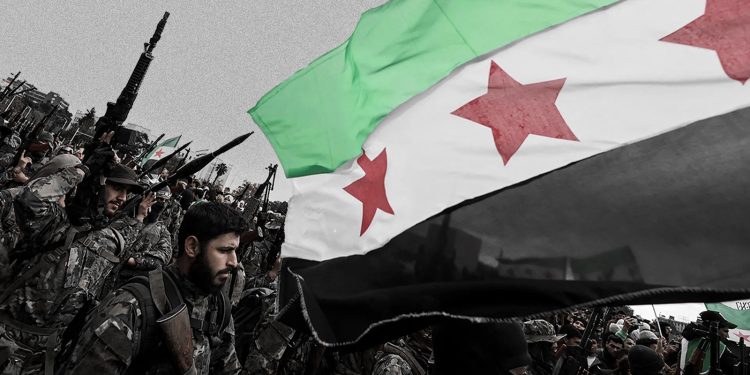
Following the fall of the Assad regime in late 2024, brought about by the large-scale military campaign “Deterrence of Aggression” led by Hay’at Tahrir al-Sham (HTS), Syria entered a critical phase of transition, fundamentally reshaping its political and military landscape. The swift collapse of the former army’s structure, the fragmentation of its leadership, and the withdrawal from key territories revealed the fragility of the institution that once formed the regime’s backbone. This vacuum has opened the door to redefining what a national army in Syria could look like.
In January 2025, the “Victory Conference” was convened with the participation of several armed factions. The event resulted in the formal dissolution of the Baath Party, the former regime’s army, and its security services, alongside the disbanding of the factions themselves. However, the conference came under widespread criticism due to the absence of key political and societal actors, as well as its lack of a coherent, integrated vision for establishing a new military institution.
Months after these developments, the structure and identity of the new Syrian army remain undefined. The criteria for joining the force are still unclear, and no formal mechanisms have been announced for integrating rebel factions, regime defectors, or foreign fighters. Amidst this ambiguity, a pressing question dominates Syrian public discourse: Will this new army truly be national, uniting Syrians across political, regional, and ideological lines?
The Outlines Are Drawn, But Implementation Remains Complex
In an exclusive interview with +963, Dr. Muhammad Abbas, a researcher and expert in military affairs, stated that since the regime’s fall, the Ministry of Defence has been working to “lay down the broad outlines for building the Syrian armed forces in accordance with a new national doctrine.” He emphasised that the integration process faces “significant difficulties due to contradictions among factions, whether ideological, cultural, or ethnic.”
He added that efforts are underway to incorporate the factions that participated in toppling the regime into this new doctrine, but progress has been slow due to the depth and complexity of these differences.
Addressing Türkiye’s involvement, Dr. Abbas said Ankara plays “a crucial role,” not only by providing military training but also by delivering curricula and tools essential for comprehensive rehabilitation at tactical, operational, and strategic levels.
On the issue of armament, Abbas noted a distinct tilt toward the Western camp. “There is a current trend toward relying on weapons and systems from the United States, the United Kingdom, France, and other NATO members,” he said, describing this option as “more realistic in light of current alliances.”
However, he warned of the potential obstacles, particularly Israel’s explicit opposition to the re-establishment of a strong Syrian army. “Israel has made it clear it will not tolerate the emergence of a Syrian force capable of participating in future regional conflicts, despite assurances from transitional leader Ahmed al-Sharaa, who stated that Syria poses no threat to its neighbours and seeks peaceful relations.”
As for integrating foreign fighters, Abbas acknowledged this as one of the most challenging aspects of the military rebuilding process. “Many of these formations possess strong ideological and ethnic identities. If they are absorbed as a single bloc, it would contradict the concept of Syrian national identity and risk creating enclaves incompatible with military doctrine.”
He added that such fighters must undergo disarmament, psychological and ideological rehabilitation, and be reoriented away from transnational agendas. “This is a complex process requiring enormous educational, moral, and social investment for them to function within a disciplined, national institution, without becoming a liability to either the army or society.”
Abbas concluded by cautioning against uncontrolled mass integration, warning that it could lead to dual loyalties within the ranks, undermining the core principles of national reconstitution.
Lack of Transparency and Rising Concerns Over Discrimination
Qasim Hariri, a former officer in the Free Syrian Army who had previously been in the national army before defecting, told +963 that institutional communication between the Ministry of Defence and defected officers remains virtually nonexistent. “Many of us are willing to participate in building a new national army free from politicisation and sectarianism, but there has been no formal outreach,” he said.
He pointed out that several defective officers have been rejected, often due to personal disputes or lingering conflicts from earlier periods of the war. “This threatens to repeat the same patterns of exclusion we previously experienced,” he warned.
According to Hariri, some individuals were admitted based on personal connections or kinship ties to current Ministry officials, damaging the credibility of the process. “This favouritism has undermined the confidence of many defectors in the fairness of the integration effort,” he said.
Regarding armed groups of a civilian nature, Hariri emphasised the importance of distinguishing between those who took up arms for self-defence and those involved in violations. “The integration process must rest on national principles aligned with transitional justice. It must include proper training and qualifications, and allow equal opportunity without discrimination,” he said.
He concluded by expressing hope that the new Ministry of Defence would rebuild the military institution based on competence and national loyalty. “This should happen through a transparent, legal, and institutional framework with broad community involvement, one that restores the army’s legitimacy in the eyes of Syrians.”











