

After years of economic deterioration, international isolation, a lack of investment, and the collapse of the local currency, Syria has entered a new phase of recovery following the fall of the Assad regime. The recent announcement of lifted U.S. and European sanctions has paved the way for a wave of investment across various sectors, led by the energy sector, which alone has attracted over $7 billion in commitments.
Major Agreements
On May 29, the Ministry of Energy in the Syrian Transitional Government signed a landmark agreement with Qatari, Turkish, and American firms to advance international investment in Syria’s energy infrastructure. The deal includes the development of four power generation stations using combined-cycle gas turbine (CCGT) technology. These stations will be located in Deir ez-Zor Governorate, Mharda and Zizoun in the countryside of Hama Governorate, and Trifawi in the countryside of Homs.
The agreement was concluded with Qatari companies UCC Holding and Orbacon, Turkish firms Kalyon GES Enerji Yatirimlari and Cengiz Energy, and American company Power International Holding. The total projected generating capacity of the four power plants is approximately 4,000 megawatts, utilising advanced American and European technology. The deal also includes the construction of a 1,000-megawatt solar power plant in the Wadi al-Rabi area, south of Damascus.
Muhammad al-Bashir, Minister of Energy in the Syrian Transitional Government, stated during the signing ceremony that the total value of the agreement is $7 billion and that it will result in the generation of 5,000 megawatts of power. He emphasised that this development will significantly increase electricity availability, with positive impacts on all aspects of daily life in Syria.
Ramez al-Khayyat, CEO of Orbacon Holding, confirmed that the participating companies will employ cutting-edge energy technologies. He noted that the projects are expected to create over 50,000 direct jobs and approximately 250,000 indirect employment opportunities.
Technical Details
Providing further details, the Director of the General Corporation for Electricity Transmission and Distribution in Syria, Khaled Abu Di, told Syrian news channel Alekhbariya that the agreement includes two types of power generation: solar and fossil fuel-based. The solar projects are expected to take up to two years to construct and will be gradually integrated into the power grid. The fossil fuel-based stations will require three to four years to begin generating electricity.
Abu Di stated that upon full implementation, the total generation capacity could reach 9,120 megawatts, enough to cover up to 85% of Syria’s electricity needs. He estimated that a significant improvement in power availability could be achieved within three to five years, depending on fuel supply. He added that the Ministry of Energy is working to ensure this by activating oil production facilities and securing new fuel supplies.
Read more: Funding Shortfall Forces UN to Halt Syrian Refugee Aid in Lebanon by 2025
Implications of the New Agreements
Dr. Ziad Arabsh, academic and economic advisor, explained that Syria’s installed electrical capacity stood at approximately 8,900 megawatts in previous years. However, only about 7,000 megawatts were functionally available, due to inefficiencies and self-consumption losses. Now, with the newly signed agreement promising an additional 5,000 megawatts of generation capacity using cutting-edge global technologies, the country is poised to more than double its effective energy output with far greater efficiency.
Speaking to +963, Arabsh emphasised that realising the full benefits of these projects requires a comprehensive rehabilitation of Syria’s power infrastructure. This includes installing new equipment at the sites of the future power stations, integrating them with existing facilities, and establishing a unified national grid. Essential components such as capacitors, transformers, and high- and low-voltage transmission lines must be deployed, alongside efficient distribution to industrial and residential consumption centres. He suggested that with successful implementation, Syria could finally put an end to chronic power outages.
Youssef Lahlali, a researcher specialising in international relations in the Mediterranean region, believes that the energy agreement will have profoundly positive implications for Syria. He noted that energy is the backbone of any economy, as it powers transportation, manufacturing, and virtually every sector of daily life.
In his remarks to +963, Lahlali stated that after years of economic collapse and international sanctions, Syria faced acute shortages of raw materials and basic infrastructure. These new agreements, he said, signal the beginning of real economic revival. The ripple effects will be felt by Syrian citizens across all segments, whether as workers, contractors, employees, or entrepreneurs, as new opportunities arise and living conditions begin to improve.
Although no official announcements regarding major oil and gas contracts had been made by the end of May, despite the lifting of U.S. and European sanctions, several media outlets have reported that companies from major countries, including the United States, are preparing to enter Syria’s oil and gas sectors in the coming years.
An Expected Agreement with the United States
On May 27, the American network CNBC reported that Syria and the United States are engaged in talks to develop Syria’s energy sector. The report quoted Jonathan S. Bass, CEO of the American liquefied natural gas company Argent LNG, who revealed a five-stage strategic plan that involves launching a joint venture called SyriUS Energy, a Syrian-American initiative aimed at rebuilding the country’s oil and gas industry with participation from major global companies.
The first phase of the plan involves re-establishing security and conducting a comprehensive infrastructure assessment, beginning with the safeguarding and assessment of key oil fields such as Al-Omar, Al-Tanak, and those in Al-Hasakah. This stage also includes planning for the development of additional oil fields.
The second phase focuses on stabilising domestic energy supplies by rehabilitating the Homs and Baniyas refineries and restoring the national pipeline network. This phase also aims to expand access to natural gas for residential use and broader energy needs in an integrated, sustainable framework.
Read more: Iran: The Last Episodes of “National Drama”
The third phase centres on forming a publicly listed entity, either on the New York Stock Exchange or Nasdaq, that would own and manage energy assets. The objective is to forge partnerships between Syria’s public and private sectors while attracting international investors. This stage also includes the creation of SyriUS Energy, a new Syrian national oil company, and drawing on foreign technical expertise aligned with Syrian national interests. Furthermore, it outlines the structuring of risk service agreements and production-sharing contracts with allied countries, facilitated through major American oil companies based in Houston, including ExxonMobil, Chevron, ConocoPhillips, Accelerate, TotalEnergies, Shell, and others.
The fourth phase introduces governance and transparency mechanisms. It includes the establishment of a U.S.-listed entity in which a private Syrian sovereign energy fund would hold a 30% stake. This structure aims to ensure transparent management and distribution of oil revenues, enhancing confidence among foreign investors and public institutions.
The fifth phase envisions Syria’s readiness for energy export and regional integration. This includes establishing legal export routes through Iraq and Israel or via rehabilitated ports on the Syrian coast, as well as integrating with neighbouring countries through shared electricity grids and regional oil and gas pipelines, thereby enhancing Syria’s economic diplomacy.
Dr. Ziad Arabsh noted that two key issues remain unresolved regarding the broader energy agreements signed with Qatari, American, and Turkish companies: identifying who will finance contracts potentially worth up to $25 billion, and covering operational fuel costs, which may exceed $50 million per month, unless a substantial portion of energy generation comes from solar power.
In a significant policy shift, the European Union announced in late February a new law permitting European companies to explore for oil and gas and invest in power generation within Syria. The EU stated that the law enables European firms to seek Syrian partners and begin joint ventures to explore and extract energy resources. Notably, it also permits these companies to export and market Syrian oil and gas in EU countries without facing legal or economic barriers.
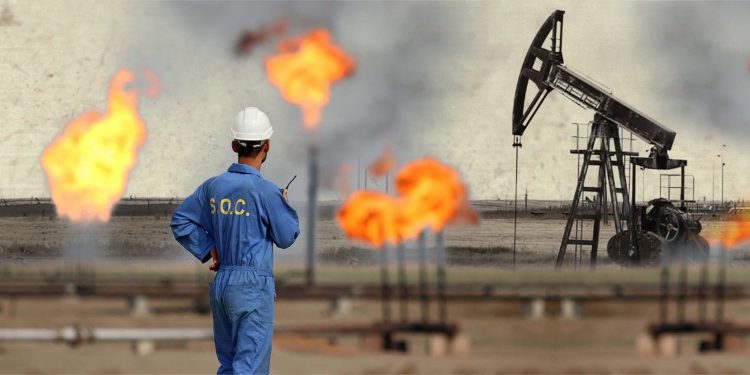
Economic data show that Syria’s oil sector has sharply declined since the onset of the conflict in 2011. Daily oil production fell from 385,000 barrels in 2010 to approximately 110,000 barrels currently. Of that amount, around 100,000 barrels per day are produced from fields controlled by the Syrian Democratic Forces (SDF), while areas under the Syrian government’s control contribute only about 10,000 barrels per day.
Natural gas output has also diminished, from 30 million cubic meters per day in 2010 to just 9.1 million cubic meters per day today. Of that, the current Syrian government produces approximately 8 million cubic meters daily, with SDF-controlled fields contributing around 1.1 million cubic meters per day.
According to 2015 estimates by the U.S. Energy Information Administration (EIA), Syria holds proven oil reserves of about 2.5 billion barrels and natural gas reserves of roughly 240 billion cubic meters.