


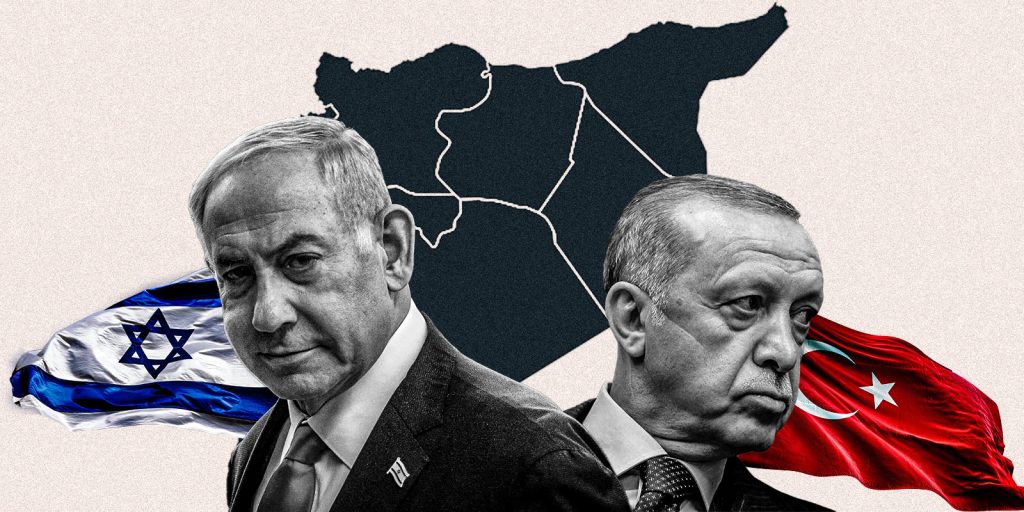
Middle East Eye reported Wednesday that Israel and Turkey have reached a discreet agreement to prevent military clashes and tensions in Syria. Citing informed sources, the report said both sides have set up a direct communication line, operating around the clock, to manage military coordination and prevent any unintended confrontations in Syrian airspace or on the ground.
The arrangement follows months of heated public exchanges between the two countries over expanding influence in Syria. Israel has grown increasingly concerned over Turkey’s rising military presence, seeing it as a long-term security challenge. This was highlighted in an Israeli intelligence leak published by N12 in January. On the other hand, Ankara has consistently condemned Israeli airstrikes inside Syrian territory, calling them a direct threat to regional stability.
According to Middle East Eye, Turkey proposed deploying ground forces in Syria — including armored vehicles and infantry units — on the condition that those positions would not host equipment capable of tracking Israeli aircraft. That means no radar stations or air defense systems. Israel reportedly accepted the proposal as long as Turkish forces don’t interfere with its own operations. One of the areas discussed for Turkish presence is north of Palmyra.
Related: Israel and Turkey Agree to Avoid Military Clashes in Syria
Meanwhile, the Israeli newspaper Israel Hayom confirmed that the two sides have reached an understanding to coordinate their military activity in Syria and prevent any unintended incidents. One source said Israel has few objections to Turkish ground forces, including tanks and troops, operating in Syria — as long as Israel’s red line remains intact: the southern region of Syria must remain a demilitarized zone.
According to the same source, one of the thorniest issues has been the presence of Turkish forces near the Palmyra region, particularly around the Tiyas (T4) airbase. The base has been used by Iran’s Revolutionary Guard as a logistics hub to support Hezbollah and has been repeatedly targeted by Israeli airstrikes. The talks have revolved around how and where Turkey might deploy radar or air defense systems without obstructing Israeli operations.
A Temporary Deal for Strategic Calm
Researcher Rashid Hourani from the Jusoor Center told +963 that this agreement is a short-term, tactical move pursued by Ankara to preserve stability and avoid military escalation in Syria. Turkey’s main interest, he says, lies in preventing further ground advances and limiting tit-for-tat violence, especially as Syria’s population shows increasing signs of resistance against Israel in hopes of rebuilding their war-torn country.
Hourani pointed to a confrontation last March in the village of Kuya in western Daraa, where Syrian youths reportedly stood up to an Israeli patrol. He views it as a reflection of the growing Syrian desire to challenge Israeli presence and shift focus toward reconstruction.
He also emphasized that Israel views Turkey’s influence in Syria with apprehension, seeing both Ankara and the emerging Syrian political landscape as sharing a common ideological and religious conviction that Israel is fundamentally an occupying power.
Read also: America and Iran: A Contradiction in Terms
A Regional Deal Under the Surface
Political scientist Salah Qayrata, speaking from Madrid, believes the agreement is less about tactical deconfliction and more about a silent, strategic reshaping of regional dynamics. According to him, this marks the beginning of a broader American-backed deal to redraw spheres of influence in Syria.
Turkey already has boots on the ground in the north, while Israel maintains a pattern of targeted airstrikes against Iranian and Hezbollah-linked infrastructure in central and southern Syria. Both operate in overlapping theaters, but neither seems eager for a direct clash.
Qayrata argues that the United States is facilitating this new arrangement as it shifts away from supporting Iranian or Russian dominance in Syria. With Moscow distracted by the war in Ukraine and facing a weakened economy under sanctions, Washington is looking to empower a more manageable duo: Israel and Turkey.
Power-Sharing Without Partition
Rather than dividing Syria along new borders, Qayrata sees this deal as a “functional distribution of influence.” It’s not about tanks and territory anymore — it’s about intelligence, economics, reconstruction, and long-term political shaping. In this new phase, influence is wielded through access, technology, and political leverage rather than physical occupation.
He describes Turkey as a pragmatic regional player with clear security interests, but one that remains open to Western influence. Israel, for its part, maintains a strategic alliance with Washington and firm red lines about its own security.
From this angle, the goal is not to partition Syria but to influence its future — its economy, its reconstruction, and its political structure — in ways that do not contradict the interests of Israel, Turkey, and the United States.
In early April, Israeli jets carried out airstrikes on military targets in Damascus, Hama, and Homs, including Hama’s military airport and the T4 base in eastern Homs. The strikes also hit Syria’s scientific research center in Barzeh, just outside Damascus.
According to Reuters, prior to these strikes, Turkish inspection teams visited three airbases in Syria — including T4 and the one near Palmyra — possibly to assess their readiness for Turkish deployments under a future defense agreement. These visits may have triggered the Israeli response, signaling Tel Aviv’s unwillingness to tolerate expanded Turkish presence near sensitive sites.
Read also: U.S.-backed Free Syrian Army Expands East of Damascus
Shifting Balances of Power
Academic and political researcher Arabi Arabi told +963 that if the Israeli-Turkish agreement proves real, it could be a sign of a new balance of power forming in Syria. With Russian influence declining and Iranian presence under pressure, a new alignment may emerge. The difference, he notes, is that Israel remains skeptical of Syria’s transitional government, while Turkey appears to support it in pursuit of its own border and economic interests.
He believes the transitional government could benefit from such an agreement by neutralizing external threats and securing international support for reconstruction and political stabilization.
Soft Partition and Strategic Returns
To Qayrata, what’s happening isn’t just coordination — it’s the beginning of a new phase of “soft power-sharing.” With U.S. backing, Israel and Turkey are quietly edging out Iran and Russia without direct confrontation or formal declarations. This new model hinges on indirect influence — political, military, and economic — rather than full control.
Turkey, despite longstanding tension with Israel, also views Iranian presence as a rival, especially in northern Syria. This shared interest may lead both countries to tolerate each other’s moves as long as they don’t interfere with core priorities. For Israel, that means maintaining air superiority. For Turkey, it’s securing its southern border and expanding its economic influence.
In return, Israel gains a potential strategic partner within NATO, easing its regional isolation. The deal could also lead to reduced political pressure on Israel and better coordination in areas like intelligence and airspace management.
Turkey, on the other hand, may be signaling its return to the Western fold. Its outreach to Israel could improve chances for F-16 purchases, reduce economic pressure, and even create new pathways for energy cooperation — such as exporting Israeli gas to Europe via Turkish pipelines.
Qayrata stresses that if this agreement is part of a broader geopolitical reshuffle — possibly involving Russian or American coordination — its effects will be felt in southern Syria, particularly in Suwayda. Israel’s interest in a strong central government in Damascus may clash with the growing autonomy in the south. In such a case, Israel may quietly accept a decentralized model if it guarantees security.
As for northeastern Syria, Qayrata notes that while Israel has not officially backed the Kurdish-led SDF, it does see value in any entity that resists Iranian control. If a Turkish-American rapprochement materializes or a Damascus-SDF deal emerges under Russian mediation, Israel may come to prefer a stable, semi-autonomous northeast over chaos or full Turkish control.
But if the goal is to restore full central authority in Damascus under international guarantees, the SDF may be pushed toward political compromises. That, in turn, could reduce the fragmented power centers in Syria — something Israel had quietly benefitted from.











