


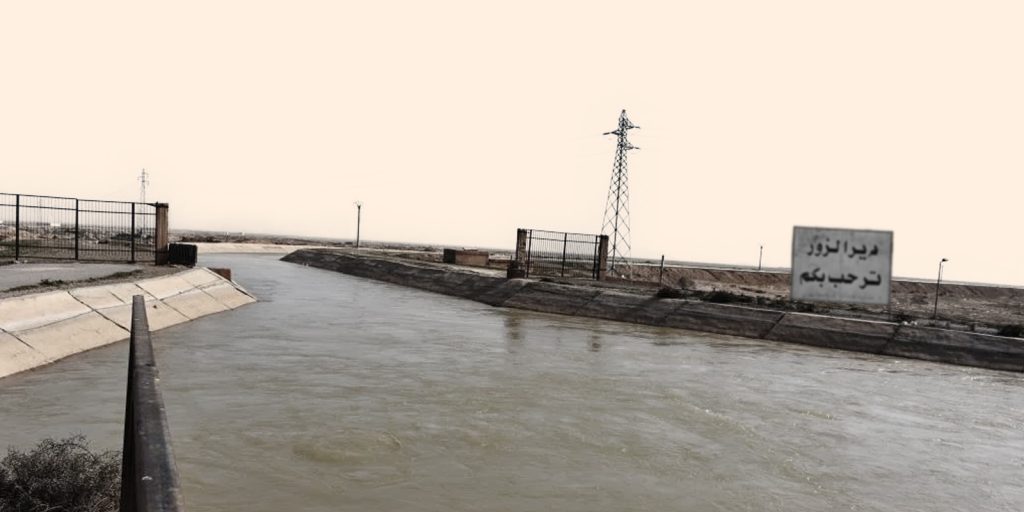
Just steps away from the Euphrates River, Qusay Al-Rafe’ stands outside his home in Deir Ezzor’s Al-Hamidiyah neighborhood, watching the water flow by. But for his family, the river is not a source of life, it is a source of daily fear.
“Even though the river runs past our doorstep, we can’t trust its water,” the 40-year-old civil servant tells +963. “It’s polluted with sewage, oil, and waste. Clean water has become a luxury we no longer have.”
Al-Rafe’s story echoes the suffering of thousands in Deir Ezzor, a once-thriving agricultural and water-rich province in eastern Syria. Today, it is mired in one of the country’s worst service collapses, its water infrastructure in ruins, its rivers contaminated, and its population left to fend for itself.
Read also: Syrian Forces Clear 150 Landmines in Eastern Deir ez-Zor
Infrastructure in Ruins
Years of war, aerial bombardments, and armed conflict have devastated the region’s water systems. Many treatment stations were repurposed as military posts, drawing attacks that left them destroyed or unusable.
Turki Al-Salem, head of maintenance at the provincial water department, says that over 80% of Deir Ezzor’s water stations are now completely non-operational.
“The networks are corroded. Spare parts are nonexistent. Repairs would cost millions of dollars,” Al-Salem says.
Only nine stations remain partially functional, while three others have languished in repair without progress for over a year. Seventeen major stations, most along the Euphrates, are completely out of service, having suffered extensive damage during years of conflict.
Even where water still flows through the pipes, it is often unsafe to use.
“Much of the current water supply is contaminated, either by sewage or petroleum leakage from smuggling activities,” Al-Salem explains. “We lack the fuel and modern filtration equipment to treat it properly.”
Living With Contaminated Water
In the town of Al-Mayadin, east of Deir Ezzor, residents like Mohammed Al-Ahmad live in constant struggle.
“The water from our taps isn’t even suitable for washing dishes,” says the father of three. “We buy drinking water from vendors, but it’s expensive, and we’re never sure it’s clean.”
His family resorts to primitive purification methods. “We boil it, let it settle, or run it through makeshift filters,” he says. “Still, my kids get sick, diarrhea, rashes, stomach issues. It never ends.”
Read also: Deir ez-Zor Residents Battle to Reclaim Homes from Iran-Backed Brokers
Al-Ahmad’s wife spends hours each day trying to disinfect the water with household materials. “This affects everything, our health, our time, our work. We live with no clean water, and no hope of change.”
The Euphrates: From Lifeline to Health Threat
Once the lifeblood of the region, the Euphrates is now a source of widespread illness.
“What’s happening to the river is a full-blown environmental disaster,” warns Owaida Al-Jamal, an official with Deir Ezzor’s environmental department.
He explains that the pollution stems from multiple sources: untreated sewage dumped directly into the river, oil leaks from illegal refining operations, and rampant dumping of household and industrial waste.
“The health consequences are severe,” he says. “Women and children are especially vulnerable. We’re seeing rising cases of diarrhea, liver infections, skin diseases, and other serious illnesses.”
Health department data supports this: more than 130 water-related illnesses are reported monthly in Deir Ezzor, Al-Bukamal, and Al-Mayadin. And that figure excludes many rural cases that never reach clinics or hospitals.
Read also: The Euphrates is Drying Up: A Worsening Environmental and Economic Crisis Endangers Millions
Local Efforts, Global Inaction
With little support from Damascus or international agencies, local water officials are trying to respond, but they’re fighting an uphill battle.
“We’re doing what we can, repairing some lines, restarting small pumps, but we’re limited by funding and equipment,” says Khaled Al-Najras, a senior technician with a local water unit.
He emphasizes the need for public cooperation. “People must stop dumping waste into the river. The Euphrates is not just a body of water; it’s our life source. We must all protect it.”
What Can Be Done
Experts agree that while full-scale reconstruction will take years, there are several urgent measures that could help alleviate the crisis in the meantime. These include distributing clean water through monitored tankers, particularly in the most vulnerable areas; deploying mobile and temporary filtration units to provide safe access to water; launching public health campaigns to educate residents on simple home-based water purification methods; securing international funding to rehabilitate water infrastructure using alternative energy sources; and enforcing environmental regulations to curb pollution and prevent oil contamination of water sources.
Despite the scale of the disaster, the people of Deir Ezzor carry on resilient, though weary. “Our children drink from a river that carries sickness, not life,” says Qusay Al-Rafe’. “We’re not asking for much, just the right to clean water. That’s all. It’s the most basic human right.”











