


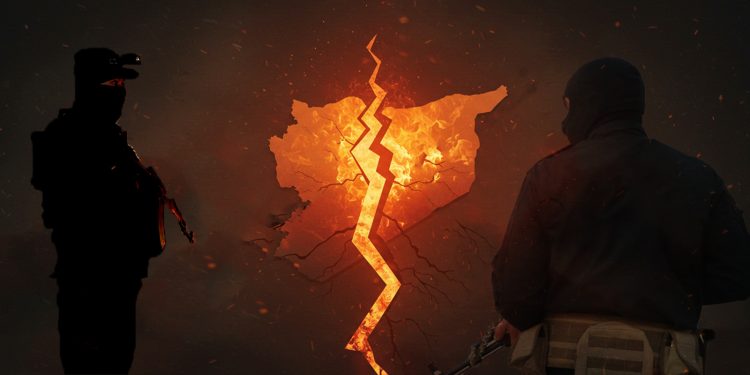
Over the past two days, the towns of Sahnaya and Ashrafiyat Sahnaya in the Damascus countryside, areas with a predominantly Druze population, have witnessed violent clashes between armed groups and local factions. The violence was triggered by the circulation of an audio recording deemed offensive to the Prophet Muhammad, allegedly attributed to a religious figure from Suwayda Province in southern Syria.
The rapid spread of sectarian incitement and hate speech on social media platforms has sparked serious concerns over threats to civil peace and societal cohesion.
Sectarian Agitation
Despite a statement from the Syrian transitional Government’s Interior Ministry asserting that initial investigations did not confirm the identity of the speaker in the audio recording, armed groups continued attacking the areas of Jaramana, Sahnaya, and Ashrafiyat Sahnaya. The ensuing clashes resulted in over 30 casualties, including General Security personnel stationed around the affected areas. Forces from the Ministry of Defense and General Security were later deployed to Ashrafiyat Sahnaya to restore order.
Read also: Syrian Foreign Ministry Rejects Calls for International Protection as Clashes Erupt
On Wednesday night, confrontations extended to northern and western Suwayda countryside after armed groups reportedly blocked the Damascus–Suwayda highway. Local factions clashed with these groups in intense fighting involving heavy shelling, leading to more deaths and injuries, according to the local news outlet Suwayda 24.
Prior to that, altercations broke out among university students in dormitories in Aleppo, Homs, and Damascus over the same audio recording, resulting in injuries and several arrests. On Tuesday evening, buses transporting students and families from Jaramana arrived in Suwayda under the escort of General Security and local Druze factions.
Calls for Protection
In response to the escalating violence, Druze spiritual leader Sheikh Hikmat al-Hijri issued a statement on Thursday calling for international protection for civilians. He described the request as a legitimate right for a people subjected to massacres and warned international organizations against ignoring the situation. He reiterated solidarity with fellow Syrians and disavowed extremist factions, saying, “We no longer trust a government that uses terrorist militias against its own people.”
The recent escalation, preceded by earlier clashes in Jaramana in March following the killing of a General Security member, highlights Syria’s deepening societal divisions. Sectarian mobilization and hate speech on social media platforms are eroding civil peace and raising fears of wider unrest, especially amid widespread access to weapons outside state control.
Read also: Sectarian Clashes Continue in Southern Damascus Suburb
Internal and External Drivers
Journalist Bassam Ballan argues that rising sectarian rhetoric is tied to both domestic challenges and foreign agendas. “In recent months, several regional and international powers have actively sought to destabilize Syria, using sectarian incitement as the easiest tool to undermine national unity,” he said.
Ballan also criticized the government for failing to enact clear laws that criminalize sectarian hate speech. “Those who incite violence do so openly and without consequences,” he added, warning that Syria could descend into civil war if this behavior persists.
Historical Roots
Dr. Samaher Al-Khatib, a Syrian expert in diplomacy and international relations, traced the roots of sectarianism to French colonial policies that divided the country into ethnic and sectarian cantons. “These divisions were preserved and manipulated by both the Assad regime and the current de facto authorities,” she explained. External actors, including Qatar, Saudi Arabia, Turkey, Iran, Russia, and Israel, have also played a role in deepening these divisions.
Political analyst Alaa Al-Asfari emphasized the importance of civil peace and coexistence: “There can be no dominance of one sect or ethnicity over another. The only viable solution is shared living, which should be both a legal principle and a cultural value.”
Collective Responsibility:
Al-Safari cautioned that Syria is on the brink of civil war unless serious efforts are made to de-escalate tensions. “This is a shared responsibility of the government, religious leaders, and citizens. Any weapon outside state control is illegitimate, but peace must also be inclusive and equitable.”
In response to these tensions, a wide-ranging meeting was held at “Dar Ara” in Suwayda on Tuesday. The gathering brought together Druze spiritual leaders Hammoud Al-Hanawi and Yousef Jerbo’ along with Christian Bishop Antonios Saad, local faction leaders, tribal representatives, and community figures. They emphasized the need to reject sectarianism and affirmed their commitment to civil peace.
The participants denounced any insults against religion and called for accountability for those who incite violence using divisive rhetoric. “Such individuals only represent narrow agendas, not the broader interests of the Syrian people,” a source from the meeting stated.
Read also: Sectarian Clashes Erupt Near Damascus Over Blasphemy Audio; 12 Killed
Rebuilding Trust
Ballan stressed that hate speech and sectarian mobilization run counter to the principles of a modern state: “These divisive narratives destroy national institutions and derail progress. The only way forward is through cooperation, tolerance, and mutual respect, the values that once defined Syria.”
He argued that the government bears the primary responsibility for enforcing laws and dismantling the networks of incitement. “All sectarian voices must be held accountable, and space must be created for a shared national identity.”
Dr. Al-Khatib warned that sectarianism and hate speech threaten to unravel Syria’s social fabric. “By exploiting identity politics, these narratives turn political disputes into existential battles, escalate violence, and fuel armed conflict. They undermine trust, obstruct peace, and delay any political resolution.”
Ballan concluded that today’s environment is even more dangerous than the early years of the revolution. “Back then, the lines were clearer. Today, it’s chaos, and the only solution is bold action from the government and a national dialogue to restore control and unity.”
As part of the government’s response, Interior Minister Anas Khattab recently held a meeting with provincial governors to explore ways to strengthen civil peace. Minister of Information Hamza Al-Mustafa also called for a new media ethics charter, to be developed jointly by media institutions and civil society, to regulate public discourse and limit hate speech.











