


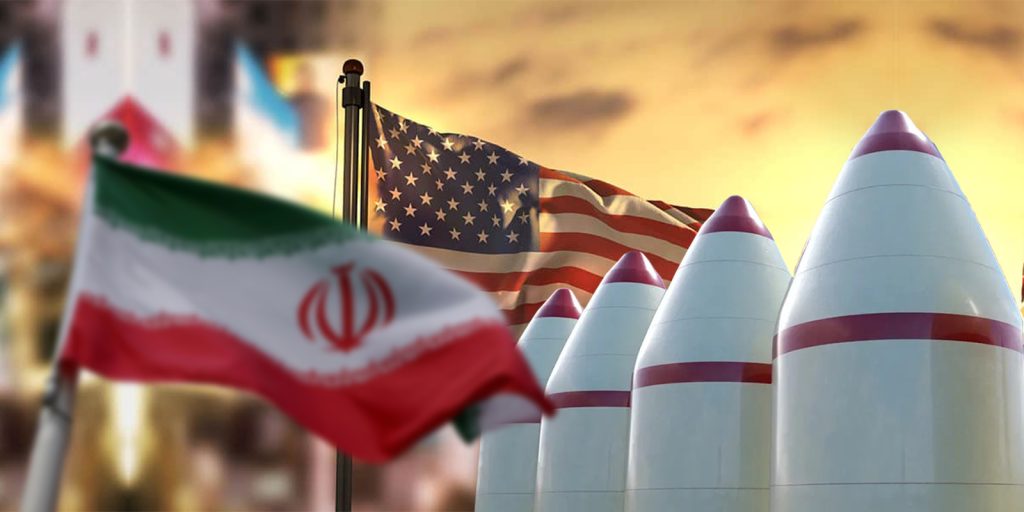
All eyes turned to the Sultanate of Oman this past Saturday as the first round of talks between the United States and Iran over Tehran’s nuclear dossier got underway. But as the region braces for further instability, the world wonders: are Oman’s mediation efforts the last chance for diplomacy, or the beginning of a path to war?
The negotiations come at a time of heightened tension across the Middle East, where recent political and military developments have reignited fears of an armed confrontation. The rhetoric surrounding Iran has sharply escalated, and Muscat has emerged once again as a critical venue for backchannel diplomacy.
Conflicting Messages from Both Sides
Last Monday, President Donald Trump announced that his country would begin high-level direct talks with Iran, warning that “Iran would be in great danger if talks fail.”
However, just hours after the U.S. announcement, Tehran confirmed the date of the talk but rejected the premise of direct engagement.
According to Iran’s Tasnim News Agency, the discussions would be indirect, led by Iranian Foreign Minister Abbas Araghachi and U.S. Middle East envoy Steve Witkov.
Posting on X, Araghchi described the Muscat talks as “both an opportunity and a test,” adding “The ball is in America’s court now.”
The negotiations follow the Trump administration’s unilateral withdrawal in 2018 from the 2015 nuclear agreement, known as the P5+1 deal, which had been in effect since October 2015 and was set to expire in October of this year.
Direct or Indirect Dialogue?
Dr. Ghazi Faisal, consultant at the Iraq Center for Strategic Studies, based in Oman, noted the conflicting narratives surrounding the nature of the talks. “Trump is emphasizing direct dialogue, which reflects American preconditions,” he told +963.
“Meanwhile, Araghchi insists on indirect talks, aligning with Tehran’s longstanding position of avoiding direct engagement with Washington.”
Faisal also recalled that Iran’s founder, Ayatollah Ruhollah Khomeini, had left behind a political testament instructing future leaders not to normalize relations with the United States, a sentiment that continues to shape Tehran’s posture.
Strategic Calculations on Both Sides
Dr. Masood Ibrahim Hassan, a researcher specializing in Iranian affairs, told +963, that the negotiations in Muscat could represent a “lifeline” for a regime under significant internal and external pressure.
“Tehran is grappling with a deepening economic crisis due to international sanctions, as well as growing domestic unrest fueled by dissatisfaction with government policies,” Hassan said. “Externally, Iran’s regional influence is waning, and it urgently needs to restore strategic balance.”
Despite its rhetoric of resistance and sovereignty, Hassan added that Iran may be willing to compromise, especially in the face of unpredictable U.S. moves and potential Israeli military escalation.
On the American side, Hassan argued, the motivation lies in reshaping the regional order. “Washington is looking to contain Iran and align it with its broader strategic vision. A “domesticated” Iran would be easier to integrate into the architecture of a new Middle East,” he said.
The Military Option: A Path to War?
Should the Muscat negotiations fail, a full-scale conflict between Washington and Tehran remains unlikely, at least directly, according to Dr. Hassan.
He argues that the United States is acutely aware of the disastrous consequences a total war with Iran could have on its broader strategic interests in the Middle East.
However, Hassan sees a different scenario emerging: a military confrontation between Israel and Iran, potentially under U.S. auspices. He points to the increasing possibility of a preemptive Israeli strike on Iran’s nuclear facilities to prevent Tehran from joining the so-called “nuclear club”. With uranium enrichment levels now at 60% well above the permitted 4% cap and edging dangerously close to the 90% threshold required for weapons-grade material, Israel considers this development a direct threat. According to Israeli nuclear doctrine, any potential nuclear rival in the region crosses a red line, and Washington, Hassan claims, has effectively given Tel Aviv the green light.
Researcher Dr. Ghazi Faisal offered a blunt assessment of Iran’s current position: it must either accept a sweeping “Trump-sized” deal or prepare for confrontation. Such a deal would demand the dismantling of its nuclear program, the suspension of its ballistic missile development, and an end to its support for armed proxy groups across the region.
“These U.S. conditions clash fundamentally with the ideology of the Guardianship of the Islamic Jurist,” Faisal explained, referring to Iran’s constitutionally enshrined principle of regional influence and territorial reach.
Faisal also underscored the Pentagon’s recent deployment of a second aircraft carrier to the region, interpreting it as a clear signal that Washington is not merely bluffing, the military option remains a tangible contingency.
Can Iran Withstand a War?
When it comes to Iran’s military capacity to confront the United States, both Hassan and Faisal agree: that there is little room for illusion. They argue that Iran’s decades-long regional expansion strategy has effectively collapsed, particularly following setbacks in Syria, Lebanon, Gaza, and Yemen.
“Despite having extensive assets in Syria, including military bases, Revolutionary Guard units, affiliated militias like the Zainebiyoun and Fatemiyoun, and influence over Syrian intelligence, Iran suffered a strategic defeat,” Faisal noted. “Its position in Lebanon, once a critical stronghold, has also weakened substantially.”
The consensus among observers is that Iran, while capable of asymmetric retaliation through its regional proxies, lacks the conventional military strength for direct conflict with the United States.
Broader Implications
Whatever the outcome in Muscat, the consequences will reverberate far beyond Iran’s borders. Dr. Hassan emphasized that a successful agreement could boost Iran’s struggling economy, reinforce the regime’s political position at home, and stabilize the global energy market.
On the other hand, failure could prove catastrophic. Hassan warned that without a deal, the regime’s internal collapse becomes a matter of “when, not if.”
Faisal echoed this view, adding that a breakdown in negotiations would likely isolate Iran further, putting it in direct conflict with international law and key global powers. The fallout, he warned, could lead to a devastating war, with the Iranian population, half of whom already live below the poverty line, paying the heaviest price.
A military strike on Iran’s nuclear facilities would not be a localized incident, but a regional shockwave with profound strategic implications. Such an event could fundamentally alter the balance of power in the Middle East, dragging in multiple actors and triggering a broader conflict.
Despite ongoing diplomatic overtures, the United States military posture suggests that war remains a live option. As tensions rise and crises converge across the region, the coming weeks may determine whether Muscat marks the beginning of peace or the final calm before the storm.











